Do You Want This Man to Be Mayor? Kirk Caldwell
Editor’s note: This series takes you inside a day in the life of the three leading candidates to complete the last two years of former Mayor Mufi Hannemann’s second term. To learn more about the candidates’ record and their positions on key issues, click on their names below.
Today: Kirk Caldwell
Wednesday: Panos Prevedouros
Tuesday: Peter Carlisle
Kirk Caldwell is 57 years old, and he wears his heart on his sleeve. He loves “to connect” with people, write poetry and celebrate his Waipahu roots. As acting mayor of the City and County of Honolulu since July, he’s nearing the end of what he describes as one long job interview for the full-time gig he really wants. So come along and find out what the everyday world of a campaign looks like through his eyes.
10:37 a.m. “Alooooooha!”
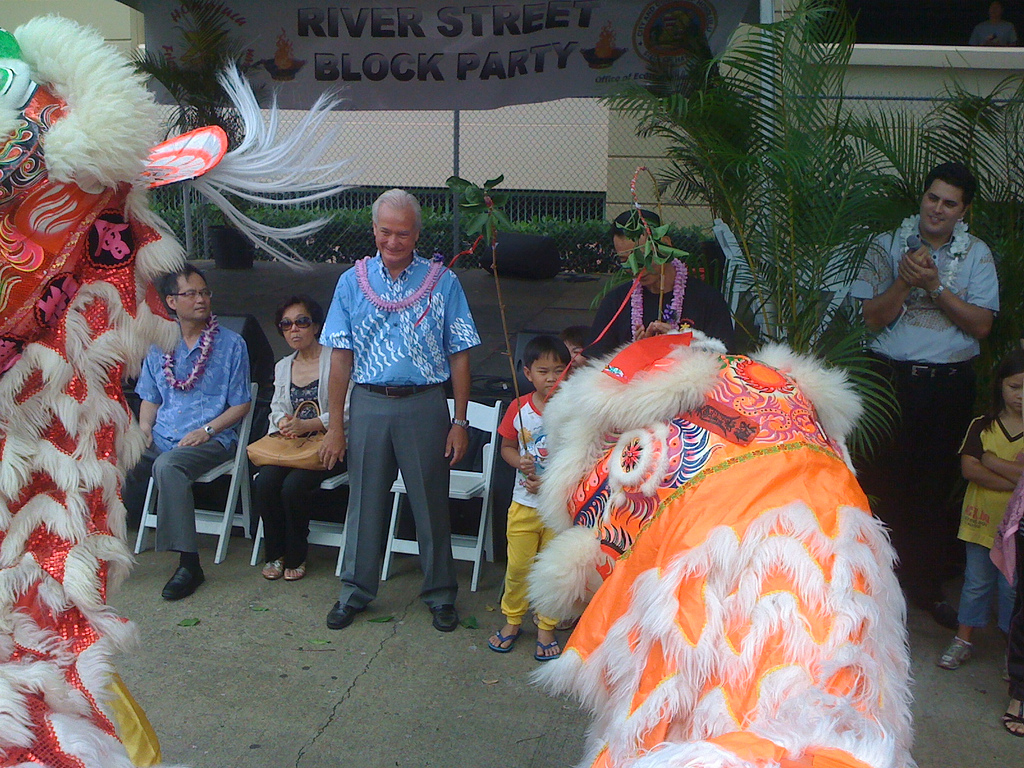
It’s drizzling on River Street, where lion dancers have gathered for a block party.
Kirk Caldwell smiles, offers the traditional red envelope with money inside, and gestures for children to come closer. After the performance, the emcee introduces the acting mayor.
“Good morning and aloooooha,” Caldwell calls into the microphone, prompting the crowd to greet him back. “Chinatown is such a diverse part of our community, and it’s really breathtakingly beautiful. Where this city really began was in Chinatown.”
Caldwell calls up Rod Tam, an opponent in the mayoral race who represents the neighborhood on the City Council, and the two present an oversized $10,000 check from the city to the Friends of Chinatown. With a slight adjustment, Caldwell ensures the purple lei draped over his aloha shirt is hanging properly. His posture is good, his gray slacks unwrinkled.
As someone else speaks at the microphone, a scruffy man in torn, layered clothing pushes an empty stroller past the river wall. Caldwell’s gaze follows the man as he passes, and the candidate’s sigh is visible.
11:55 a.m. “Oh yeah, I’m the mayor!”
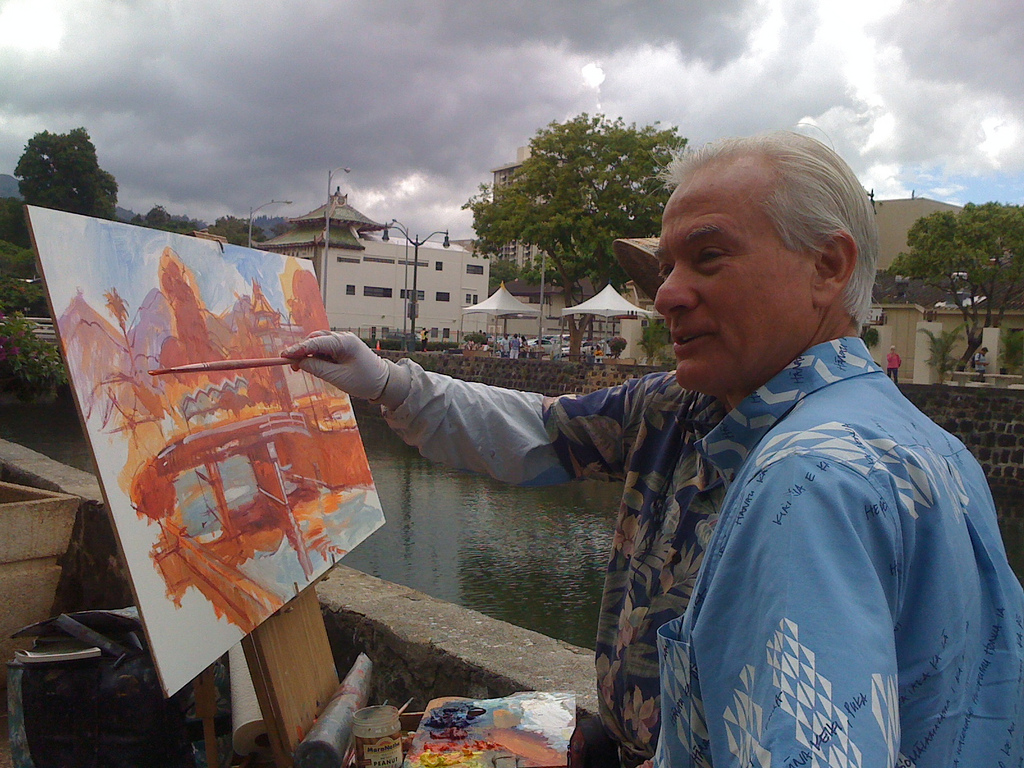
Manapua in hand, he’s eating as he walks past outdoor checkerboard tables, talking to painters who have set up canvases along the riverbank.
“It’s a great subject,” Caldwell gestures to a painter’s canvas, and then to the landscape across the street.
Caldwell meets a boy with a bloody tissue wadded up one nostril. The boy — he tripped, he explains — insists he’s fine but Caldwell directs him to a kiosk administering first aid.
Continuing along the river, Caldwell shakes hands with people near an inflated bouncy house. “Another Waipahu girl!” Caldwell announces when a woman tells him they’re from the same town. “I’m very proud of my Waipahu heritage.”
Caldwell doubles back around, and begins walking back down the other side of the river. He moves at a fast clip, and when he nears the Sun Yat-Sen statue, he walks right up to it and touches the base.
“They recently redid this” he tells the people standing around the statue, before quickly moving on. Another one of Caldwell’s opponents, Peter Carlisle, is shaking hands about 20 feet away. If one of them catches a glimpse of the other, neither lets on.
Caldwell won’t talk about his opponents. It’s not productive to focus on them or the idea that anyone could be mayor besides him, he says. He also won’t say what he’ll do if he doesn’t win the election.
“If I’m willing to answer that, I might as well go home right now,” Caldwell says.
At a fruit stand, Caldwell buys a bag of Thai mountain apples, 10 for four dollars, and a teenager with braces turns her head when she hears someone refer to him as the mayor.
“You’re the mayor?” she asks, grinning. “Can I get a photo with you?”
“Acting mayor,” Caldwell corrects, as he stands beside her, smiling for the cell-phone camera.
“We’re from California,” the girl says. “That’s why I didn’t know.”
Caldwell doesn’t mind at all. He tells the girl and her family “aloha,” and now he’s offering mountain apples to everyone around him, smiling.
“I do think my name recognition is getting better though,” Caldwell says. “A lot of people see me on the street and now they say, ‘Hey mayor!’ and I look around like ‘Oh, where is he?’ and then I remember, ‘Oh yeah, I’m the mayor!’”
12:13 p.m. “Workin’ on a Saturday!”
A group of men in Parks and Recreation uniforms approaches.
“Workin’ on a Saturday!” Caldwell says, thanking them.
A family with a little girl stops to talk to him, and he scoops up the toddler.
“Pretty good,” the girl’s mother says. “She’s not crying. Usually she cries when other people pick her up.”
Caldwell’s scrunches his nose at the little girl, smiling.
“I have a daughter, too,” he says.
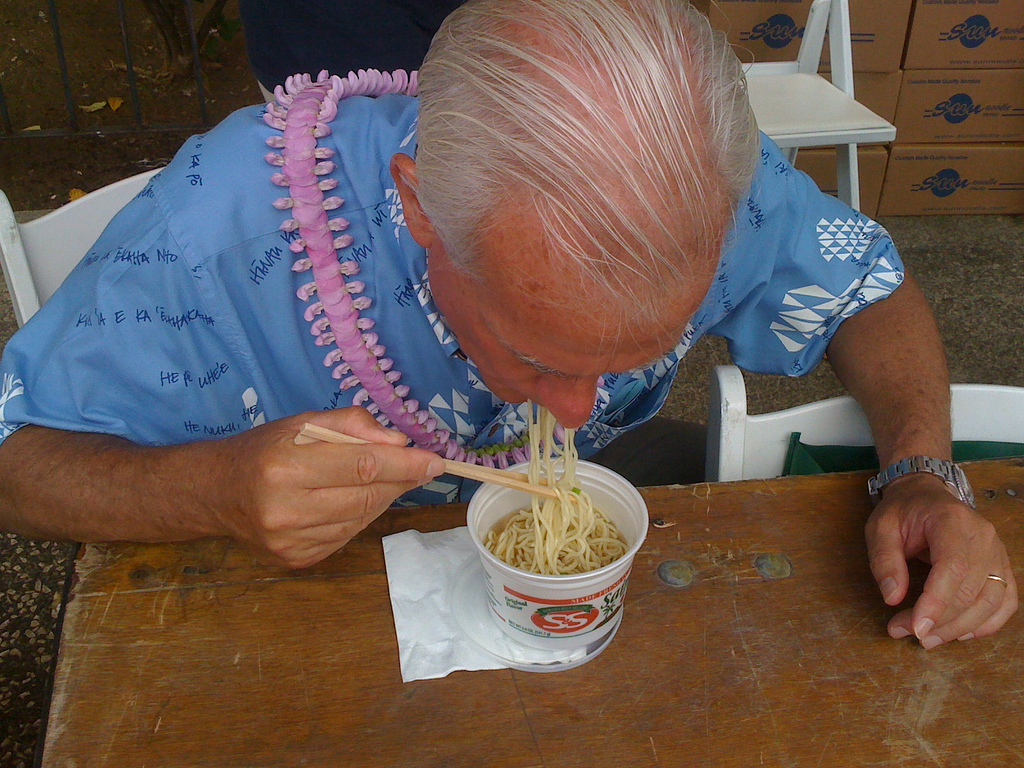
Behind the family, he sees saimin for sale, and decides he wants some. As he’s buying it, he’s offering — practically insisting —to treat everyone around him.
“He’s like an Italian grandmother,” his campaign manager, Kimberly Devlin, jokes.
“This saimin is so ono,” he raves.
As he enjoys his latest snack, Caldwell is chatting and cracking jokes. Devlin urges him to hurry, worried that he’s going to be late, and Caldwell dismisses her lightly, until finally agreeing it’s probably time to get to the next event.
“It’s like really tough getting him out of any place,” Devlin says.
Before she can finish the thought, he’s stalled again, talking to another group of people en route to his car.
1:09 p.m. “I wore slippers even in winter.”
Caldwell is eyeing the lunch offerings at the Pearl City Family Fun day.
“We get to do two fun community events today!” Caldwell says, surveying the area. “Look at the pool! We should have brought our swimsuits.”
First things first. Caldwell wants lunch. Minutes later, he has a plate of rice and pork in one hand, and a diet coke balanced on the lid of his Starbucks latte in the other. He went for a run this morning, he explains, so he’s still hungry.
Caldwell sits on a metal folding chair in the open-air pavilion. The Royal Hawaiian band is set up nearby, taking a break from playing, and it gets him talking about how much he loves them, how much he loves music.
“I saw Jimi Hendrix play at the Blaisdell in the late 1960s,” Caldwell brags. “That was back when I had long hair, down to my shoulders.”
Caldwell laughs as he remembers his university years at Tufts just outside of Boston. He recalls how he used to bring lei from Hawaii to the women who worked in the cafeteria.
“The girls loved me in college,” Caldwell says. “I was the guy from Hawaii, and I played it up. I wore slippers, even in winter.”
1:39 p.m. “It says what we are, as people of Hawaii.”
After quickly cleaning his plate, Caldwell approaches a group of children playing and running in circles.
“Howzit!” he squats to talk to them.
“Give uncle a hug,” a parent urges. “He’s running for mayor.”
Caldwell stops for a photo opportunity with a group of police officers, before another man approaches him with a question.
“Can I have your eyes?”
“My eyes?” Caldwell leans in to be sure he’s heard properly. “But I like my eyes.”
The Donate Life volunteer explains he’s looking for people to sign up to become organ donors. Specifically, Hawaii needs eye donors, he says.
“I’m an organ donor,” Caldwell pulls out his wallet to point to proof on his driver’s license. The volunteer explains it’s an electronic registry, different from the one accessed through a driver license. Caldwell signs up before introducing himself to some ladies in red AARP T-Shirts at the next booth over.
“I didn’t know you were born in Waipahu!” one says, explaining she recently heard so in one of Caldwell’s television ads. Another woman says she’s a Republican, and knows he’s a Democrat, before scurrying away.
Caldwell gets to talking with a man who’s telling him about growing up in a Chinese plantation settlement. Now, they’re swapping stories, and Caldwell begins telling him about the summer he spent working the pineapple fields. The man is nodding in recognition, but before they can continue, Caldwell sees an older woman, one shoulder dipping to offset the weight of a heavy garbage bag she’s carrying. He trots over and insists she give it to him. When she refuses, he pries the bag out of her hand.
“Thank you!” she calls out after him, as he walks it to a bin.
“I’ve got some at my house,” a nearby man calls after him.
Standing on the outskirts of the open-air pavilion, Caldwell is scribbling the names “Oshiro” and “Takumi” onto a piece of scrap paper. They’re reminders for when he’s ready to mention their names when he addresses the Pearl City crowd.
He begins with the same call-and-answer as always: “Alooooooha!”
First, he speaks to the band, thanking them for their music.
“Every holiday, every weekend, every special occasion, they work while the rest of us can sleep in, fish, surf, garden and golf,” Caldwell says. “The Royal Hawaiian Band shows us what this community has done, and it says what we are as people of Hawaii.”
2:21 p.m. “Is this a regular pig?”
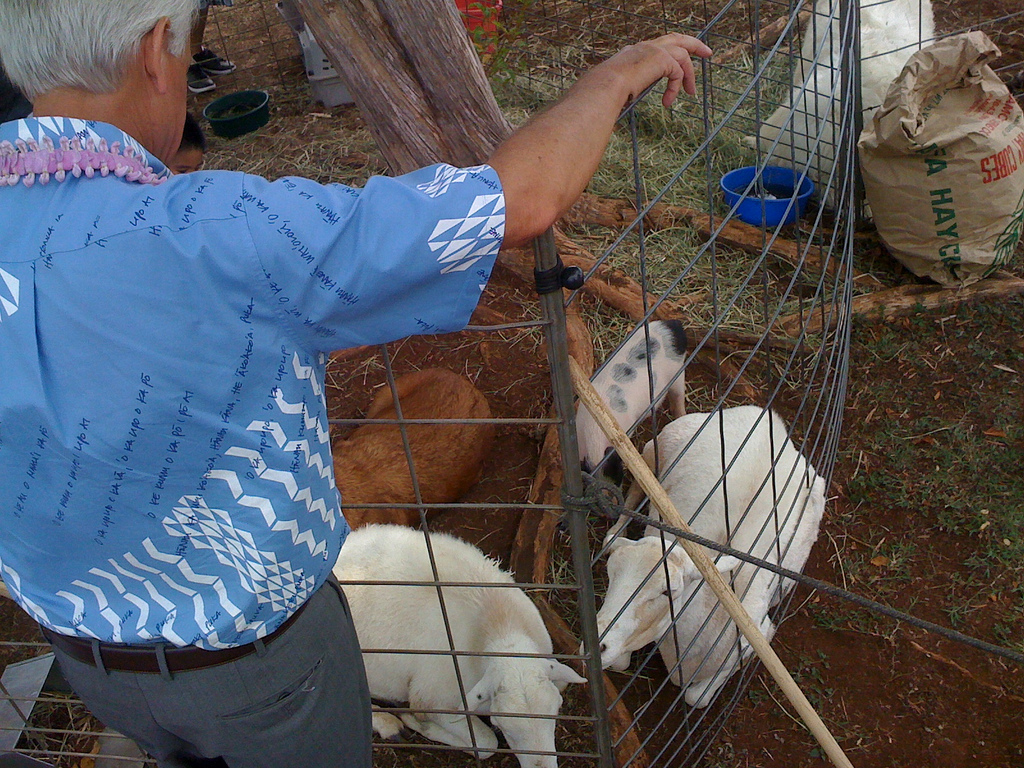
Caldwell is hovering over a little fenced-in area that houses a pig, some sheep and baby goats. Nearby, a llama and cow are in adjacent pens, and someone’s leading a pony back and forth across the grassy area.
“Is this a regular pig?” Caldwell asks pointing to a round pink and black piglet. The animals’ keeper explains the pig is a runt named akamai, Hawaiian for clever. Caldwell is working his way around the pen, and has bent down to stare intently at a gray cow.
“Look at this cow!” he’s waving people over. “I don’t know if you’ve ever looked into a cow’s eyes, and it may sound chauvinist to say, but cows always look like girls to me.”
He points to the cow’s brown eyes, its long lashes.
While Caldwell is still admiring the cow, a little boy asks, “Who is that man? He looks important.” Caldwell overhears, and introduces himself. He walks with the boy back to his family’s popcorn stand, where he buys the biggest possible bag and begins eating and sharing handfuls of it.
“This is so good.” He’s offering to share the popcorn when his campaign manager tells him to wrap things up.
“We have to move along,” she says.
Caldwell thanks the popcorn sellers, and begins to walk, but not toward the exit. He’s moved on to the Whirlybird, then a video-games booth. The kids with controllers in hand are staring up at a big video-game screen, and don’t even register his presence. “I hope you win, OK?” Caldwell tells them anyway.
The person running the booth offers Caldwell a controller, tells him he should play a game.
“No, no,” Caldwell laughs. “I don’t want to lose, that’s why.”
“Kirk,” Devlin urges. “We have to go.”
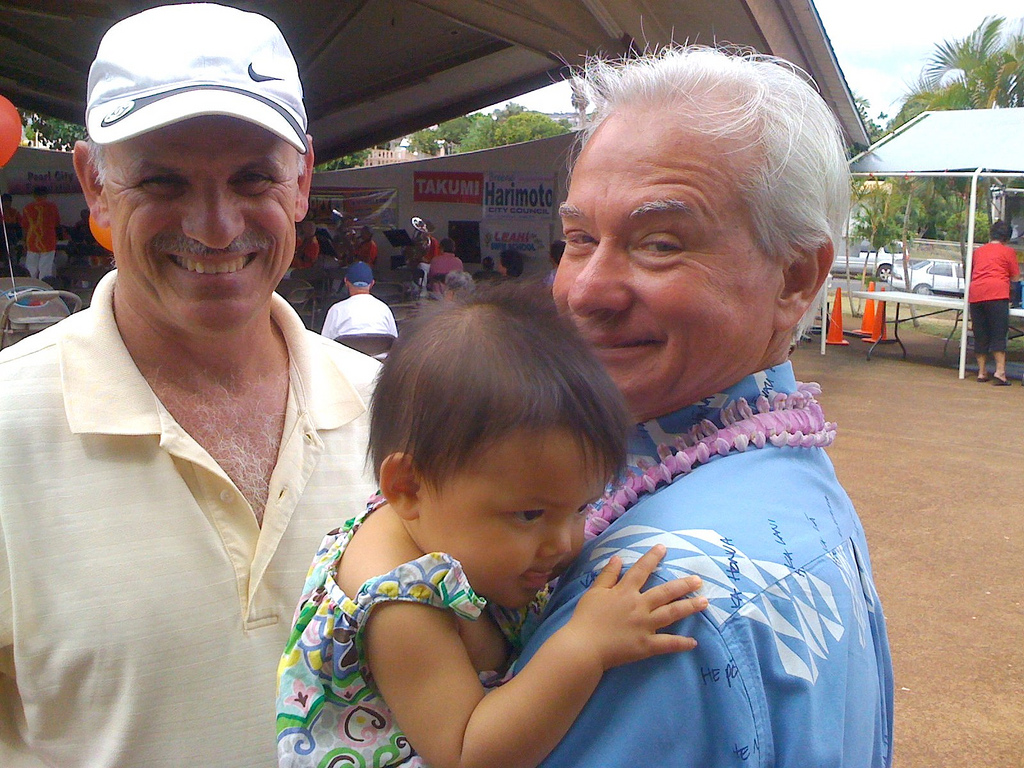
“But I like to stay!” Caldwell smiles, and begins walking with her up the hill, where he runs into former Deputy Police Chief Paul Putzulu and his grandchild. Caldwell holds the baby, who rests its head on his shoulder.
“Can I borrow the baby for the rest of the day?” Caldwell jokes.
3:28 p.m. “Behind every great woman is a great man.”
The sky over Manoa is gray when Caldwell arrives at the Waioli Tea Room. Manoa is special to Caldwell, not only because it’s where he lives but it’s also where his local political career really began.
“We got to get where it’s green,” Caldwell says of his affection for the valley. “Where you can smell the mildew, where you can hear the rain on the roof.”
Inside, mauve napkins are fanned across intricately set tables. There are deliberately mismatched teacups and ornately painted teapots, with fresh birds of paradise in tall vases. A gecko wiggles across a far wall.
There are a total of four men in the room, including a waiter and Caldwell. The other two say they’re there to support the women who organized the event, which is casually being described as “a women’s tea with a few brave men.”
The attendees are mostly in their 40s and older. The event hasn’t formally started, and people are mingling, laughing and introducing one another. Caldwell makes the rounds, shaking hands and greeting friends. The event is intimate — there are maybe 35 guests — but it’s a formidable group, including leaders in both private and nonprofit business, academia, law and politics.
Among them is Donna Tanoue, Caldwell’s wife, and vice chair of the Bank of Hawaii. Former chairman of the Federal Deposit Insurance Corporation in Washington D.C., Tanoue’s list of professional accomplishments is long and impressive.
“There are some strong women here today,” Tanoue observes with a smile.
Caldwell moves from one table to the next, pulling up a chair to chat.
“Do you want to run a 5K with me tomorrow morning?” Caldwell asks one woman. “It’s at 6:30, in Waipahu!”
“Are you insane?” the woman snaps back with a laugh.
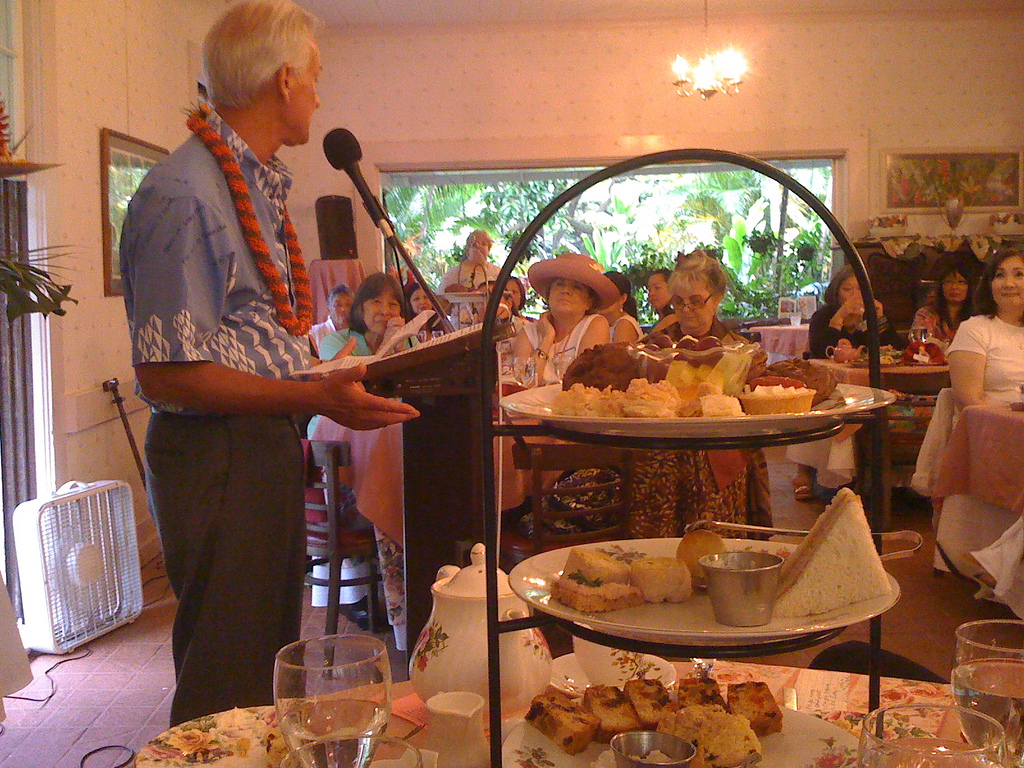
An organizer walks to the podium, welcomes the guests, and asks people to take their seats. Caldwell hops to another table, and pulls up a chair. He acknowledges that he’s the lone man at a table of women with his opening line: “I like to say behind every great woman is a great man.”
Servers bring pots of apricot tea along with tiered platters filled with an assortment of savory and sweet offerings. There are tea cakes and scones with vanilla whip butter, white chocolate strawberry tarts, guava bread, Greek salad puffs and more. Caldwell selects an oversized scone with cream.
Tanoue is seated at the next table over, and a tablemate tells her how effective she finds the latest Caldwell ad.
“I never hear the ads because I listen to public radio,” Tanoue admits with a smile. “But I will tell him.”
After eating and socializing, an organizer introduces Tanoue, who speaks to the crowd about her husband.
“For 29 years, we’ve been married,” Tanoue begins. “So I can say with great authority that I know about this guy.”
Tanoue explains she and her husband see Honolulu as a wahi pana, or sacred place, and describes their shared sense of the importance of stewardship. She calls the job Caldwell wants “unglamorous,” and says with matter-of-fact confidence that her husband is the best qualified for it. At a far table, Caldwell listens intently to his wife, smiling mostly with his eyes.
5:34 p.m. “I’m married to a very strong woman”
It’s Caldwell’s turn to address the women. He’s been asked specifically about rail, housing and elderly care. Given the crowd he’s addressing, Caldwell also focuses on what he says are persistent hurdles that remain for the women of Hawaii.
“We had our first woman governor, and she didn’t exhibit pro-women governing,” Caldwell says. “I am passionate about the issue. Part of it is I’m married to a very strong woman, but I’m also worried about equity issues.”
He gives the example of some of his wife’s experiences as chair of the FDIC in Washington D.C.
“Her male colleagues would golf and they wouldn’t invite her,” Caldwell says, and Tanoue interrupts.
“That’s because I was chairman, not because I am a woman,” she says with a broad smile. Caldwell is smiling back as the women clap and cheer.
6:16 p.m. “I don’t want them to feel like I am letting them down.”
The tea had lasted longer than Caldwell expected, and now he’s racing to Waipahu for a community movie night. The sky is pink and orange above the blanketed field. People are sprawled out with snacks and pillows, staring at a big blank screen, waiting for the sun to go down so “Where the Wild Things Are” can begin.
Caldwell’s energy level is high, seemingly sustained by each hand he shakes. A reminder that he’ll be running in a road race in 12 hours only discourages him for as long as it takes to say, “Oh man,” before he notices there’s food for sale.
Walking toward the musubi, Caldwell stops to chat with some students, most of them recent high-school graduates or freshman in college. They’re gathered around him, fist-bumping him through plastic food-service gloves. Two young men tell Caldwell they’re attending Leeward Community College.
“You know, rail will go right by there!” Caldwell tells them.
They nod, murmur “yeah.”
“But you guys will be another 10 years older by then,” Caldwell muses.
“We might still be there,” one of them offers.
Caldwell laughs. “You’re still in college in 10 years, and your parents will kill you!”
Minutes later, when Caldwell’s mobile phone rings, he walks to the parking lot to take the call. His eyes are narrowed, his mouth a thin frown. He’s clearly not happy with what’s being said, and he’s the one saying it. It turns out he isn’t going to make it to the Waianae Comprehensive Health Center for an event that evening, he explains. He had wanted to go, and thought he might be able to squeeze it in, but it’s well after 7 p.m., and he still has at least two bon dances to get to.
“I don’t want to spend more time driving than with people,” Caldwell says, “But I love the community health center, and I don’t want them to feel like I am letting them down.”
Caldwell shakes the feeling, or at least hides it, and continues greeting people. He meets a man who is celebrating his 84th birthday.
“We have to sing happy birthday!” Caldwell declares, and leads a small group in song.
“OK song, but where’s da money?” the man jokes, hand outstretched.
7:17 p.m. “The city would’ve done it right.”
En route to the first bon dance, Caldwell agrees for the first time to ride with his shadow, and opens the back door to campaign manager Devlin’s car. Technically, it’s his car — an old Lexus — but he lent it to her for the duration of her work in Hawaii. The radio’s broken, so he put a clunky transistor radio in the glove box for her. A Waialae Country Club sticker is slapped on one corner of windshield.
“Her driving makes me nervous,” Caldwell almost whispers as Devlin turns the key. “She says she’s a good driver. Maybe in New York or Tokyo!”
On the ride to Mililani, Caldwell is talking about how his work ethic evolved, and how his parents encouraged it. He remembers in boyhood the rush he got from meeting people — tourists, mostly — when he set up a little stand to sell bleached coral. He says it’s the same when he meets people today.
“I’m always looking for that connection,” Caldwell says. “I want to connect with people.”
Caldwell says he mostly learned about hard work by watching his parents. His mother had been a nurse, but stopped working to raise the five Caldwell children.
“My father was the only OBGYN on the Big Island, and he delivered babies, so he was on-call all the time,” Caldwell says. “If he was out working in the yard, he trained us so that if somebody called, we knew to ask, ‘Well how far apart are the contractions?’ and he would tell us, ‘At three minutes apart, you tell me to come in,’ because then he would drive to the hospital, which was five minutes from the house.
“So we’d call out to him, ‘Daaad! The contractions are three minutes apart!’ We didn’t even know what a contraction was. We just knew that the magic number was three minutes. I wonder if that’s still true.”
Devlin is lost.
While she’s managed several local campaigns, she’s not from Hawaii, and is relying on iPhone directions that aren’t right.
“Donna and Maya are going to come,” Caldwell says. “I asked them to come. I don’t want to not be there when they get there.”
Driving around Mililani, Caldwell becomes more aware of his surroundings, and begins to help navigate to the bon dance.
“Is this Kam right here? We need to go left. Can you tell what that says?” Caldwell is craning his neck trying to read the street signs. “Of course you can’t see the sign. There are no signs! This must be a state road. Kamehameha is a state road. No wonder. The city would’ve done it right.”
8:13 p.m. “I hope you will.”
Stepping out of the car, Caldwell puts on a black and red hapi coat. When he sees his wife and 16-year-old daughter, Maya, he brightens. They begin walking toward the large crowd. When Maya announces she can only stay until 9 p.m., Caldwell appears crestfallen.
There are hundreds of people at the dance, and it’s the biggest crowd he has seen all summer.
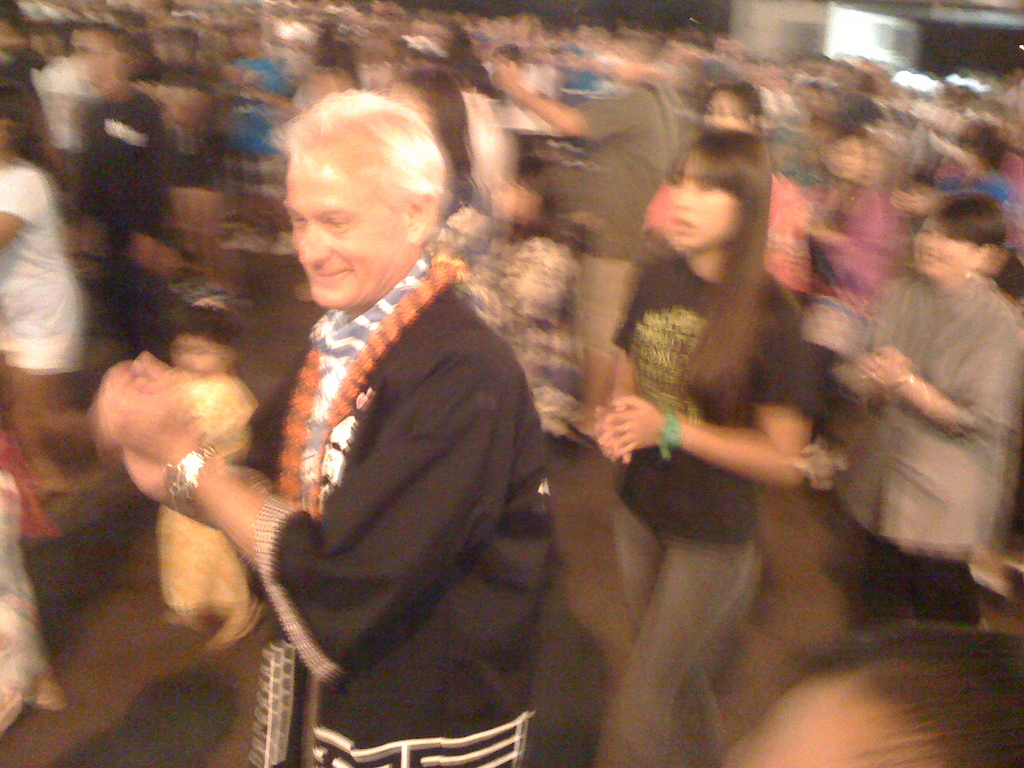
The familiar start to Caldwell’s favorite dance sounds, and he — along with Tanoue and Maya — weaves through the outer crowd to get to the dance circle. Caldwell looks the happiest he’s been all day, dancing the steps he knows, wife and daughter on either side, hopping and waving his hands, circling around and around. When the song ends, Maya and Tanoue leave, giving Caldwell a quick goodbye before their departure.
“I told her to come and now she’s leaving,” Caldwell says. “I wanted her to stay longer.”
An announcement is made that the musubi has run out, and Caldwell’s disappointment is compounded.
“No more food!” Caldwell exclaims. “Oh, man.”
Caldwell circles around, walking now, and greets everyone he encounters. He stops to pet dogs, sits with people, asks them what streets they live on, and — in one case at least — tells them his favorite tree on their block.
“I heard about you,” one woman tells him. “People told me I need to vote for you.”
“I hope you will,” Caldwell says.
8:50 p.m. “Pure poetry”
Caldwell had agreed to call it a night after the Mililani bon dance, but when he hears that the bon dance at Soto Mission of Hawaii is worth checking out, he changes his mind.
“It’s on the way home,” he persuades his campaign manager. “We won’t stay too long!”
In the car, driving town-bound, Caldwell again brings up his daughter. He likes writing poetry for her, and for his wife and others in their family.
“But, I mean, everyone writes poetry,” Caldwell says, looking genuinely surprised to have the assumption challenged. “I like poetry. I like writing poetry. I think I’m pretty good at it. People tell me it moves them.”
Caldwell says poetry moves him, too.
“When I read the Gettysburg address, I cry,” Caldwell says. “It’s pure poetry, what Lincoln wrote. It’s in iambic pentameter, it’s inspired. It is one of the best things ever written. It is the best speech ever written. When I read it, I always get choked up.”
It’s not infrequent that he cries, Caldwell says, but quickly interrupts himself.
“You’ll write about it and then Peter Carlisle or Panos Prevedouros will read about it!” he laughs. “I don’t cry that much. I mean, I’m not a crybaby.”
Thinking back to the last time he cried, Caldwell lists a conversation with the widower at a recent funeral, and the day he filed his paperwork to run for mayor.
“When I went to file, I was walking down the stairs, and I saw Marcus Oshiro standing there,” Caldwell says. “I didn’t call him, he just came. He brought a lei. I thought, ‘This is friendship. This is true friendship.’ And I got tears in my eyes. But I didn’t cry! I wasn’t sobbing or anything.”
Devlin pulls the car into the parking lot of the mission, and Caldwell focuses on the event to come. It’s 9:05 p.m., and Devlin reminds him about the road race in the morning.
More than an hour later, Caldwell is still making the rounds, chatting with people sitting in metal folding chairs around the dance circle.
A new song starts, and Caldwell recognizes it, turning toward the music like it called his name. He wants to dance. His campaign manager shoots him a look, and reminds him of the time.
Caldwell concedes, and agrees to be dropped off at home. It’s nearly 11 p.m. when she gets him there.
“So I’m picking you up at 5:30 a.m.?”
Caldwell makes a mock-complaining noise.
“Yes, yes, I’ll be ready,” he says. “But I don’t know how fast I’m going to be. I’m not going to win it or anything.”
Caldwell says goodnight and disappears into his house. Tomorrow’s race isn’t the one he’s likely to dream about.