Aiona: Affordable Care Act Will Strain State Budget
“The ACA will put tremendous strain on our state budget with regards to medical services programs which will increase to the tune of $240 million over the next five years.”
That is what the Republican candidate for governor, James “Duke” Aiona, said at a Kaiser Permanente-sponsored candidate forum at the Sheraton Waikiki last week.
The federal Patient Protection and Affordable Care Act was signed into law on March 23, 2010. The law has numerous applications, some of which include expanding Medicaid eligibility, providing incentives for businesses that offer health care and prohibiting denial of coverage because of pre-existing conditions.
The Act, along with the Health Care and Education Reconciliation Act of 2010, make up the national health-care reform legislation that will be rolled out over the next four years.
The most recent American Community Survey showed 93 percent of Hawaii residents were covered by health insurance, ranking the state second in the nation in percentage of residents with health care coverage.
But is it true that the ACA will burden Hawaii’s medical services budget by $240 million over five years?
Nope.
It’s actually quite a bit more than that according to the state Department of Human Services.
“The lieutenant governor was really being very conservative when he put out there $240 million in a five year period,” says Lillian Koller, director of the department. “He was really trying not to be an alarmist.”
Koller said that Ainoa was referring to a report by Milliman Inc., a group that says on its website that it “is among the world’s largest independent actuarial and consulting firms.”
“Our actuarial,” Koller says, “a nationally-renowned firm named Milliman – they’ve actually concluded and have a report they gave to us when I asked them to assess the impact of the Patient Protection and Affordable Care Act. The impact to Hawaii’s general fund during that period of time would be a total of $489.6 million.”
The Milliman report looked at several factors that would effect Hawaii’s coffers over a period of seven years – not five as Aiona said – from 2014, when the Act takes full effect until 2020.
The report was provided to Civil Beat by Koller but both the director and Milliman stress that there are several factors regarding health-care reform that have yet to be addressed. Meaning that the figure they offer, $489.6 million, while their best estimate, is subject to change depending on pending lawsuits and the ironing out of particularly complicated sections of the reform.
Still, Koller stands by Milliman’s conclusion.
The report sought to answer two of Koller’s questions:
-
How many people in total will be added to your Medicaid rolls?
-
What will the new law cost your state for the period 2014 to 2020? Give your best estimate and please include your assumptions for that estimate. (States have calculated numbers in many ways: such as the Haislmaier spreadsheet, or private/state actuaries). Ideally, this number will take into consideration projected administrative costs, loss of state premium insurance tax revenue (e.g., self and employer covered lives converting to Medicaid program; crowd out effects of expanded federal regulation and new fed annual fees on insurers), and impacts of new law on state and local government employees and their benefits.
The short answer to these questions is that Hawaii will have to allocate more money in order to meet the increasing demands of health care in the state. The long answer is below.
First, Milliman explains that “the bill expands eligibility to all individuals and families with income up to 133 percent FPL.” FPL is the federal poverty line. Typically, Medicaid in the United States would cover up to 100 percent of the FPL for families and individuals. Health care reform expands this coverage by another 33 percent.
“Currently,” the report says, “most Hawaii residents up to 133 percent FPL are eligible for Medicaid. However, there are still a significant number of individuals and families under 133 percent that are uninsured.”
The report went on to say that many other Hawaii residents are also eligible “for the limited benefits associated with QUEST-ACE or QUEST-Net, and therefore choose the coverage available through their employer.” Milliman says that due to a “phenomenon” of reform, it expects there will be a 27.8 increase in QUEST Medicaid enrollment.
“Due to the expanded media coverage of the Medicaid expansion,” the report says, Milliman believes that up to 50 percent of individuals eligible for Medicaid, though not currently insured, will take advantage of the federal act. Milliman calls this the “Woodwork Effect.”
For QUEST-ACE and QUEST-Net users, Milliman expects an even higher enrollment.
“For individuals and families between 100 percent FPL and 133 percent FPL, we are assuming a much higher percentage will enroll. Currently, many of these individuals are eligible only for the limited benefits under QUEST-ACE or QUEST-Net. These individuals will now be eligible for a much richer package of benefits as required by the reform bills, increasing the incentive to enroll. We are assuming 75 percent of currently uninsured individuals in this income group will enroll in Medicaid.”
The report also discusses what it calls the “Crowd Out Effect.”
Milliman says that there are about 30 percent of Hawaii citizens living at or below 133 percent FPL that have private insurance, in spite of the fact that they are eligible for Medicaid. It says that many of these individuals are likely to switch to QUEST-ACE and QUEST-Net because of new incentives.
Under the proposed reform, these individuals will now be eligible for “full Medicaid benefits,” the report says. “With no premium payment out-of-pocket.”
Using these assumptions, Milliman then identified six issues that they used to calculate their figure:
- Increased Case Load
- Primary Care Fee Schedule Increases
- Increased CHIP Federal Match
- Pharmacy Rebates
- Passive Renewal Provision
- Presumptive Eligibility Provision
Increased Case Load
Milliman says that due to the circumstances described above, there will be an appropriate increase in medical case loads. The report offers the table below:
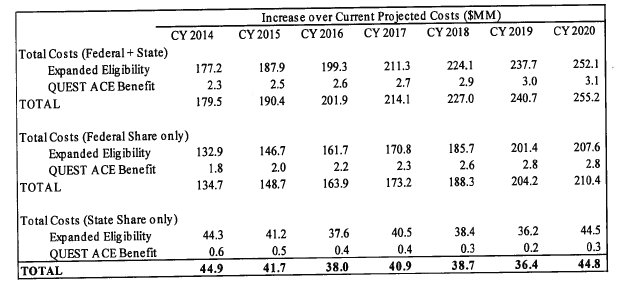
“Based on the assumptions outlined above and our current understanding of the bill,” Milliman says, “the cost to
the state over the first seven years would be $285.4 million.”
Primary Care Fee Schedule Increases
Milliman says that health care reform will increase the Medicaid fee schedule to Medicare fee levels for select primary care physicians. Currently, the report says, the Hawaii Medicaid fee schedule is at 60 percent of the Medicare fee schedule.
“The Federal share of this increase for 2014 is 100 percent and after that the state will pay a share consistent with the other professional services,” Milliman says.
Based on current patterns, the report estimates that the federal provision “will cost the state an additional $150.7 million over the seven years of the projection.”
Increased CHIP Federal Match
Milliman concedes that Hawaii will receive up to an additional 23 percent in federal funding between Oct. 1, 2015 and Sept. 30, 2019. It estimates that over the seven-year-period savings for Hawaii will total $27.3 million.
Pharmacy Rebates
“Due to the fact that most of the Hawaii Medicaid population is in managed care, the expansion of rebates to MCO provided drugs will generate savings in Hawaii,” the report says. “We are assuming that the state will receive a rebate of 11 percent for generic drugs and 15 percent for brand.”
Milliman says that these rebates will save Hawaii $73.2 million over the projection period.
Passive Renewal Provision
The report says that Hawaii has already estimated these costs will increase $20 million annually.
Presumptive Eligibility Requirement
Hawaii state government has also estimated this cost, which the report says is $2 million annually.
Total
Removing the pharmacy rebates and the increased CHIP federal matching, Milliman says that “all of the above items produces a total cost to the State over the period 2014 — 2020 of $489.6 million.”
There were other smaller figures included by Milliman that have not been included in this article that make up the difference if you’re checking the math at home.
Aiona technically had the cost wrong. But is he correct that the ACA would put a “strain on our state budget.”