Today’s Disclosure, Yesterday’s News
Hawaii’s citizens have no means of scrutinizing their representatives’ current financial ties as lawmakers begin the legislative session Wednesday.
The result of a loophole in the state’s ethics laws, the most up-to-date income information available to the public is as much as two years old, raising the question of its value in determining possible conflicts of interest.
State law stipulates that all elected and appointed officials (except judges) must file a public financial disclosure for the previous calendar year’s activity. The filings are due between Jan. 1 and May 31 of each year.
A Civil Beat investigation found that the vast majority of legislators file after the session adjourns.
This means that if politicians file their 2010 calendar year disclosure between April 29 and May 31, 2011, they will be filing after the 2011 legislative session concludes. By filing so late, it’s likely that the next time that the information would be newsworthy is the 2012 legislative session, long past any vote that could appear to have been influenced by a financial relationship.
Past Legislation
It’s an issue the Legislature has tried to address in the past, albeit with no success.
Last year, Sen. Les Ihara, Sen. Carol Fukunaga and Sen. Bobby Bunda introduced a bill that would have required monthly financial disclosures while legislators were in session.
The bill read, “The disclosure reports that are filed are not due until after the legislature adjourns; even if a legislator takes initiative to disclose financial relationships with lobbyists, the information is not available to the public when it is most relevant.”
It died without a vote in committee.
House Speaker Calvin Say told Civil Beat that monthly disclosures would be cumbersome for the ethics commission inputting all of the data into their system, but that he would consider alternatives. Say said a required quarterly financial statement might be more reasonable and that he is open to any ideas that would make the system more effective.
Still, he isn’t worried about present practices.
When Civil Beat asked Say if disclosing the previous year’s financial information after votes had been cast opened the door to the possibility that the public wouldn’t know about possible conflicts of interest, he said, “No.”
When asked about the merits of a monthly disclosure system, he replied: “No. There’s no need to. Because it’s going to come out anyway at some point in time, right?”
He is correct that the information will eventually come out.
But the fact is that it most often would come out long after public interest in any possible conflict would have faded.
2010 Filing Dates
A Civil Beat review of financial disclosures found that few legislators file during the legislative session.
Counting each member of the Legislature listed on the state ethics website – but excluding new members – that filed a 2010 disclosure, only 13 filed during the legislative session. The rest, 51 others, filed after the 2010 legislative session finished.
If the public wants to know exactly who their representative is financially connected to right now during this legislative session, there is no means to do so.
The tables below show when financial disclosures were received by the state ethics commission for 2010.
2011 House of Representatives
Dates in bold denote those legislators filing before session adjourned.
| Representative | 2010 Disclosure Received by Ethics Commission |
|---|---|
| Henry James C. Aquino | May 28 |
| Karen L. Awana | June 2 |
| Della A. Belatti | May 27 |
| Thomas M. Brower | June 1 |
| Rida T.R. Cabanilla | May 13 |
| Diana M. Carroll | June 3 |
| Corinne W.L. Ching | May 17 |
| Dwight P. Chong | May 24 |
| Isaac W. Choy | May 13 |
| George D. Coffman | February 1 |
| Ty J. Cullen | November 16* |
| Cynthia F. Evans | April 12 |
| George R. Fontaine | December 1* |
| Faye P. Hanohano-Kaawaloa | June 1 |
| Sharon E. Har | May 26 |
| Mark J. Hashem | December 6* |
| Robert N. Herkes | May 28 |
| Linda E. Ichiyama | November 18* |
| Kenneth T. Ito | January 26 |
| Aaron L. Johanson | December 6* |
| Gilbert S. Keith-Agaran | April 22 |
| Chris K. Lee | May 28 |
| Marilyn B. Lee | January 25 |
| Sylvia J. Luke | May 20 |
| Joey Manahan | May 28 |
| Barbara C. Marumoto | May 26 |
| Angus L.K. McKelvey | June 1 |
| John M. Mizuno | May 25 |
| Daynette S.P. Morikawa | November 16* |
| Hermina M. Morita | May 20 |
| Mark M. Nakashima | May 28 |
| Scott Y. Nishimoto | May 27 |
| Blake K. Oshiro | May 10 |
| Marcus R. Oshiro | January 19 |
| Kymberly N. Pine | June 4 |
| Karl A. Rhoads | March 29 |
| Gilbert R. Riviere | December 6* |
| Scott K. Saiki | May 20 |
| Calvin K.Y. Say | May 11 |
| Maile S.L.S. Shimabukuro | June 1 |
| Joseph M. Souki | June 3 |
| K. Mark Takai | May 18 |
| Roy M. Takumi | June 2 |
| Cynthia H. Thielen | January 19 |
| James K. Tokioka | May 27 |
| Clifton K. Tsuji | May 7 |
| Gene R. Ward | May 24 |
| Jessica E. Wooley | June 1 |
| Ryan I. Yamane | May 11 |
| Kyle T. Yamashita | March 19 |
(*Denotes first disclosure after election, which is required within 30 days of election.)
2011 Senate
Dates in bold denote those legislators filing before session adjourned.
| Senator | 2010 Disclosure Received by Ethics Commission |
|---|---|
| Rosalyn H. Baker | June 1 |
| Suzanne N. Chun Oakland | February 8 |
| Donovan M. Dela Cruz | December 9* |
| J. Kalani English | June 2 |
| William C. Espero | June 1 |
| Carol A. Fukunaga | June 1 |
| Gerald M. Gabbard | April 12 |
| Brickwood M. Galuteria | June 1 |
| Joshua B. Green | January 20 |
| Colleen W. Hanabusa | May 27 |
| Clayton H. Hee | May 26 |
| David Y. Ige | May 18 |
| Les S. Ihara, Jr. | June 1 |
| Michelle N. Kidani | June 1 |
| Donna M. Kim | May 28 |
| Russell S. Kokubun | May 27 |
| Ronald D. Kouchi | October 4* |
| Clarence K. Nishihara | January 14 |
| Ellen L. Pohaikaua Ryan | December 1* |
| Samuel M. Slom | May 11 |
| Dwight Y. Takamine | June 1 |
| Brian T. Taniguchi | June 1 |
| Jill N. Tokuda | May 28 |
| Shan S. Tsutsui | May 21 |
(*Denotes first disclosure after election, which is required within 30 days of election.)
The Rest of the Country
According to the National Conference of State Legislatures, all but three states require personal financial disclosures. Idaho, Michigan and Vermont have no requirement. There are 45 states that require annual updates and two – North Carolina and North Dakota – that require disclosures only during election years.
The NCSL does not keep track of state timeline requirements for filing disclosures, but a cursory Civil Beat investigation of state statutes found several instances of legislatures requiring filing during legislative sessions.
Some of those states are:
Alaska
Alaska requires legislators to file during the session if they experience a change in their financial interests.
A screenshot of the primary disclosure rule for Alaska is below:

Delaware
Delaware requires yearly reports and that disclosures be made public by March 15, during session. A screenshot of some of its disclosure requirements is below:

Indiana
Indiana requires yearly reports of the previous year’s activity within one week of the beginning of the legislative session. A screenshot of some of its requirements are below.

Kentucky
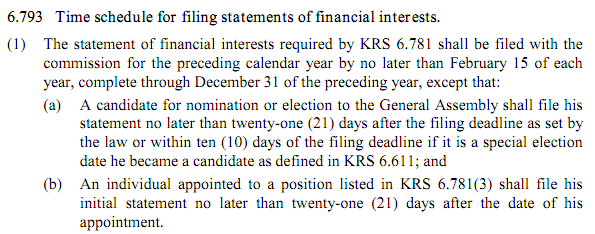
Kentucky requires yearly financial disclosures for the previous year’s activity to be filed no later than February 15, during legislative session. The disclosure must cover the previous year up to Dec. 31. A screenshot of some of the requirements is below:
Maine
Maine’s Legislature requires that public servants file financial disclosures by February 15 for the previous calendar year’s activity. A screenshot of the rules is below.

Nebraska
Nebraska requires disclosures to be filed by April 1, later than some other legislatures, but still before the end of legislative session. A screenshot of some of its requirements is below:

Not all states require disclosures and many have similar standards to Hawaii’s current law. For example, Georgia, Florida and Louisiana allow legislators to file after session, even as late as July.
But many states have recognized the need for the public to be aware of their representatives’ financial and business ties when they’re casting votes and have taken steps to ensure fuller transparency.