I Come From a Family of Unorthodox Human Statistics
Hawaii is going through a health crisis that translates into profound personal loss that I know too well. It is something to think about as people prepare to vote.
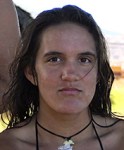
My name is Ciara Winona Kealohilani Kahahane. My heritage can be described by a bumper sticker I see from time to time: 100 percent part-Hawaiian.
I suffer from some of the litany of health concerns that plague every human being, though I have not been stricken by any of the typical Hawaiian diseases — obesity, heart disease, diabetes, etc.
I do, however, suffer from a mental illness, something that is often overlooked in the public discourse about healthcare.
It is difficult for me to find a doctor who accepts my brand of insurance, leaving me with a half-baked approach to medical treatment.

The author of this Community Voice, Ciara Kahahane, and her late father.
During the spring semester of 2014, I was even compelled to withdraw from school by an unexplained illness that left me barely able to stand, let alone attend class.
I learned about doctor’s office waits, the blood test, the rearranging of one’s schedule to suit the only available appointment that week. But I am lucky — I am still alive.
We throw statistics around when discussing the problem of health, especially as it relates to the Native Hawaiian people.
Deane Neubauer’s essay in the book The Value of Hawaiʻi, a source of some inspiration for this piece, cites some numbers. Native Hawaiian death rates from cardiovascular disease are 44 percent higher than the U.S. average, 39 percent higher for cancers and 196 percent higher for Type 2 diabetes.
This state of being is allowed to persist in part, I believe, because these statistics are only numbers.
They may be startling, but symbols on a page can be ignored, concealed or filed away in the back of the mind to grapple with later.
I have my own information to share.
These are statistics that we do not normally discuss. Forty percent of the family that she birthed, raised, and loved, has preceded her in passing. She has buried 67 percent of her sons, attended two-fifths of a potential five funerals at our church, Maria Lanakila.
My dad and his siblings were one-half Hawaiian, their parents each half as well. My uncle was the second of three brothers. Before the islands’ first foreign contact, in 1778, alcohol was unknown to these shores. If he were born three centuries ago, no drop of liquor would have passed his lips.
But alcoholism had been hurting Native Hawaiians for over a century. In 2012, my uncle died of liver cancer in a hospital room in Honolulu, miles away from his home on Maui. Medical interventions were too little, too late.
My father was named Daryl Collins Kahahane. His Hawaiian name was Lani, a component of the name I received when I was born.
Three hundred years ago, he would have eaten a Hawaiian diet. Meals would consist of taro, sweet potato, fish, bananas, and other traditional foods — a diet high in vitamins and low in fat. These foods would probably not have resulted in him suffering from heart disease or diabetes. He may not have had a heart attack in our front yard.
Scar tissue would probably not have formed in his heart, staying with him for the handful of years to come. And he might not have died at the age of 63, while I was finishing up the spring semester of my sophomore year in college.
But in 2013 — after decades of mayonnaise, spare ribs, root beer, and SPAM — we are far from the old days.
My grandmother, who still lives in Lahaina, was born 82 years ago just up Lahainaluna Road from the sugar plantation where my father was born. She saw two of her sons die before her, in the span of two years. The youngest of the three brothers survives, along with two daughters.
These are statistics that we do not normally discuss. Forty percent of the family that she birthed, raised, and loved, has preceded her in passing. She has buried 67 percent of her sons, attended two-fifths of a potential five funerals at our church, Maria Lanakila.
But no number value can be put on her loss. There is no replacement for a son or a father.
July 25 would have been Daryl Collins Kahahane’s 65th birthday. Instead of celebrating with a slice of Chantilly cake, my dad’s favorite, I was home alone, looking through my absentee ballot for the upcoming primary.
For the years to come, I want a candidate who understands the reality of Hawaii’s current health crisis and the repercussions it has on the local population; who supplies solutions instead of empty promises; and who can set down a framework that will support a college student with major depression like me, my grandmother who is going strong, and men like my father, from a long line of Hawaiians, who was part of a dying breed.
 GET IN-DEPTH
REPORTING ON HAWAII’S BIGGEST ISSUES
GET IN-DEPTH
REPORTING ON HAWAII’S BIGGEST ISSUES
Community Voices aims to encourage broad discussion on many topics of community interest. It’s kind of a cross between Letters to the Editor and op-eds. This is your space to talk about important issues or interesting people who are making a difference in our world. Column lengths should be no more than 800 words and we need a current photo of the author and a bio. We welcome video commentary and other multimedia formats. Send to news@civilbeat.org. The opinions and information expressed in Community Voices are solely those of the authors and not Civil Beat.