New Disclosure Law No Problem For These UH Regents Applicants
Despite a new law requiring public financial disclosures for more state board members, there seems to be no shortage of people interested in serving.
When Gov. Neil Abercrombie announced in June that he intended to veto new legislation requiring public financial disclosures for the members of 15 additional state boards and commissions, he reasoned that it would discourage worthy people from public service.
He also reckoned that the policy would “work against women” — a gaffe that elicited outrage from the likes of the League of Women Voters and Common Cause Hawaii.
The governor didn’t end up vetoing the bill. Instead he let the measure, which was passed unanimously by the Legislature in May, become law in July without his signature.
And while it did result in some resignations from the affected boards, there seem to be plenty of other people willing to fill the vacancies, if the 14 current nominees for four positions on the University of Hawaii Board of Regents are any indication.
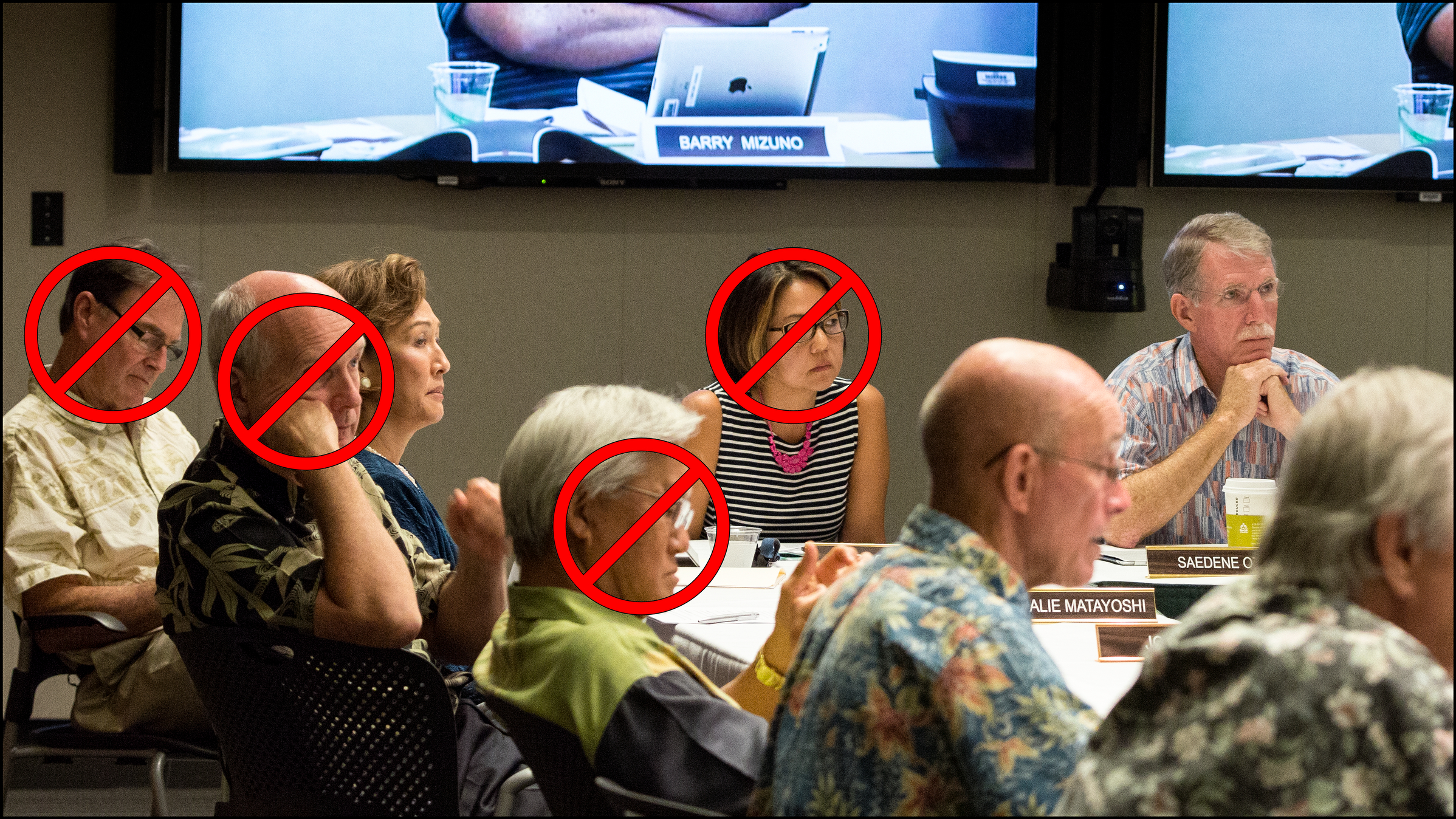
Photo illustration showing the four members of the UH Board of Regents who resigned recently. From left, Carl Carlson Jr., John Dean, Tom Shigemoto and Saedene Ota.
PF Bentley/Civil Beat
The financial disclosure statements require board members to reveal their income sources as well as salary ranges for themselves and their spouses. The forms also request information about organizational affiliations, stock holdings, property ownership and creditors.
For years, the financial reports have been publicly available for roughly 180 other state employees, including legislators, department heads, the governor and members of other major boards. The new law requires the same of 15 more boards, including the UH regents.
On Thursday, Civil Beat filed a lawsuit challenging the Hawaii State Ethics Commission’s decision not to release statements submitted by the more than 100 current board members before the new law took effect July 8. Instead, the commission wants to wait one to two years to require full disclosures.
The law’s passage prompted the resignations of at least 16 board members, including four of the 15 UH regents. Central Pacific Bank President and former Regent John Dean resigned before the bill even became law, writing, “I am willing to disclose my affiliations publicly, however, I do not have an interest in making my family’s personal financial information available to the general public … My resignation at this time is strictly a personal decision …”
Now, the council in charge of identifying candidates for the university’s governing board has come up with 14 nominees who would fill the four vacant seats on an interim basis — one each for Oahu, the Big Island, Kauai and Maui County. All were recruited after the disclosure law was passed. Abercrombie is expected to make the selections shortly, after which the state Senate will consider confirming them.
Seeking a New Direction for UH
Conversations with a handful of the candidates indicate a pool of prospective regents who want to rebuild the public’s confidence in the university, an institution that’s been incessantly pummeled by bad press. Most recently, former UH Manoa Chancellor Tom Apple’s controversial firing and news of the campus’s alarmingly shrunken budget have raised concerns about the university’s transparency.
The candidates reached by Civil Beat said that they believe in public financial disclosures. They said they hope the new law will improve the board’s relationship with the community and enhance its effectiveness and ability to shape university policy.
“I believe the public has the right to be assured that decisions of the Board of Regents are completely independent of potential personal economic benefit,” said Michael McEnerney, a certified public accountant and attorney who’s being considered for the Oahu seat vacated by Dean. “Since the regents are not directly compensated, it is reasonable for … the people of Hawaii to be sure the governing body’s decisions are not affected by potential personal benefit of the members.”
The other 13 nominees include Simeon Acoba, Jr. a former associate justice for the Hawaii Supreme Court; Maralyn Kurshals, a former Board of Education member; Peter Hoffman, a former Hawaii County councilman; and David Iha, a former UH budget executive and Board of Regents secretary. Three of the nominees have been on the short list for Board of Regents seats in years past: Randy Vitousek, a Big Island attorney; Klaus Keil, a former UH cosmochemistry researcher and professor; and Sherrilee Dodson, the executive director for Habitat for Humanity Maui.
Here’s a full list:
City and County of Honolulu (for a term to expire June 30, 2017)
- Simeon R. Acoba, Jr.
- Peter S. Adler
- Maralyn A. Kurshals
- Michael T. McEnerney
- Russel S. Nagata
Hawaii County (for a term to expire June 30, 2016)
- Wayne S. Higaki
- Peter S. Hoffmann
- Roy A. Vitousek III
Kauai County (for a term to expire June 30, 2017)
- Dileep G. Bal
- David Iha
- Klaus Keil
Maui County (for a term to expire June 30, 2015)
- Sherrilee K. Dodson
- Anders F. Lyons
- Helen F. Nielsen
Four of the candidates responded to requests for interviews and were available for comment: McEnerney; Vitousek; Adler, a planner and mediator; and Lyons, a business consultant. Acoba declined to be interviewed, saying it was inappropriate to comment, while Keil and Kurshals did respond but couldn’t talk before this story was completed.
Disclosures ‘a Blessing for the Public’
Adler, a former president of the national conflict-resolution nonprofit the Keystone Center, said his experience has taught him how resources such as public financial disclosure statements enhance an organization. Adler is applying for the Oahu seat.
“On the one hand it’s a burden for those who want to do some public service, on the other hand it’s a blessing for the public,” he said.
Adler, whose daughter teaches sociology at Leeward Community College, said his biggest interest in serving UH involves “long-range planning.”
“Boards tend to focus on the issues of the moment, whatever crisis du jour is going on,” Adler said. “But there are big changes in the world that affect how higher education functions … (the Board of Regents) needs to resist the temptation to go down and micromanage things.”
Adler said he hopes the university harnesses its areas of expertise — its “world-class institutions” — to solve “world-class problems.”
Vitousek, an attorney on the Big Island, also wants the university to capitalize on the areas it excels in — such as agriculture. Vitousek was a member of the UH law school’s first graduating class in 1976. He is a partner at Cades Schutte LLP, where current Regent Jeff Portnoy is also an attorney.
“We should be the world leader in what’s ours,” Vitousek said, suggesting that UH should invest more resources in training resource managers.
He said he doesn’t blame the former regents for resigning and joked that his financial disclosure statement is “explicitly boring.”
“Because the Board of Regents gets a lot of public attention and deals with a lot of controversial issues, anything that can allow people to focus on the substance of the issues and the substance of the decisions is a good thing,” he said.
Lyons, a Maui resident who’s president of Kapalaea Consultants, said his priority for UH would be diversifying its revenue stream and better preparing students for Hawaii’s shifting economy.
“The Board of Regents presents a real opportunity to have an influence on an iconic organization in Hawaii,” he said, adding that he wasn’t entirely comfortable with the new financial disclosure requirement but felt like the chance to serve was more important.
McEnerney, who received his master’s in business administration from UH Manoa and currently serves on the state Regulated Industries Complaints Office advisory board, said he wants to be a regent because he wants to enhance access to educational opportunities for all of Hawaii’s people.
He said it’s important that the Board of Regents be subject to public financial disclosures because “the public has the right to be assured that (its) decisions … are completely independent of potential personal economic benefit.” The same principle, he said, applies to CPAs.
“Hopefully the new policy will provide a board with increased diversity of members who can work collaboratively” to fulfill its responsibilities of appointing and evaluating the president, developing policy, strategic planning and oversight, McEnerney said.