

Honolulu Prosecutor: Newspaper Op-Ed Was ‘Uninformed, False Statements’
Keith Kaneshiro wanted to be heard on why he took a cop domestic abuse case to a grand jury. We’re happy to continue this important discussion.
A recent opinion column in the Honolulu Star-Advertiser concluded that the prosecutor’s office manipulated a grand jury to squash any charge against police Sgt. Darren Cachola because prosecutors wanted to find a way to do so without having to accept the responsibility and resulting criticism.
The column went on to disparage prosecutor Keith Kaneshiro, saying, “Since the decision not to indict Cachola, Kaneshiro has presented himself to the media as a crusader against domestic violence. We hope he is serious, but considering his office’s dismal record of bringing domestic violence cases to trial and obtaining convictions, we cannot help but wonder.”
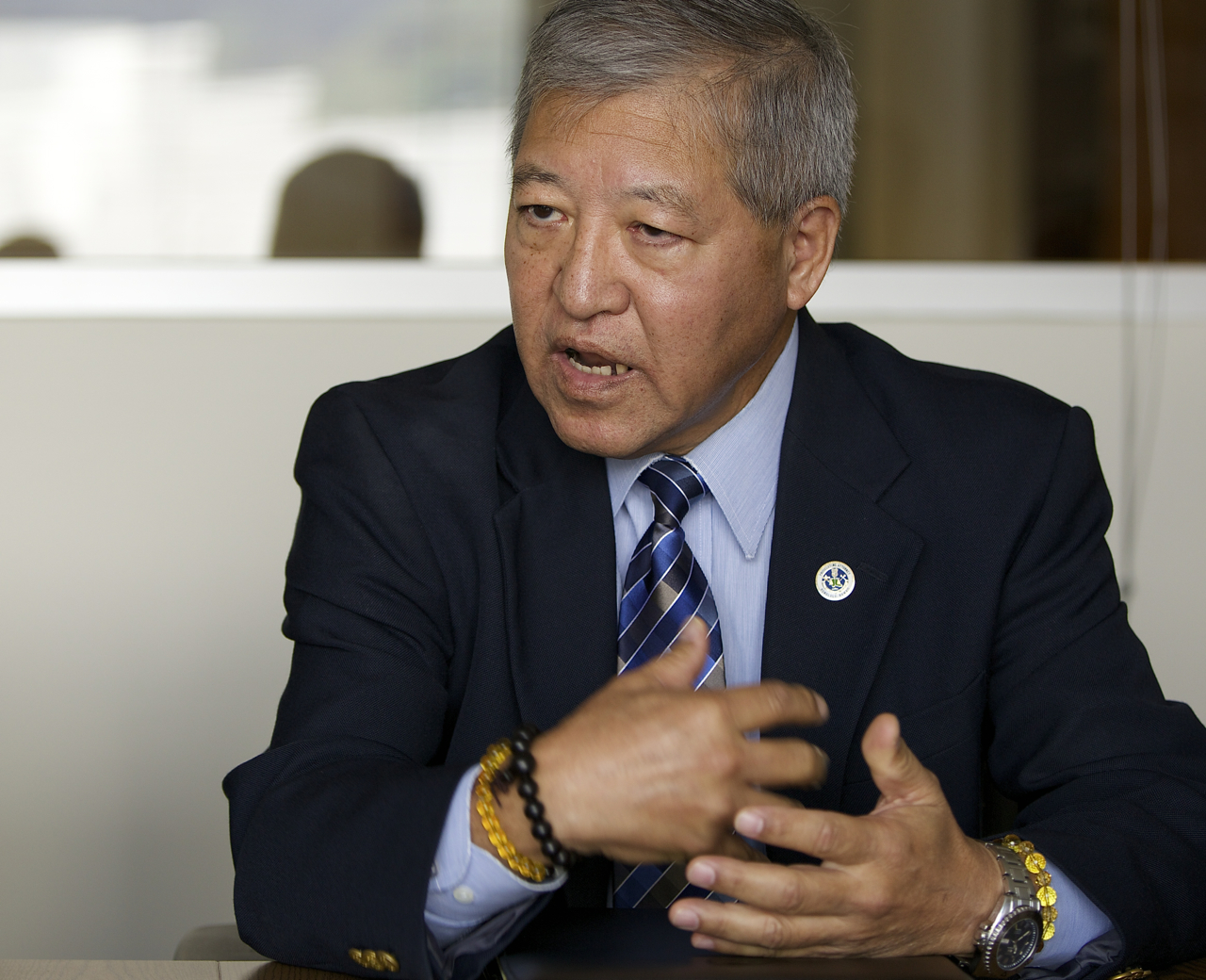
Honolulu City Prosecutor Keith Kaneshiro responds to a question during an editorial board meeting at Civil Beat’s Kaimuki office Oct. 24.
Nathan Eagle/Civil Beat
The column was written by David Johnson, Meda Chesney-Lind and Nicholas Chagnon of the University of Hawaii’s School of Social Sciences. They arrived at their conclusion even though they did not know what drove the decision to take the case to a grand jury, what evidence and witnesses were presented to the panel, or what interactions took place in the room. They also made uninformed and false statements about the purpose of a grand jury and how it functions.
As the column called into question the integrity of the prosecutor’s office, we asked the Star-Advertiser if we could submit a detailed rebuttal. We were told that any rebuttal would have to be limited to a 150-word letter to the editor.
We thank Civil Beat for giving us a forum to tell our side.
The premise of the column was built on four statements, which we will answer:
• “Misdemeanor cases such as Cachola’s are rarely taken before a grand jury.”
Does this mean that prosecutors should have ruled this out as an avenue for finding the truth? Given the heightened publicity and the community’s mistrust of law enforcement at the time, and the fact that the investigation had stalled, taking the case to a grand jury was the best way to determine its merits and make that determination public.
• “In practice, probable cause is an easy threshold of proof for the prosecutor to reach because grand juries function mainly as a rubber stamp.”
This is a lie that impugns the judicial system and insults and demeans the contributions of the citizens who participate in the process. The panel that heard the Cachola case had access to Cachola’s girlfriend, every videotape and every witness to the event, audio of the 911 call, reports, even police detectives. They were very inquisitive and, aided by a lawyer who acted as counsel, were actively involved in questioning. They took their responsibility seriously. They were no rubber stamp.
• “As a classic article in criminology concludes, grand juries are ‘total captives of the prosecutor who, if he is candid, will concede that he can indict anyone, at any time, for almost anything, before any grand jury.’ ”
In a Grisham novel, perhaps. In the real world, under the Hawaii Rules of Professional Conduct, a prosecutor is a sworn minister of justice who cannot “institute or cause to be instituted criminal charges when (the prosecutor or government lawyer) knows or it is obvious that the charges are not supported by probable cause.”
• Prosecutors “took a path that enabled them to use the grand jury as a shield against public criticism, and they probably did not seriously seek an indictment at all.”
Criticism is an inescapable reality for prosecutors; there is no shield against second-guessing. As to the notion of not seriously seeking an indictment, convening a grand jury is not a frivolous matter for prosecutors or the courts. This is not a charade. Prosecutors are sworn to present a fair case and grand jurors are sworn to decide the case based on law and evidence. Grand juries are called upon to affirm charges, not to deny the truth. Any effort to use a grand jury for any other purpose is misconduct.
Without prosecutors convening a grand jury – where evidence can be presented and reluctant witnesses compelled to testify under oath – the Cachola case would have ended when police determined there was insufficient evidence to charge and closed their investigation.
And having made the decision to take that next step, why would prosecutors provide the grand jury with all the available evidence and witnesses if the intent was to convince the panel to decline charges?
Johnson, Chesney-Lind and Chagnon build their case on false assumptions and their own personal biases. Facts show that every effort was made to seek an indictment.
Finally, Keith Kaneshiro is no latecomer to the issue of domestic violence. In fact, he has been an advocate for victims of domestic violence for more than 30 years, ever since a woman in a case he was assigned to as a deputy prosecutor was shot to death by her husband.
In his first term as prosecuting attorney, he established the office’s domestic violence unit. When he returned to office in 2010, he added deputies and resources to the unit, which now charges as many as 20 misdemeanor abuse cases a week.
The office is also close to opening the Honolulu Family Justice Center, which will provide long-term transitional housing and support services to help victims of domestic violence make clean breaks from their abusers and the cycle of violence.
One point the prosecutor won’t argue is the low conviction rate in domestic violence cases. Even if the office takes all of its cases to trial, that outcome won’t change until community attitudes toward abuse do.
A grand jury is like any other jury in that its members are drawn from the community. If there is any takeaway from the grand jury’s decision in the Cachola case, it might be that until the community better understands the complex dynamics of abusive relationships – and why a victim would say it was just horseplay, because he really loves me – juries will struggle to return guilty verdicts despite what appears to be clear evidence of abuse.
 GET IN-DEPTH
REPORTING ON HAWAII’S BIGGEST ISSUES
GET IN-DEPTH
REPORTING ON HAWAII’S BIGGEST ISSUES
Community Voices aims to encourage broad discussion on many topics of community interest. It’s kind of a cross between Letters to the Editor and op-eds. This is your space to talk about important issues or interesting people who are making a difference in our world. Column lengths should be no more than 800 words and we need a current photo of the author and a bio. We welcome video commentary and other multimedia formats. Send to news@civilbeat.org. The opinions and information expressed in Community Voices are solely those of the authors and not Civil Beat.
