

Neal Milner: We’re Dealing With a Growing Wave of Fragile Families
The new economic realities that are destabilizing the working class have even young Americans nostalgic for the days of “Leave It to Beaver.”
During the holidays we usually think about two extreme kinds of families. One is ohana, those close, comforting families that celebrate together. The other is the family in dire crisis. Without immediate help they will have no celebration at all.
But there is another type of family that has become more common, where ohana takes on a different, more fragile cast and where crisis, though maybe not so immediate, lurks just around the corner and is just as threatening.
A family like this one:
Derrick is a 26-year-old who is back living in his old room at his parents’ Kaneohe home. For a couple of years he’d been living with his girlfriend Jane and their 2-year-old daughter Denise in a run down Mo’ili’ili apartment. But the rent was too high, and they were no longer getting along so well, so Derrick moved out while Jane took the infant and moved back in with her own mother.

It’s increasingly difficult for many American families to even imagine living in a house, much less one lile this at Universal Studios where the Cleaver family lived in the “Leave It to Beaver” TV show that came to symbolize American life in the 1950s.
Tony Hoffarth/Flickr.com
Derrick sees Denise, whom he loves very much, a couple of times a week. He and Denise’s mom get along now, but neither of them wants to get back together. In fact, Jane has a new boyfriend.
Since he finished high school, Derrick has had a few odd jobs — non-union construction worker on small jobs, restaurants, night clerk at 7-Eleven, some off and on musician gigs — but nothing permanent, nothing stable. No pensions, no benefits. Nothing that holds his interest or pays enough to get him to go to work every day.
Denise’s mother had dropped out of community college when she got pregnant.
More than anything else, Derrick wishes he could be a good provider for Denise, but he sees nothing on the horizon that could make that possible.
In fact it is hard for him to imagine any optimistic horizon at all.
Derrick’s life is a product of cultural and economic changes that have made his life and the life of his family very vulnerable.
A little over half of Americans ages 25-34 have a high school degree but no college. They are the ones that today’s economic and cultural changes have put most at risk.
This group has a significantly higher unemployment rate than college graduates do. The incomes of those who work are much lower. And their family lives are more at risk and far less stable than those with college degrees.
‘Leave It to Beaver’ and a New Working Class
Derrick is fictional, but there is a good chance that you know of someone like him because, as Andrew J. Cherlin shows in his recent book, “Labor’s Love Lost: The Rise and Fall of the Working-Class Family in America,” this scenario has become more and common throughout the U.S. Derrick exemplifies America’s new working class.
Hawaii’s working class previously did not look or work like the blue-collar workers on the mainland who toiled in large, smoke-belching factory jobs.
But, as Andrew Levinson shows in his book “The White Working Class Today,” members of working class are no longer typically found in those huge factories. Those factories are gone. So is the union protection. Instead they are more likely to be stocking clerks, gardeners, dishwashers and laborers on small, non-union construction sites.
They do the same work and face the same instability that Derrick does.
A few years ago the sociologist Timothy Nelson asked a group of low-income men whose children were not living with them what their ideal marriage would be (Cherlin discusses this study in his book.)
“Leave It to Beaver” was a common answer.
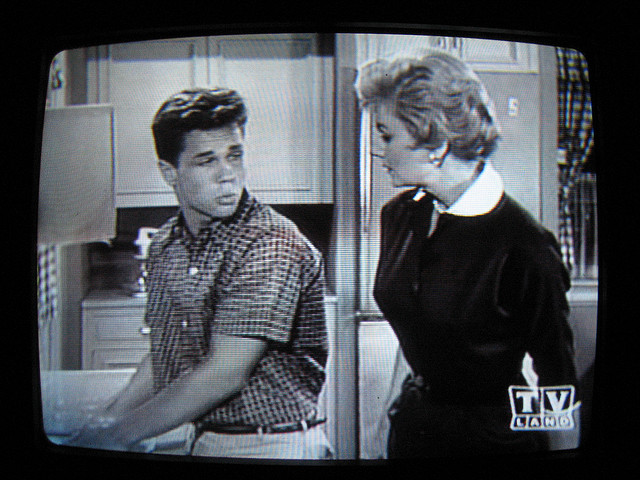
In a scene from the TV show “Leave It to Beaver,” Wally (Tom Dow) talks with his mother, June Cleaver (Barbara Billingsley).
Diana Beideman/Flickr.com
A 24-year-old white man said he wanted to be like the old TV show’s father figure, Ward Cleaver, because Ward was always happy, and the Cleavers had everything they needed. A 26-year-old Latino said that Ward and June Cleaver had the ideal marriage.
None of the men had been born when “The Beav” and his brother Wally were on the air. The last new episode aired more than 50 years ago.
So these men were nostalgic for a past they had never remotely experienced, a time when high school graduates could get good, stable jobs, families were secure, the husband’s income was enough to provide, and having kids outside of marriage or even living together before marriage was totally unacceptable.
The 30 years after World War II were a uniquely bountiful and culturally homogeneous period in American history. There was a family-centered culture bolstered by an economic prosperity that included the working class.
High school graduates could get decently paying, stable jobs, often in unionized workplaces. Of course there were class differences, but the level of economic inequality was historically low. Prosperity did indeed trickle down to the working class.
Families were male-dominated, sometimes in a nice Ward Cleaver sort of way and sometimes not. But there was a shared belief in the need to postpone living together or having child before marrying. There was also still a pretty strong consensus that a woman’s greatest value was in the home.
The Cleavers were a more than a little sappy. As kids, we made fun of them. But the Cleavers did not seem all that out of the ordinary.
In fact, in the 1950s when “Leave It to Beaver” began its rise to popularity, almost half of white children lived in family situations similar to the Cleavers. (The number of African American families was not as high but still significant.)
The difference between middle class and working class families narrowed as working class family norms became more and more like those of the better-off neighbors.
Economics, Culture, and Families Today
Those young men in the study who so admired the Cleavers are also living in an historically unique period. But for them, this period is uniquely bad.
In Cherlin’s words, “It is the conjunction of the polarized job market (the trend toward both higher paying and lower paying jobs) and the acceptance of partnering and parenting outside of marriage that makes the current state of American family life historically unique” and tremendously fragile.
According to 55 by 25, a Hawaii educational advocacy group, college graduates here make more than twice the income of high school grads.
That’s typical, but the disparity between college and high school is increasing. And although the economy has recently improved, wages have not, and income inequality continues to rise.
These differences carry over into family life in very important ways.
Derrick and his high school classmates who went on to college probably share the same post-1975 tolerance regarding pre-marital sex. They were equally likely to have shacked up. But college-educated people are more likely to get married before they have children.
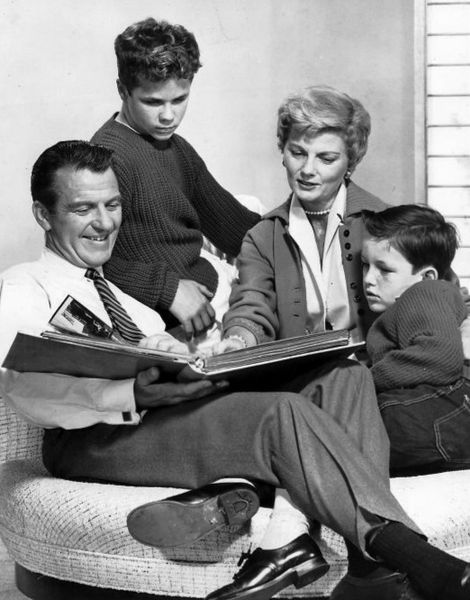
The TV Cleaver family, from left, Hugh Beaumont (Ward Cleaver), Tony Dow (Wally) Barbara Billingsley (June Cleaver) and Jerry Mathers (Theodore aka “Beaver”).
The Bees Knees Daily/Flickr.com
Thirty-eight percent of the births in Hawaii in 2012 were to parents who were not married, just slightly below the national average. The parents of these children are much more likely to have a high school diploma or less.
Today, three-quarters of women without bachelors degrees have at least one child out of wedlock by the time they are in their late-20s.
Cherlin says the U.S. “is moving even further ahead in a category no nation wants to lead: the most unstable family lives.”
On measures of child well-being, Hawaii is about average (24th) compared to the rest of the country. So it’s not a stretch to assume that family situations here are typical.
Half of the non-marital relationships with children end within five years, which is much shorter than the time that married people stay together. The U.S. leads the Western world in the percentage of parents who have children with more than one partner.
In these situations, kids’ lives are more vulnerable. They are less likely to do well in school, have emotional problems, and get into trouble with the law
All in all, a rocky future for Denise and her parents. Derrick’s story can raise a lot of emotion: He should man up, learn to keep it in his pants, take responsibility. Or, it’s not his fault, he’s a victim of larger forces over which he has no control.
It’s about a decedent culture. No, it’s about a bad labor market.
Love them or hate them, condemn or sympathize, Derrick, Jane, and Denise are important because the country’s economic and cultural future depends on what happens to people like them.
Next column, I’ll look at possible ways to make things better.

