Selma at 50: Our Work Is Not Yet Done
Five decades after an iconic series of voting rights marches in Alabama, America’s civil rights work is far from over.
Editor’s Note: U.S. Rep. Mark Takai was among lawmakers taking part in the annual congressional civil rights pilgrimage to Alabama, this year marking the 50th anniversary of the Selma to Montgomery marches. He shared personal posts during the three-day trip and concludes with this column. Read the posts in chronological order here, here and here.
After an eventful three days visiting the heart of our nation’s civil rights movement, I couldn’t get to sleep Sunday night.
There was so much to be grateful for these past few days. I’m still reliving the words of repentance and forgiveness coming from Peggy Wallace Kennedy, daughter of the late former segregationist Gov. George Wallace, to Congressmen John Lewis, one of the original “Big Six” of the Civil Rights Movement.
But what kept me up Sunday night and pains me is still hearing the sounds of the drums beating and people yelling during President Barack Obama’s speech. I learned later that there was a group from Ferguson, Missouri, demonstrating against ongoing police brutality. One young protester was quoted as saying, “The president is the same skin color. Why is this still happening to us?”
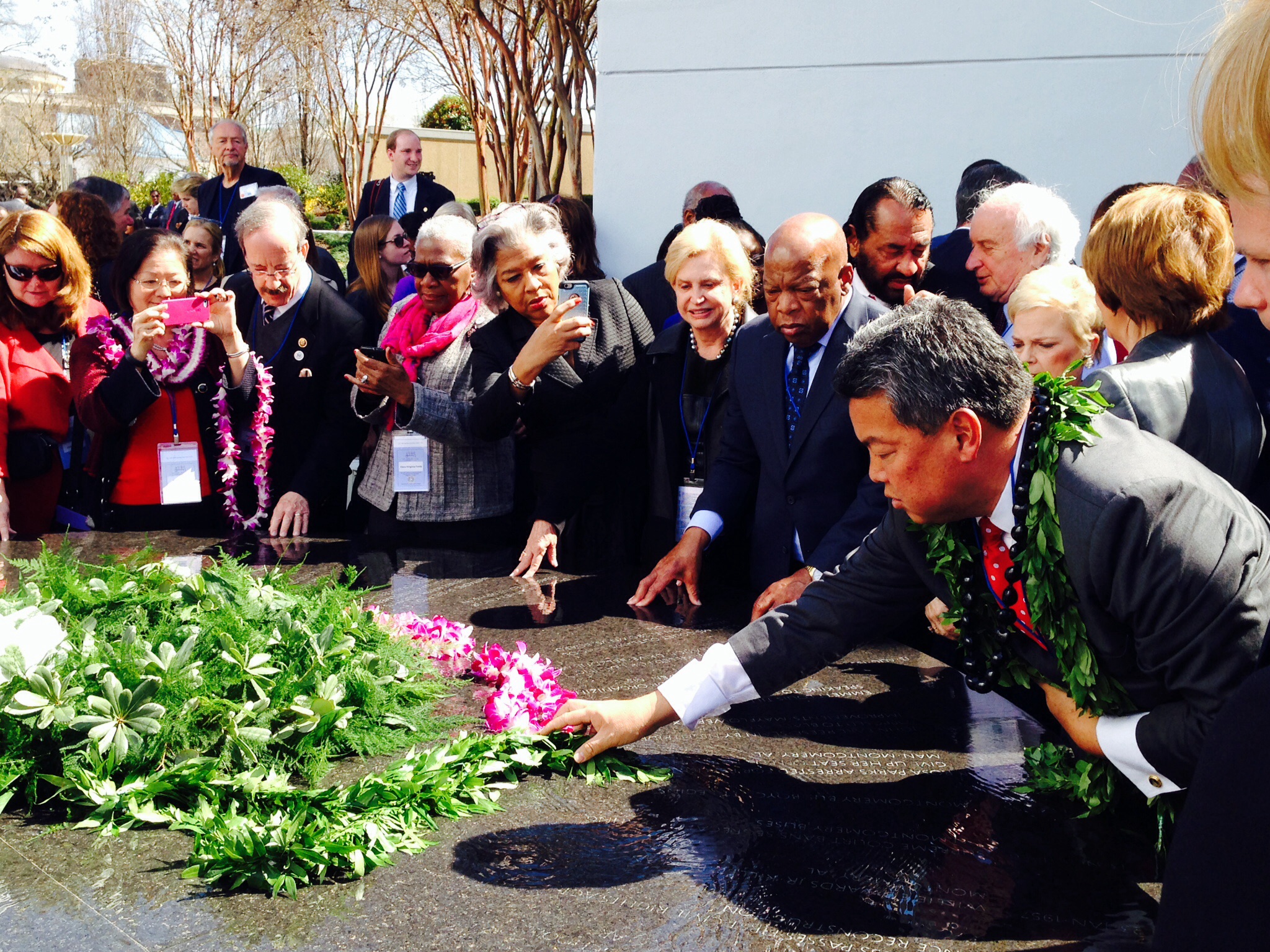
Mark Takai, right, and others leave their lei in respect to those who suffered beatings at the hands of Alabama state troopers and others 50 years ago during the Bloody Sunday march.
U.S. Rep. Mark Takai
I am forever grateful to Congressman Lewis for his dedication and his inspiration. I also appreciate all that Faith and Politics, the organization that has coordinated this congressional pilgrimage for the last 15 years, has done for me and countless others to bring us into personal relationship with this important place and chapter in our country’s history.
This past weekend, Sen. Mazie Hirono and I (along with nearly 100 members of Congress) heard from Juanita Abernathy, whose husband was the late Rev. Ralph Abernathy, the civil rights leader. “We’re not finished. It’s not over yet,” she said. “We are still going to see to it that justice and equality in these United States will no longer be attached to color.”
Even Todd Endo, one of the last surviving Asian American participants in the 1965 voting rights demonstrations in Selma, wonders why the work is still not done. I had a chance to meet with Todd and some members of the Japanese American Citizens League at our hotel, where we talked about the significance of the 50th anniversary, but spent much of our time on the now.
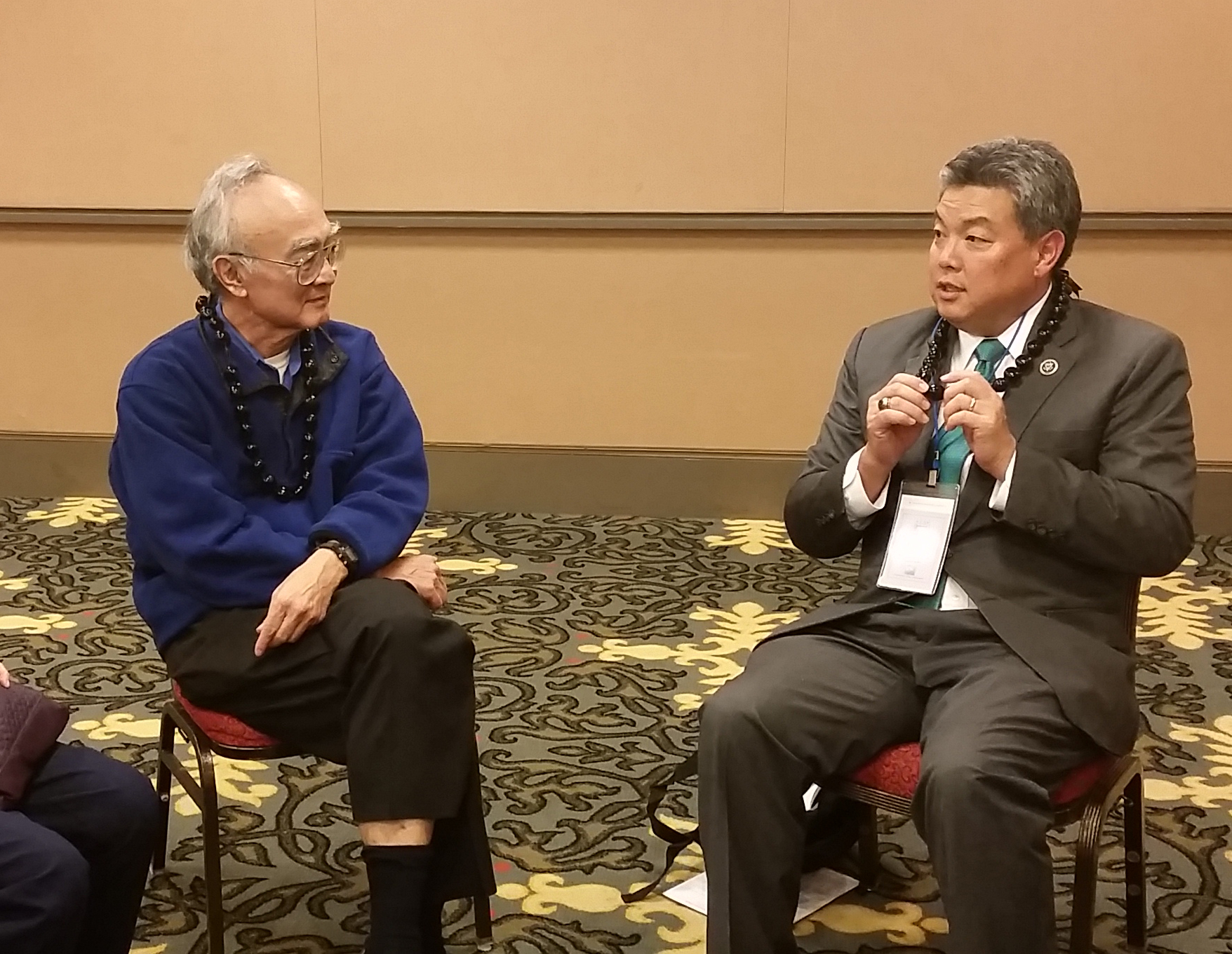
Todd Endo of the Japanese American Citizens League, left, and Takai speak about civil rights in America and the 50th anniversary of the Bloody Sunday march.
U.S. Rep. Mark Takai
Floyd Mori, the president of the Asian Pacific American Institute for Congressional Studies, also was in Selma. Floyd told me that he came to Selma because “The battle for equality is heightened today by the political reality that new Americans have not yet achieved their full stature as Americans in today’s democracy.”
I told Todd, Floyd and others that I am serving in Congress to continue to push forward legislation reaffirming the Voting Rights Act, to end racial profiling and discrimination, to comprehensively reform immigration policies, and to commit to equal rights for all.
A few years ago, I drafted and helped to pass “Civil Liberties and the Constitution Day” in Hawaii. Today, we are among just a handful of states that pay tribute to past struggles and spend time educating our keiki on the importance of standing up and standing together for civil rights. I will be introducing a bill later this year to designate a “Civil Liberties Day” in the United States.
The younger generations are the ones that will carry the legacy of the Freedom Marches into the future, and we need to ensure that everyone knows exactly what is at stake.
In his famous address, Dr. Martin Luther King Jr. said, “I have a dream that one day my four little children will live in a nation where they will not be judged by the color of their skin, but the content of their character.”
We have not yet accomplished Dr. King’s dream; there is work still to be completed. So let’s get together and get it done.
 GET IN-DEPTH
REPORTING ON HAWAII’S BIGGEST ISSUES
GET IN-DEPTH
REPORTING ON HAWAII’S BIGGEST ISSUES
Community Voices aims to encourage broad discussion on many topics of community interest. It’s kind of a cross between Letters to the Editor and op-eds. This is your space to talk about important issues or interesting people who are making a difference in our world. Column lengths should be no more than 800 words and we need a current photo of the author and a bio. We welcome video commentary and other multimedia formats. Send to news@civilbeat.org. The opinions and information expressed in Community Voices are solely those of the authors and not Civil Beat.