Health Beat: Protect Pilot Privacy or the Lives of Innocents?
The intentional crashing of a plane in the Alps raises troubling questions about how we deal with pilots who are medically or psychologically unfit to fly.
Germanwings Flight 9525 crashed in the alps in late March, killing all on board including co-pilot Andreas Lubitz, who authorities believe was responsible for crashing the plane.
Preliminary investigation has led to the suspicion that this was a deliberate act of a mentally impaired man who was dealing with vision and psychological issues that he deliberately hid from his employer. Prior to the flight, he had been declared unfit for duty, yet no one stopped him from walking into the cockpit and intentionally killing everyone on board.
German officials searched his home and found a note from his doctor declaring him unable to fly, yet according to airline protocol, it is the responsibility of the pilot to notify the airline himself, which he clearly did not do the morning he chose to board that doomed plane.
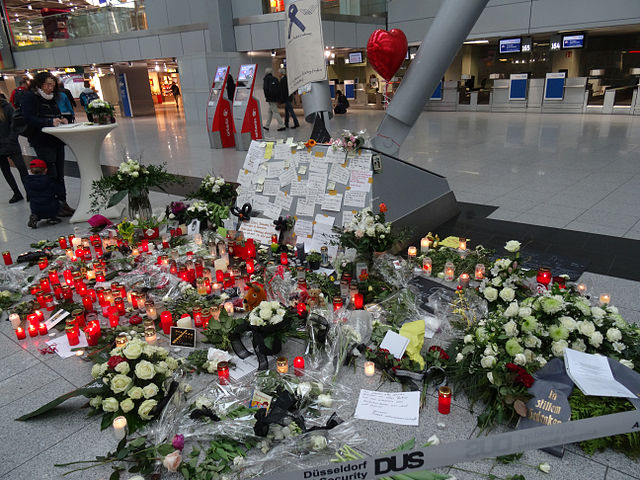
Mourners created a makeshift memorial in the Dusseldorf, Germany, airport for the victims of Germanwings Flight 9525.
Hans135797531 via Wikimedia Commons
The direct consequence: 149 innocent people plunged to their deaths high in the Alps, innocent victims of one man’s deranged plan, the purpose of which will never truly be known.
When someone is declared unfit for duty for any medical reason, should the medical professional have a duty to notify the individual’s employer? Especially if the person is in a position where they are in charge of more than 100 other lives?
Where pilots, bus drivers, taxi drivers and anyone else directly responsible for the safe transportation of other people are concerned, it’s time to stop protecting privacy and start protecting the public.
Perhaps if the medical person who wrote Lubitz’s note had a duty to inform the airline, this tragedy might have been avoided. Regardless of the circumstances concerning why, a note clearly stating his inability to fly was found torn in the trash, and nothing had been done about it.
What are the rules of notification for airlines?
In the United States, the Federal Aviation Administration requires that pilots undergo periodic medical examinations, which are supposed to include questions regarding psychological as well as medical health. For commercial pilots, examinations are required every six months over the age of 40, yearly if under 40.
Special qualifications are required for doctors who examine pilots, including certification as a designated aviation medical examiner. In the FAA handbook, there are severe penalties imposed on any doctor who fails to discover or report a disqualifying diagnosis. A fine of up to $250,000 and prison time of up to five years can be imposed on both the doctor and the pilot if fraudulent activity is discovered.
At any time, the FAA may request re-examination of a pilot, for any medical conditions. However that only happens if someone reports a problem. Pilots are expected to self-report any changes in their medical status, and there is no current legal requirement of any private medical doctor to notify anyone if she/he declares a pilot unfit for duty.
Europe has a similar system of examination and also relies on pilots to self-report any medical or psychological conditions.
Such a system for unfit pilots is like asking a drunk bar patron to use their his/her judgment and not get behind the wheel of a car. But in this case, it’s the controls of a plane, and there are a lot more lives directly at stake.
The medical community might be up in arms with such a suggestion. After all, privacy rules are supposed to protect patients. The federal Health Insurance Portability and Accountability Act of 1996 (HIPPA) requires that all medical information be kept private, released only with direct permission from patients. That means if you call my office to ask me about your mom’s medical conditions, I can’t answer your questions, unless she has given me written permission to do so. Violations of the law can result in a $10,000 penalty for each offense.
But in this case, we have to take a closer look at whom we are actually protecting. Each one of the 149 people on board that plane lost their lives because Andreas Lubitz lied. He was not fit to take those controls, and as more and more information surfaces, the sheer terror of his victims is a rallying cry to change the system that protects someone in his position instead of everyone else.
The FAA should have a reporting system so that any doctor who examines a patient who happens to be a pilot and determines that the patient is unfit to fly can notify the FAA with no privacy imitations. Immediate notification of their employer should take place, and all future flights should be reassigned until a full investigation can take place. Pilots should be put on paid administrative leave so that their families are protected financially. Employers should be responsible for the consequences if pilots are not fit to fly and yet are still allowed to operate their planes.
If we have learned anything from this tragedy, it’s that our current system of self-reporting doesn’t work. Whether Lubitz took the plane down due to a psychiatric or medical cause, the fact that a doctor knew in advance that he was not able to fly and yet had no responsibility to tell anyone puts all of us at risk the next time we step foot on a plane.