Caldwell Is Right To Veto Any Sit-Lie Expansion
The City Council would be unwise to override the veto and should set aside a revised version of the bill. Temporary shelter must come first.
Mayor Kirk Caldwell made the right call Thursday. We commend his decision to veto the City Council’s bill expanding Honolulu’s controversial “sit-lie” ban, a law targeting sidewalk squatters who are typically homeless.
After weeks of criticism of the legislation, including a revealing look at the bill’s legal vulnerabilities from Civil Beat’s Rui Kaneya, Caldwell agreed that the expansion would reach beyond prime commercial areas and that by doing so, would almost certainly provoke a legal challenge. That could result in unnecessary costs to the taxpayers and put the city’s sit-lie bans in Waikiki and Chinatown at risk — a possibility Caldwell wants to avoid.
The alternative bill he’s putting forward ought to be put on the back burner, too. The city needs to move forward on solutions for temporary housing for homeless people displaced by sit-lie, many of whom are now rapidly swelling the ranks of the homeless in Kakaako and the Kapalama Canal area.
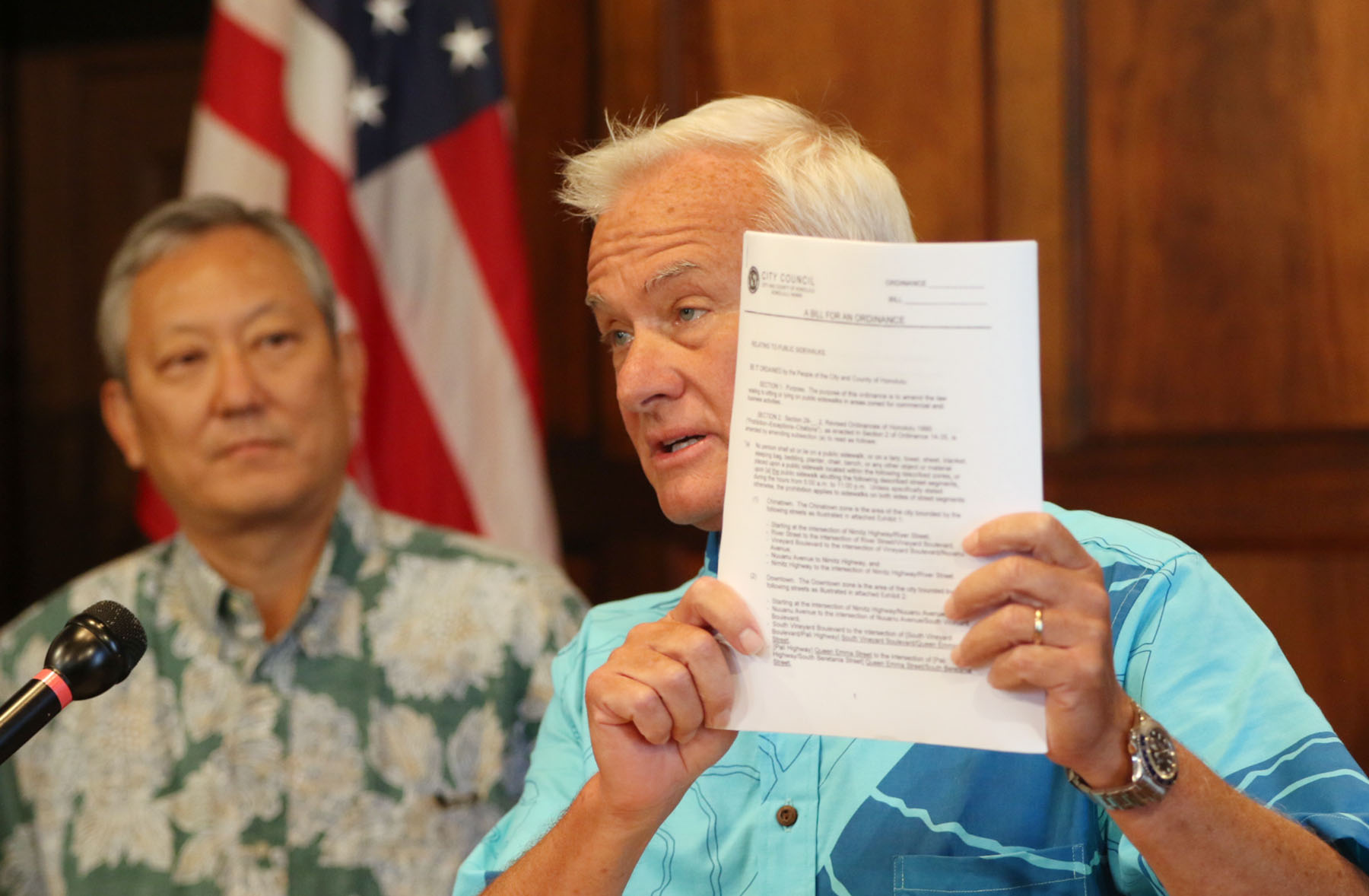
Mayor Kirk Caldwell explains his decision to veto the sit-lie expansion during a Thursday press conference.
Cory Lum/Civil Beat
The mayor has a fundamental philosophical issue to resolve as he moves forward. On the one hand, he argues that sit-lie has “worked beautifully” thus far, pointing to businesses understandably pleased with their cleaner and more attractive surroundings and police who say the law has been a helpful tool in dealing with the most difficult and persistent homeless individuals.
On the other hand, he has stopped city enforcement actions against homeless people in Kakaako “because what we’re doing now is just moving them around,” as he said last week in an appearance on Hawaii News Now.
Those sweeps — along with sit-lie — are part of the mayor’s “compassionate disruption” policy. He made a strong point in the same appearance that he doesn’t want to send law enforcement back into Kakaako “until we have units or some type of shelter space for (the homeless) to move into.”
Calling sit-lie a big success in Waikiki but enforcement sweeps problematic is, at best, contradictory, when both leave the homeless without a place to go. Removing tons of garbage and mitigating further messes is important, but what of the human destruction left behind?
Meanwhile, discussions appear to be taking on a new urgency regarding finally identifying that temporary shelter space, which should have been put in place before sit-lie implementation began, as the City Council requested last fall. Council members appear to be interested in the vacant Hilo Hattie’s building on Nimitz Highway, and the mayor’s office has promised an “update” on a potential temporary shelter space on Sand Island “in coming months.”
It’s a critical matter of sequencing; temporary housing is the moral underpinning of the law, the compassionate part of compassionate disruption. Securing it should be the precursor to any further action.
Any further expansion of sit-lie should be shelved until this need is addressed. It’s a critical matter of sequencing; temporary housing is the moral underpinning of the law, the compassionate part of compassionate disruption, and securing it should be the precursor to any further action. Without it, as the mayor acknowledged, we’re simply moving the homeless around.
Because the City Council passed its sit-lie expansion by a 7-2 margin, there’s a possibility it might override the mayor’s veto. But members would be doing so against the legal advice of their own attorneys and a chorus of community critics who point to a growing set of problems caused by implementation of the existing sit-lie ban over the past eight months.
We encourage the mayor, council members and other leaders who are being drawn into the conversation to use the mayor’s veto as a chance to hit the reset button. Focusing all available resources now on temporary shelter will make it possible for homeless advocates and organizations and others understandably troubled by the implementation of sit-lie and by enforcement sweeps to partner with the city on a more holistic, values-based approach that brings all partners to the table.
That reset should include, by the way, an honest evaluation of the mayor’s request for seven new staff positions to help identify temporary and permanent housing for the homeless.
Some council members have rejected that request out of hand. But as Civil Beat has reported, finding housing for chronically homeless individuals is particularly challenging in Honolulu.
If funding part or all of the mayor’s request will help the city to begin to make tangible progress on slimming the ranks of the homeless, which have grown by 35 percent over the past six years, we’d like to hear what reasons might exist for not doing so, other than simply wanting to invest the budget in other ways.
In the face of official actions toward the homeless that often seem not to have their best interests at heart, it’s easy for phrases like “compassionate disruption” and “Housing First” to sound like empty sloganeering. Temporary shelter can breathe life back into those ideas. Let’s make it the first order of business.