Civil Bytes: Virtual Reality is Getting Real in Hawaii
Local startup VRCHIVE, founded by self-taught developer Kai Kau, hopes to make its mark on the soon-to-explode business of virtual reality.
Virtual reality. It’s an oxymoron that’s morphed from sci-fi fodder to a tech behemoth almost overnight. Or, at least since Facebook paid $2 billion for virtual reality hardware company Oculus Rift early last year.
Since then, Microsoft has announced HoloLens, Samsung released its $200 Note-smartphone-powered Gear VR, HTC announced its Vive headset, and Google has released a cardboard-plus-smartphone headset called, um, Cardboard, that you can build yourself for less than 10 bucks. With such massive attention, virtual reality, or VR, is poised to become the next “must have” device for the masses.
As tech heavyweights dump billions into virtual reality, it’s an industry waiting to happen.
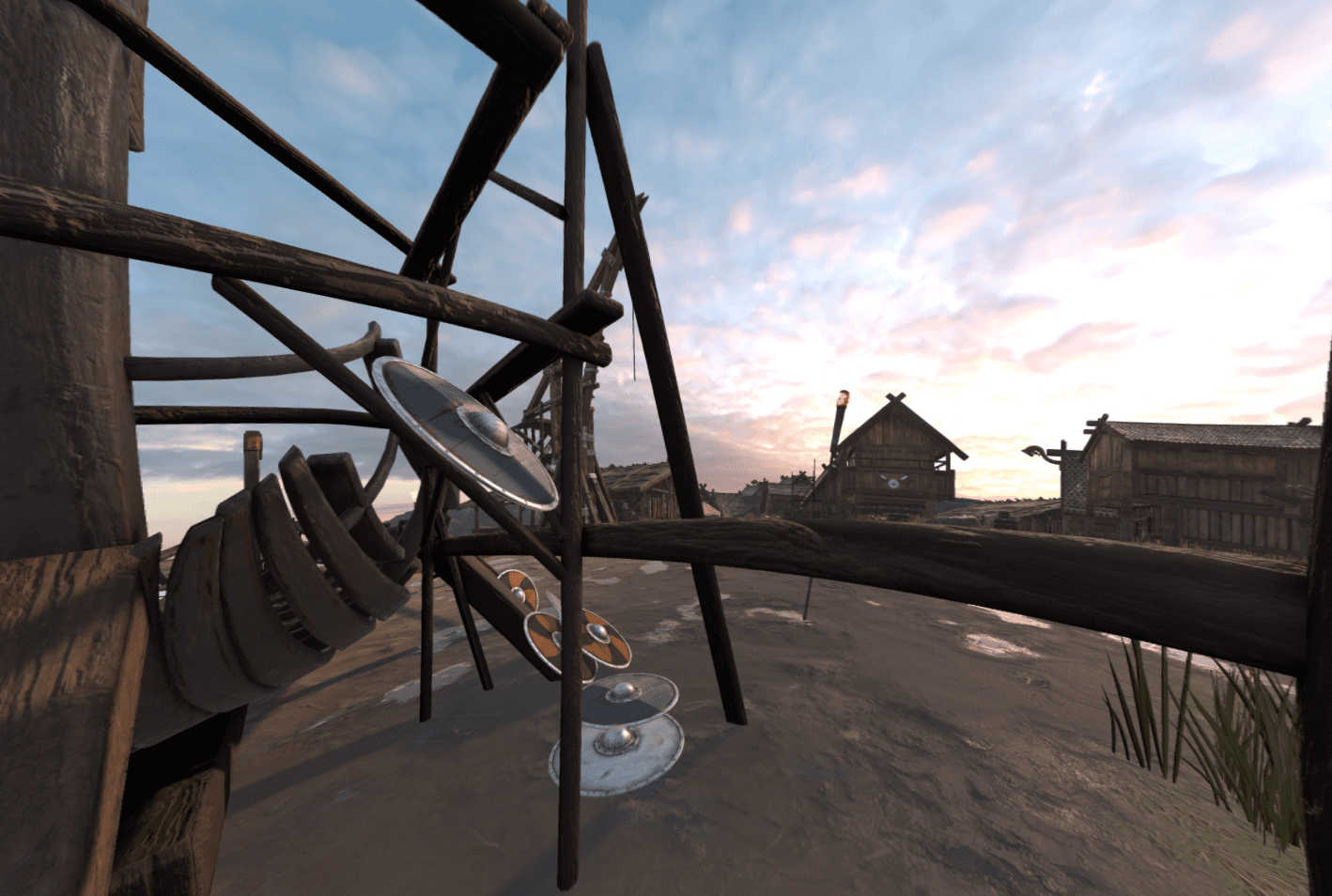
This image and the ones below are VRCHIVE snapshots from within virtual worlds.
Articulite
So far, however, the reality of VR has been limited to showy demonstrations of yet-to-be-released software, a few simple games, and blocky virtual worlds to walk through. Locally, a few companies have popped up to change that while making VR potentially Hawaii’s next big thing.
Virtual reality is the concept of using software to create simulated worlds in three dimensions. In many cases, it involves wearing a headset that immerses you in the simulated world so that everything you see exists only as images created by software. It puts you inside of a game or movie or world. You have the ability to look around, in all directions, and walk or fly or interact with objects. Companies even envision users wearing gloves that contain sensors so that your hands can manipulate, and even feel, virtual objects.
While most of the money seems to be focused on gaming, you can imagine a doctor putting on a VR headset and “walking through” a patient’s stomach to get a close-up view of an ulcer. Or, imagine an engineer getting to walk around, open the door, sit in, and drive a new car years before it’s ever manufactured. Games, however, open up the concept of entertainment and virtual worlds designed purely for recreation.
In Hawaii, the biggest VR news of late has been around local firm Total Recall Development claiming that Oculus Rift ripped off its technology and used it as the basis for its own hardware. But another company, VRCHIVE, is looking to get in on the VR wave by staking a claim to a simple idea that involves some complex computing.
“We’re trying to build the ‘street view’ of the metaverse,” said Kai Kau, founder of VRCHIVE, which is based in Honolulu.
In a nutshell, VRCHIVE lets you take a snapshot from within a virtual environment and share it with people outside of that virtual world. It’s Flickr for VR. Sounds simple, you might be thinking, but remember that VR is three-dimensional, so the snapshot has to be 3D as well (or, at least give the impression of 3D, similar to the stereoscopic View-Master toy you used as a kid). Think about Google Map’s street view, where you can look up and down and all around from any spot on nearly any street. VRCHIVE allows you to do the same, but you’re snapping that picture from within a virtual world. It’s not just a simple, flat, square image.
You can view some examples of VRCHIVE’s VR photos at alpha.vrchive.com.

Aaron Priest
“Three-dimensional VR is the future of the Internet. It’s the future medium that we’ll be interacting with, walking through, and playing games inside,” continued Kau. “Just like the real world, people are going to want to take pictures. Our software lets them take a 360-degree picture that they can then share outside of the virtual world.”
That sharing outside of the virtual world is where VRCHIVE’s technology shines.
“Everyone has a cell phone, but not everyone will initially have a VR headset,” he added. “Our software will allow anyone to see inside that virtual world using their phone or web browser.”
Kau started VRCHIVE about two years ago. He was an early backer of Oculus Rift on Kickstarter, way before its $2 billion acquisition, and became one of the first, if not only, owners of a VR headset in Hawaii. In true geek spirit, his first thought wasn’t to develop new VR apps.
“Once I got the headset, I made sure everyone knew about it,” Kau said proudly. “But no one knew what to do with it or what it could do. I even started the Hawaii Virtual Reality Club to get more people involved and talking about VR locally.”
Kau looked at some of the early VR software and was underwhelmed with the “pixelated and blocky” images and video that stuttered and froze. The more he saw, the more he wanted to build something better, so he started his company and got to work.
“We’ve been live and letting people test it for about two years,” said Kau. “We haven’t gotten any negative reviews yet, so we’re focusing on quality before we launch.”
VRCHIVE is currently enrolled in Blue Startups’ accelerator program, which ends in a few weeks, and plans to launch publicly shortly after that. Other than Blue Startups’ $20,000 investment, VRCHIVE is totally self-funded. The most impressive part of the backstory is Kau himself: He’s been coding since age 12, attended the Johns Hopkins Center for Talented Youth, augmented his popularity in high school by developing software that helped him and his friends circumvent the school’s web filters, and skipped college.

Wormslayer
But Kau doesn’t look backwards. He’s focused on the future.
“Our next step is to monetize,” Kau mentioned. “It’s free to use now, and we’re adding a donate button soon. The way I see it, if people don’t like it, then I’m doing something wrong.”
With most of the VR focus on gaming, VRCHIVE plans to launch with support for “a few games” and the ability to be used across hardware platforms. So, whether you’re playing on an Oculus Rift or an HTC Vive or some other VR headset, VRCHIVE will work.
After launch, Kau says that VRCHIVE won’t just be limited to pictures, but admits that moving to other areas, especially VR video, is a complex computing challenge. Since VR generally runs at 90 frames per second (which is three times that of standard video), there are usually six camera views to be stitched together, and there’s a different video stream for each eye, the amount of computing power and storage is daunting. Another startup, Vrideo, based in Southern California, is already working on immersive videos that offer 360-degree, stereoscopic views.
But yet again, Kau is only looking forward.
“This VR technology is what my kids and grandkids will be using,” said Kau. “They won’t be playing games on phones and working on laptops. They’ll be doing it in virtual worlds. I’m doing this to make my mark on that future, to make my mark on the world, and to do something cool.”
You can see VRCHIVE present at Startup Paradise Demo Day, which takes place Friday, from 3 p.m. to 6 p.m. at YWCA of Oahu. Tickets to the demo day are $25.