

Curt Sanburn: ‘Stripped-Down Hotels’ Are Popping Up Like Weeds
As Hawaii’s first crop of branded limited-service hotels takes shape, some are worried they’ll limit jobs — and the aloha that makes Hawaii famous.
In late June, Laie’s new 144-room, three-story hotel, prominent on Kamehameha Highway and officially named the Courtyard Oahu North Shore, will open its air-conditioned lobby and lanai-less, motel-style rooms to paying customers — and to about 20 full-time managerial staffers and 30 part-time workers, students from Brigham Young University-Hawaii’s hospitality program.
The building, designed by AE Urbia Architects of Salt Lake City, presents its low-slung profile to passersby on Kam Highway under a gently pitched roof with deep eaves. The sand-colored facade is a not-unpleasant series of projecting and receding bays, all of it resting on an exaggerated stone-dark base that is, in fact, the first floor.
The Laie hotel, which replaces the old Laie Inn, a Maori-flavored McDonald’s and a gas station, is the most apparent among Hawaii’s new breed of smaller, off-the-beach, non-resort hotels popping up — or planned — at some of Hawaii’s most unlikely visitor destinations.
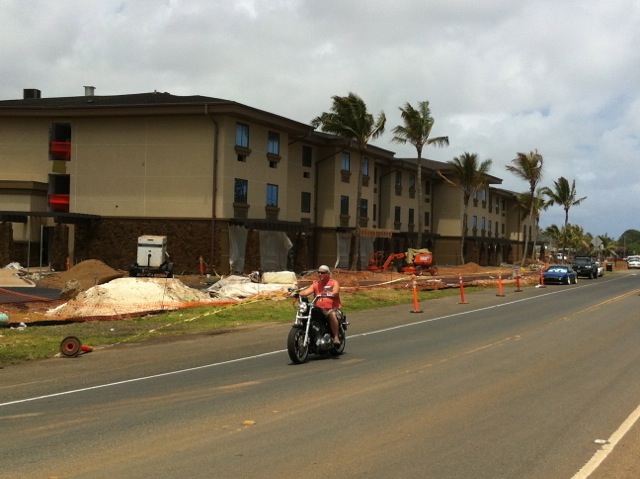
The new Courtyard Oahu North Shore takes shape in Laie.
Curt Sanburn
In industry parlance, these are known as “limited service hotels” (LSHs), which usually means no restaurant, beverage, or room service; minimalist rooms; few bellman and concierge services, etc. — and significantly lower labor costs per dollar of revenue.
LSHs are ubiquitous on the mainland: cookie-cutter, WiFi’d shoeboxes in their parking lots clustered around freeway interchanges, suburban office parks and airports, the spawn of long-gone Holiday Inns and Howard Johnsons branded to a fare-thee-well. And they might just be one of the things — along with AirBnBs and other illegal short-term rentals — that finally erase what’s left of traditional boundaries between local and tourist Hawaii.
So far, there are at least six built and planned LSHs to consider (including the Laie Courtyard). Three years ago, the 138-room Courtyard by Marriott Maui Kahului Airport hotel opened near Costco in Kahului. Not to be outdone, Honolulu International Airport reportedly will soon be getting a 15-story, 247-room Courtyard by Marriott.
The developer responsible for Kahului’s Marriott (it gets raves on Yelp!), R.D. Olson of Irvine, California, specializes in LSHs nationally. According to news reports and its website, Olson has plans for at least two more in Hawaii. A 150-room Residence Inn by Marriott to be located at the $500 million Ka Makana Alii mall development in Kapolei on Oahu, and another 200-room Residence Inn is set for an inland parcel at South Maui’s Wailea resort. Reportedly, Kapolei’s new mall will also be getting a second LSH, a 175-room Hampton Inn, in 2016. As the online travel news site TravelPulse.com boasted depressingly, “Hawaii will become the last state in the United States to feature a Hampton hotel.”
Honolulu’s Kakaako transit-oriented development plans include room for three LSHs, while initial planning for Castle & Cooke’s massive Koa Ridge development in Central Oahu has talked about at least one.
Opening the floodgates a little wider still, in 2013, the Honolulu City Council unanimously loosened permit requirements for hotels with fewer than 180 rooms, provided they’re on land zoned BMX-3 (Business Mixed Use — for example, the King/Beretania corridor) and are located within central Honolulu, on the Ewa plain, or in Central Oahu. On May 1, 2013, Mayor Kirk Caldwell signed Bill 75 into law.
‘Select Service Property,’ Limited Service Hotels
“We call it a Select Service property,” Dave Betham, the Laie hotel’s newly installed general manager, tells me as he takes a few minutes out of his hectic schedule to give me a quick tour, even though interiors aren’t finished and construction gear and mattresses, still in their boxes, clog the hallways and rooms.
“The Courtyards are called that,” Betham explains, “to differentiate them from other Marriott hotel products. It means we don’t have all the bells and whistles of a full-service property — no bell desk, no room service. Other chains have similar properties. For example, Double Tree and Hampton Inn are two Hilton products.”
In the hotel’s backyard, the pool deck is wrapped by lawn and fresh plantings — Manilla and loulu palms, ti, plumeria, monstera. A free-form pool features a lava-rock waterfall in the middle of it.
Betham points out the firepit with seating, off to one side. “Most Courtyards have similar features, just like the footprint of the property” he says, but the pool area is larger than usual: “Typically, Courtyards are for business travelers, but we expect to welcome more leisure travelers.”
Inside the glassed-in lobby area, between the porte cochère and the pool area, a bistro-style cafe and a Starbucks are in the works, as are media pods and an oversized TV for sports events. “Where’s the bar?” I ask.
“Um, we will not be serving alcoholic spirits, since Laie is dry,” Betham says, adding that the hotel is proud to be showcasing a large wave photo mural by late artist/surfer Jon Mozo.
Both rooms and corridors are surfaced in pale, bilious shades of beige, green and grey, with dark, wood-like, built-in headboard units studded with electrical outlets. Windows are square sliders, centered in the walls, one per room, except for the seven, one-bedroom, “king suites” at the building’s corners.
“What you see here is exactly what will be replicated on each floor,” Betham says as we walk the narrow, still-un-carpeted hallways. He says the hotel, already in the Marriott reservations system, is taking reservations at room rates between $220 and $320 per night.
I ask him about himself. Has he been with Marriott long?
“This is my first opportunity to work for Marriott,” he answers.
Before that, the Samoa native was a reservations manager at the Polynesian Cultural Center and, before that, general manager of VIP Trans, an airport shuttle company. He says he’s happy because his home is just blocks away in Laie town.
“We don’t have all the bells and whistles of a full-service property — no bell desk, no room service.” — Dave Betham, Mariott’s Courtyard Oahu North Shore general manager
With 144 rooms and 50 employees, the Courtyard Oahu North Shore — a name devised, no doubt, for Google search engines rather than felicity — has a worker-per-hotel room ratio of .35. By comparison, the nearby full-service Turtle Bay Hotel, with 377 non-managerial workers and 485 rooms, has a ratio of .77, or twice as much service, according to Ben Sadoski, chief researcher with UNITE HERE Local 5, a hotel and health care workers union with about 8,500 hotel workers, mostly in Waikiki, currently on its rolls.
In a phone interview, Sadoski acknowledges the attraction of LSHs, especially among wallet-watching and business travelers and among “the younger generation.”
And let’s face it, the idea of some uniformed grandee carrying your roller luggage and backpacks up to your room is antediluvian.
“Our union’s concern is that these stripped-down hotels lead to a loss of aloha,” Sadoski says. “Part of the reason people come here to Hawaii is not just for the beaches and scenery, but for the aloha spirit, which is something real and palpable. You know, people greeting you when you drive up in your rental car or when you walk into the lobby, a smile when you sit down to breakfast. All of that.”
Sadoski’s other big concern is that smaller staffs mean more work for each worker. “These hotels generate far less and demand far more for the communities they’re in,” he says.
In 2013, Sadoski and his colleague Ivan Hou co-authored a report for Local 5 called “The Goose that Lays the Golden Time Bombs — How Hawaii’s Changed Hotel Industry Threatens Our Futures.” They reported that employment at a cross-section of Hawaii’s unionized hotels declined 13 percent between 2005 and 2012, despite positive revenues in all but two of the years following the 2007 recession.
They attributed this decline in service to a transformed hotel business, now mostly controlled by private equity firms and real estate speculators (as opposed to free-standing hotel companies) looking for short-term cash at the expense of long-term viability.
The second factor cited in the report is the “changing lodging product.” In 2011, they reported, little-or-no-service condotels, timeshares, individual vacation units and LSHs made up 42 percent of Hawaii’s hotel inventory, up from 26 percent in 2000.
“It is up to the citizens of Hawaii,” Sadoski and Hou wrote, “to create the home we want for ourselves. The current system rewards short-term investment and development strategies even as they hurt Hawaii’s people. If we are to build a more sustainable state, we need to recognize the problems we face, organize as a common group to move Hawaii’s political leaders to take appropriate action to regulate the industry to protect and support working families statewide and the viability of tourism.”
Impact of Tourism Policy on Hawaii
The reason I’m alarmed about these mainland-branded, generic, non-resort hotels suddenly popping up in mauka lands is that I thought the state had long ago decided to focus on high-end tourism and make visitors pay through the nose for the privilege of being in what is Earth’s one true paradise, thereby enriching the lives of those who are from here and who live here.
In his 2008 book, “Developing a Dream Destination: Tourism and Tourism Policy Planning in Hawaii,” UH Professor of Economics James Mak traces public reactions to Hawaii’s explosive tourism growth in the 1960s and ’70s.
In 1972, as tourism reached 1.2 million visitors per year (it’s now hitting 8 million), a survey of residents’ attitudes commissioned by the Hawaii Visitors Bureau showed 63 percent felt the amount of tourism was just right, or should be cut back. In a speech in 1973, HVB Chairman William G. Foster urged that “the State act to control the growth of tourism.”
In 1976, the Legislature passed Act 133 calling for a state plan that would, according to Mak, “guide future tourism development that would meet the needs of both tourists and residents and at the same time protect the environmental, social, and cultural resources of the state.”
The state’s tourism plan, one of 12 functional plans, was finally enacted into law in 1980. In it, nine state tourism policies were enumerated. Policy No. 2, “Meeting the Social, Economic and Physical Needs of Hawaii’s People,” included seven implementing policies. The first of these was to “Give preference to the development of full-service hotels over other types of visitor accommodations.”
But, as Mak explains, the 1992 Gulf War led to a period of economic stagnation in the mid-1990s, which led to more state action, including creation of the hotel tax-funded Hawaii Tourism Authority in 1998. The agency, peppered with tourism executives, produced its first internal strategic plan in 1999, with three goals, including increasing visitor spending per person per day.
As Mak notes, this goal represented a stark departure from previous tourist policy, which was simply to maximize visitor numbers.
As Mak writes, “Ultimately, attracting higher spending visitors requires Hawaii to produce a higher quality tourism product, which means developing luxury resorts instead of budget or standard quality hotels.”
See? I’m not crazy!
The reason I’m alarmed about these mainland-branded, generic, non-resort hotels suddenly popping up in mauka lands is that I thought the state had long ago decided to focus on high-end tourism.
So, I wanted to talk to someone at the HTA involved with steering the industry and riding herd on policy questions that might require legislation and regulation. In light of this sudden profusion of lanai-less and soulless motels, I wanted to understand when and if basic state policy had changed.
I contacted their high-powered public relations firm, Stryker Weiner, to ask to talk to someone. With a few days’ warning, the HTA couldn’t find anyone to talk about LSHs, so instead its PR people sent me a statement via email, “attributable to George Szigeti, president and CEO of HTA, in regards to your story.”
Here it is, verbatim: “The Hawaiian Islands offer a wide selection of lodging options for visitors who seek different experiences while in Hawaii, and the development of new hotel accommodations, including limited-service hotels, help to enhance the long term sustainability of our visitor industry and our local economy.
“Newly built limited-service hotels and projects planned for the future, offer alternative lodging options for visitors, as well as for kamaaina traveling between the islands for business, sporting events or to visit family and friends.”
On the occasion of the publication of Professor Mak’s book “Developing a Dream Destination” in 2008, the author gave an interview to then-Pacific Business News reporter Chad Blair during which Blair asked Mak to evaluate the leadership of the HTA.
This is most of what Mak had to say: “Since the leadership of the HTA comes largely from the visitor industry, and the focus of HTA has been promoting the growth of tourism, what happens when the interests of the industry come into conflict with the interests of the community? The majority of the people — or at least respondents to the annual surveys of resident reactions — now think that the interests of the industry are given greater priority than their interests.”
Sure, it’s eight years later, but really, what has changed?

