More Hopeful Signs From the Capitol Regarding Homelessness
The appointment of Scott Morishige as the new state coordinator on homelessness is the latest bit of good news from a governor suddenly engaged in the issue.
In the 2½ weeks since the Governor’s Leadership Team on Homelessness has been formed, we’ve seen exactly the flurry of action one would hope from the group of senior leaders Gov. David Ige assembled for what he’s described as an “unprecedented” effort to tackle one of Hawaii’s most troubling and persistent challenges.
On Monday, following the group’s third weekly meeting, Ige named Scott Morishige the new state coordinator on homelessness. As Civil Beat’s Rui Kaneya reported, Morishige is currently executive director of the Hawaii community group PHOCUSED, a respected advocacy organization for the poor and homeless. The appointment was announced at a press conference attended by U.S. Sen. Brian Schatz, as well as Honolulu Mayor Kirk Caldwell, Sen. Jill Tokuda and other members of the leadership team.
Ige is also expanding the coordinator’s office, so that Morishige will have up to three people working with him. Previous homeless coordinator Colin Kippen, who was in the role for four years, was hamstrung in an organizational structure that provided him only an assistant coordinator and virtually no budget.
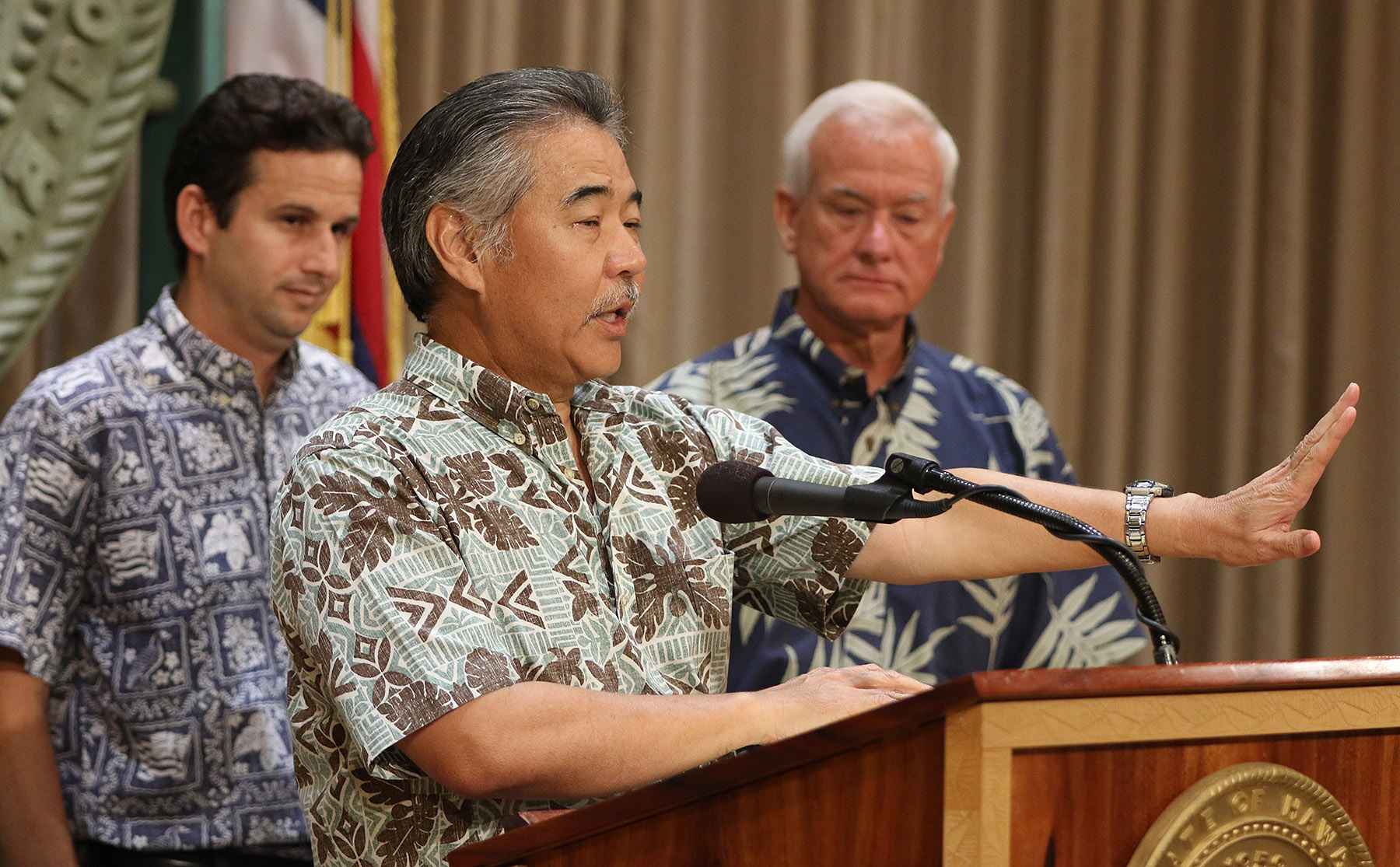
Gov. David Ige speaks while U.S. Sen. Brian Schatz, left, and Honolulu Mayor Kirk Caldwell listen during a press conference announcing the selection of Scott Morishige as the state homelessness coordinator.
Cory Lum/Civil Beat
Morishige’s appointment follows last week’s disclosure by the leadership team that two new properties are under consideration as potential temporary shelter sites: The planned site of the Liliha Civic Center (in Iwilei at the old Oahu railway station) and Kakaako’s Next Step homeless shelter, which would need to be expanded.
At the same time, Ige made it clear that the leadership team is still considering whether converting the former Hilo Hattie property on Nimitz Highway into a homeless shelter for as many as 800 individuals makes sense — an idea that was recently rejected by the Caldwell administration. The property may now have new potential, since its creditor has reclaimed the site and signaled the “potential to negotiate a more fair lease,” according to Caldwell.
Schatz’ participation came less than two weeks after he and fellow Hawaii delegation members cheered the U.S. Department of Housing and Urban Development’s announcement of nearly $14.3 million in new funding to address the state’s homelessness and affordable housing crisis. Schatz said he’s continuing dialogue with HUD officials and advocating making more use of HUD’s expertise in tackling Hawaii’s issues.
Good news, all. After months of collective stumbling about in the dark on homelessness, it’s as though Ige has turned on the lights for his fellow state and city leaders. Bringing senior officials from various government branches together not only sharply cuts the level of bureaucratic process required to move essential decisions forward, it forcibly circumvents a silo mentality that too often defeats work that is much more effective when it’s collaborative and shared.
Unfortunately, the Honolulu City Council’s disjointed efforts on homelessness continue to complicate the matter on Oahu. The council’s ill-advised expansion of controversial bans on sitting and lying on sidewalks in select areas of Honolulu continues unabated. The initial sit-lie ban served as a catalyst for the rapid expansion of homeless encampments in Kakaako and the Kapalama Canal, causing much of the crisis that the leadership team is responding to now.
After months of collective stumbling about in the dark on homelessness, it’s as though Ige has turned on the lights for his fellow state and city leaders.
But council members seem to have learned little from that historical lesson, overriding a mayoral veto to significantly expand the bans in June, and voting last week to extend the bans to a pair of Honolulu shopping malls.
Caldwell doubts the shopping mall bans’ legal viability and is “unlikely to sign” the bill, according to his spokesperson, but he supports yet another ban passed by the council last week outlawing camping along city streams. That measure is intended to get at the encampment along the Kapalama Canal, though exactly how is a mystery, since the city has no more temporary shelter for the homeless in hand than it did when it passed the original sit-lie ban last fall. Though the city is moving forward now on a temporary shelter on Sand Island that would house up to 87 people at a time, it will be months before that space is ready.
Legal doubts about the sit-lie bans likely grew further last week when the Obama administration pronounced similar laws unconstitutional in a U.S. District Court filing in Idaho. In that matter, the Obama administration said the City of Boise’s “anti-camping law” that bans sleeping in public spaces punishes “conduct that is a universal and unavoidable consequence of being human,” violating the Eighth Amendment.
“Sleeping is a life-sustaining activity — i.e., it must occur at some time in some place. If a person literally has nowhere else to go, then enforcement of the anti-camping ordinance against that person criminalizes her for being homeless,” said the filing in part.
If the sit-lie bans don’t fall to legal challenge, the recent expansions could cause further complications by herding the homeless en masse into other neighborhoods. City Council members who support the bans say they’re only being responsive to concerns expressed by their district constituents. That’s a particularly cynical variety of leadership, in our opinion.

Scott Morishige
He begins work Aug. 24, and if the past 2½ weeks are any indication, he’ll need to be ready to hit the ground running.