Finally, a Better Approach to Homeless Sweeps in Kakaako
Next week’s plan to humanely and responsibly move 25 homeless people to shelter sets a standard for how our homelessness challenge must be met.
After a 10-month break from enforcing Honolulu’s property storage and sidewalk nuisance ordinances in Kakaako, the city will resume its sweeps on Tuesday in a limited area around the Hawaii Children’s Discovery Center.
Mayor Kirk Caldwell quietly halted the controversial enforcements late last year as criticism mounted of the city’s handling of homelessness. The ordinances and related sweeps, along with sit-lie bans passed last fall, were blamed for swelling homeless areas in Kakaako, along the Kapalama Canal and elsewhere, as the city ignored warnings and put them into effect without first identifying temporary housing for those displaced by the laws.
Kakaako saw some of the worst effects, with homeless encampments of more than 300 people on sidewalks near the Discovery Center and the University of Hawaii’s John Burns School of Medicine. Without a place to go, homeless individuals caught in the sweeps often simply watched city crews bag up their trash and unneeded belongings and then they came back to resettle in the same places as soon as officials left.
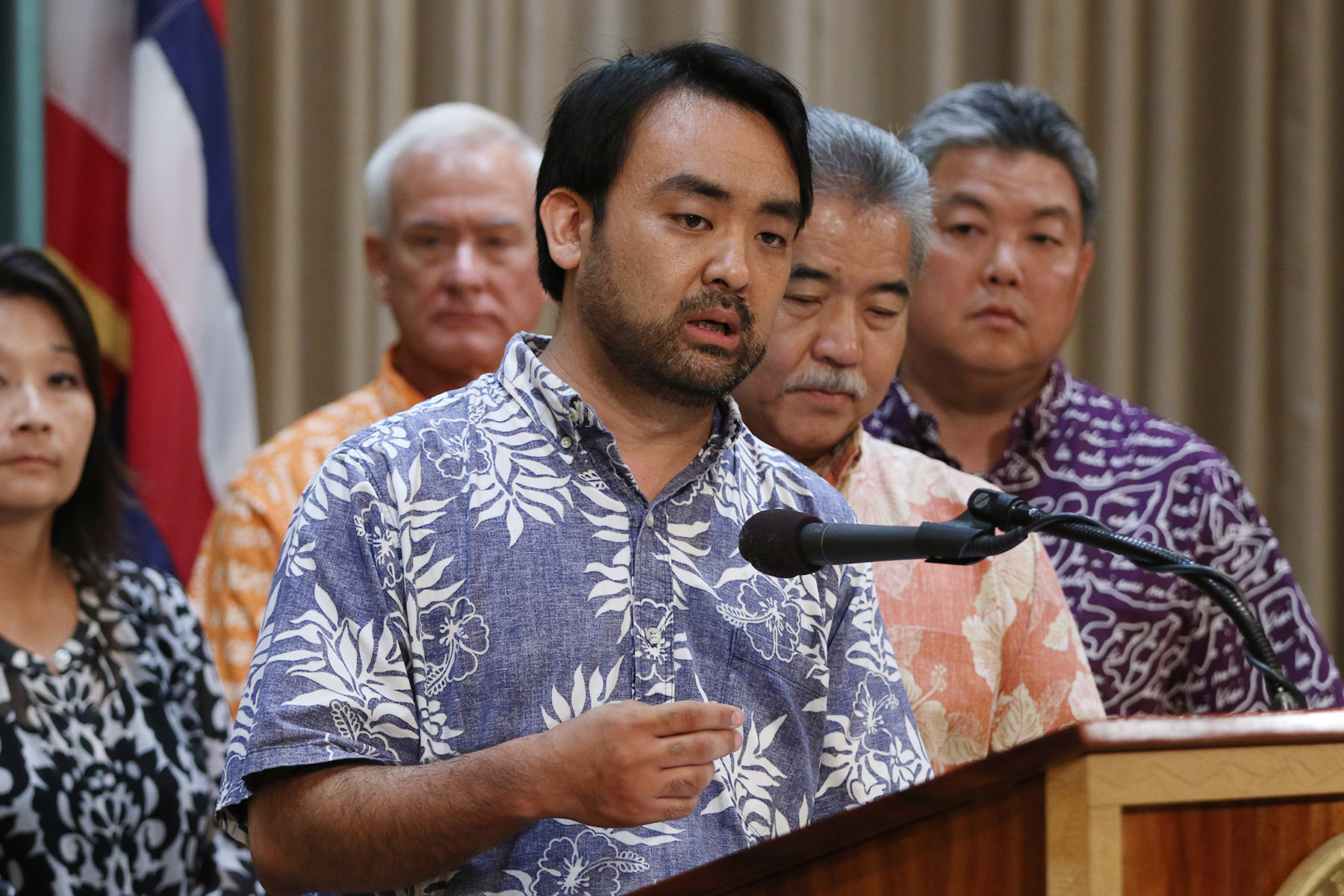
Scott Morishige, State of Hawaii homelessness coordinator, speaks to media during a press conference from the Governor’s Leadership Team on Homelessness.
Cory Lum/Civil Beat
The new enforcement actions, if executed as the city promises they will be, make more sense. Here’s why.
- They’re focused on a specific area and on a small number of homeless individuals. Officials will only be acting inn the area around the Children’s Discovery Center at Ohe and Olomehani streets, where staff have reported ongoing problems with people defecating and littering on their property. Officials plan to move about 25 people from that area.
- Temporary housing has already been identified for those to be displaced. Each of the 25 will have a shelter bed, if they choose to accept it, and proximity to services that could help them access long-term housing, potential employment and other services.
- Advance warning has prepared those to be affected for the disruption. Messages were posted around Kakaako earlier this week in Chuukese, Marshallese, Samoan and English letting people know about the Sept. 8 enforcement date.
These are the sorts of actions that flow from a team approach guided by respect of the basic human dignity and worth of each person struggling to get by without a home on our streets. They represent a departure from previous sweeps where concern seemed to stop with basic enforcement of the law, whether that actually solved any of the individual challenges causing folks to be camped on city sidewalks.
It’s no accident, of course. The Governor’s Leadership Team on Homelessness has mostly taken charge of new governmental actions on Oahu on homelessness, and the governor himself asked Caldwell to postpone further sweeps in Kakaako until more shelter space could be identified. Caldwell worked with Ige’s newest appointee, state Homelessness Coordinator Scott Morishige, to find temporary housing in advance of this proposed enforcement, preparing next week’s focused sweep for success.

The Children’s Discovery Center in Kakaako. Targeted enforcement of property storage and sidewalk nuisance ordinances will take place around the center next Tuesday.
That would mean putting roofs over the heads of about 300 people, according to a survey of the area taken in late August, or about 6 percent of the 4,900 homeless people estimated to be living on Oahu in the annual homeless point-in-time count undertaken last January.
It may sound like a small drop in a large bucket, but such is the enormity of Hawaii’s homeless challenge. It will not be resolved through big, broad efforts, but in bits and pieces, understanding that each homeless person and homeless family are, after all, people, with individual circumstances and needs that must be evaluated and dealt with if we are to make sustainable headway.
Morishige gets that reality, and appreciates that the success that the leadership team is having thus far on Oahu is due to the coordination it has facilitated between team members, service providers, community stakeholders and government departments. Said Morishige, “This is a model that we want to replicate in other areas of the island.”
Morishige has been on the job for less than a month, but is already proving the benefit of having an individual in this role with deep, respected experience working with Honolulu’s homeless challenge. We expect his impact will grow as the governor further builds out this position, with the additional staff and budget promised when Morishige was appointed.
Larger challenges lie ahead for the leadership team, including determining which of the growing number of temporary shelters currently under consideration are actually developed, making good on Honolulu’s commitment to end veteran homelessness and, biggest of them all, confronting the scarcity and costliness of housing that make Honolulu’s homelessness problem so resistant to solutions.
As the leadership team develops its action plan and moves modest, early initiatives forward, we look forward to the sustained improvement in Hawaii’s homeless situation that this new approach increasingly seems poised to deliver.