Schatz Holds Keys to Hawaii’s Tech Industry, Business Growth
Without the infrastructure to support better service, our business environment is at risk. But Sen. Brian Schatz is in a position to help.
When you hear the phrase “tech hub,” cities like San Francisco, Austin, New York and Boston come to mind. But an unexpected hub here in our island state is catching up, and its tech sector has a chance to help spur economic growth in Hawaii.
Hawaii currently ranks sixth in the nation for the number of tech workers who are self-employed, and our state’s tech industry employs more than 15,000 people. Add that to the 1,984 tech companies on the island, and we’ve risen in the ranks as a viable option for start-ups, entrepreneurs and technology innovators and investors. We are not and will never be Silicon Valley, but the recent success of some technology companies here is impressive.
Access to the Internet is a crucial component in expanding Hawaii’s tech sector, and ensuring businesses continue to settle and grow here. It is not easy given where we sit, but we are making progress there, too. As a tech business owner, I rely on constant and uninterrupted Internet access to keep my operation running smoothly, whether at my desk or on my smartphone.

Yet on the wireless side of things, everything depends on a finite resource known as spectrum, and with 71 percent of Hawaii business people using more than one device at a time to access the Internet, it is in seriously high demand.
While Hawaii is ranked third in the nation for broadband adoption, most of the state’s consumers subscribe to lower-tier service options that put us at the bottom of the pack for adoption of high-speed Internet. According to a 2014 report from Hawaii-based consulting firm SMS, this type of deployment “provides little business incentive for providers to invest in infrastructure that can support speeds comparable to that of leading nations in the world.”
Yet as our demand for higher speed broadband services grows, so do our state’s efforts to foster deployment of broadband infrastructure that makes us a desirable candidate for companies to invest in and a place for entrepreneurs to settle. Without the infrastructure to support better service, Hawaii will struggle; without a strong mobile network, we run the risk of deterring future investment.
This is a real fear for business leaders who see Hawaii’s potential as a vibrant business destination.
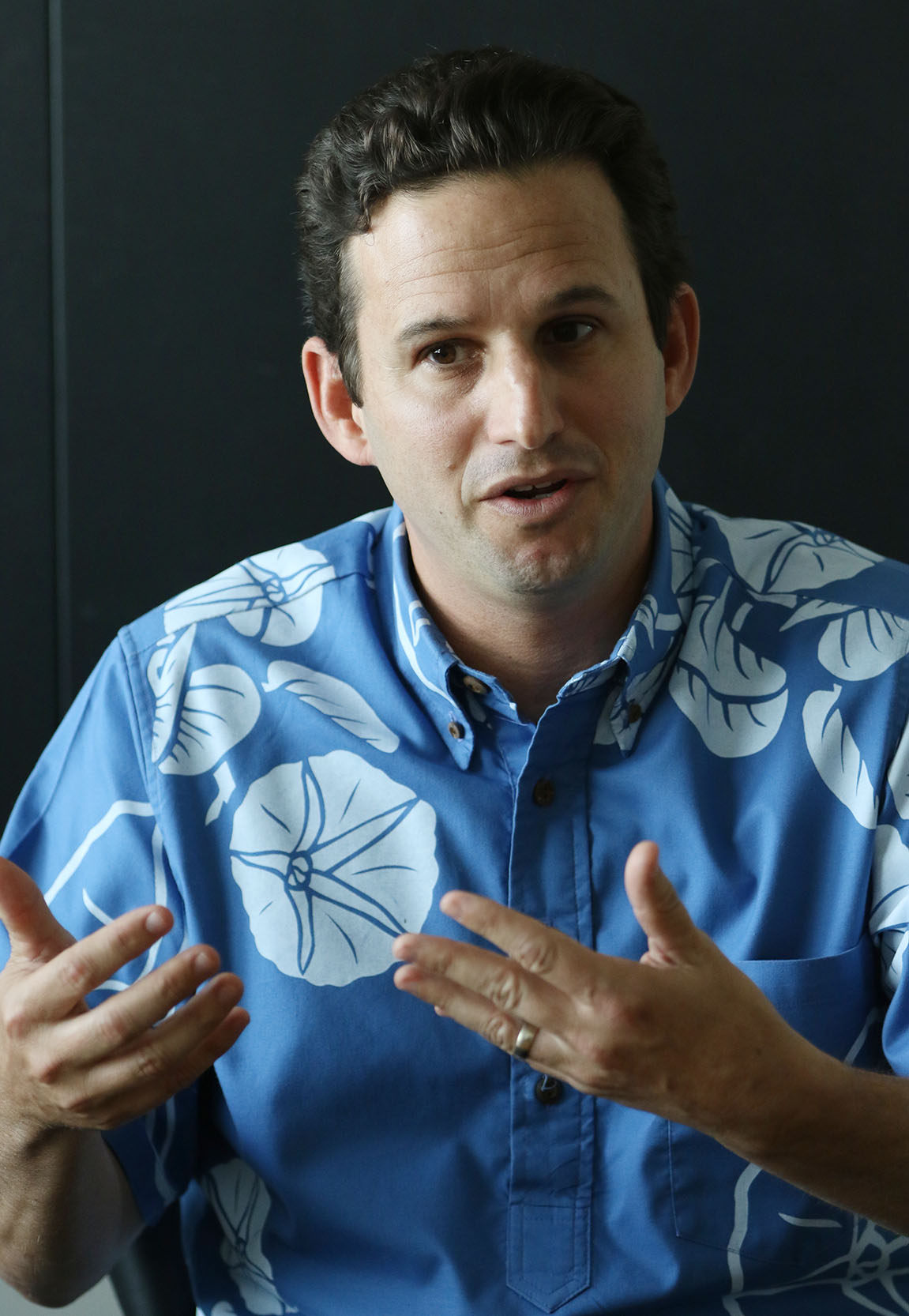
Fortunately, as a member of the Senate Committee on Commerce, Science and Transportation, U.S. Sen. Brian Schatz is in a position to help the continued growth of our Internet ecosystem.
In a recent letter to Schatz, a group of local business and technology leaders — myself included — applauded his “continued leadership in overseeing and crafting technology and communications policies as the Internet reshapes communications, the economy and numerous other industries.”
Still, despite Congressional efforts both here and on the mainland, reports show that wireless networks are spread far too thin, and, as the letter explains, “without bringing more of these invisible airwaves to the private market, the ‘new normal’ of the connected work we enjoy could soon be compromised.”
In the next four years, demand for mobile data is expected to increase more than six-fold. We need a comprehensive legislative approach to free up additional spectrum to meet the ever-growing demand for mobile services.
The solution lies with the government, which currently controls as much of 70 percent of the spectrum that would be prime for commercial wireless use. An opportunity exists for Congress to work hand-in-hand with various federal agencies to identify and reallocate some of that spectrum to better serve the ever-growing wireless ecosystem.
Unlike so many issues that go nowhere in a dysfunctional capital 5,000 miles away, the reallocation of government spectrum is neither partisan nor ideological.
In a recent interview with Politico, Schatz said, “There is both enough spectrum to be reallocated and enough revenue on the table that if we make an arrangement where some of the revenue generated is provided to the Department of Defense in order to alleviate sequestration, then there’s an opportunity for everyone to benefit here.”
Unlike so many issues that go nowhere in a dysfunctional capital nearly 5,000 miles away, the reallocation of government spectrum is neither partisan nor ideological. Schatz can confidently work across party lines to advance a positive solution knowing that he is in no way betraying his Democratic colleagues.
Given the 13-year timeline to reallocate spectrum, there is no better time than now to begin acting. I hope Sen. Schatz will take a leadership role in advancing that solution in order to create a clear pathway to free up additional resources to meet Hawaii’s – and the country’s – increasing demand for mobile services.
Hawaii’s business owners don’t want to simply participate in today’s Internet-driven world; we want to thrive in it. And a comprehensive and aggressive legislative plan that frees up wireless airwaves will allow us to do just that.
 GET IN-DEPTH
REPORTING ON HAWAII’S BIGGEST ISSUES
Community Voices aims to encourage broad discussion on many topics of community interest. It’s kind of a cross between Letters to the Editor and op-eds. This is your space to talk about important issues or interesting people who are making a difference in our world. Column lengths should be no more than 800 words and we need a current photo of the author and a bio. We welcome video commentary and other multimedia formats. Send to news@civilbeat.org. The opinions and information expressed in Community Voices are solely those of the authors and not Civil Beat.