

Curt Sanburn: Discovering Architectural Delights And A Sense Of Place In Pawaa
An architectural tour of a few, tucked-away blocks of central Honolulu uncovers some of the best of mid-20th-century Modernism, Hawaii style.
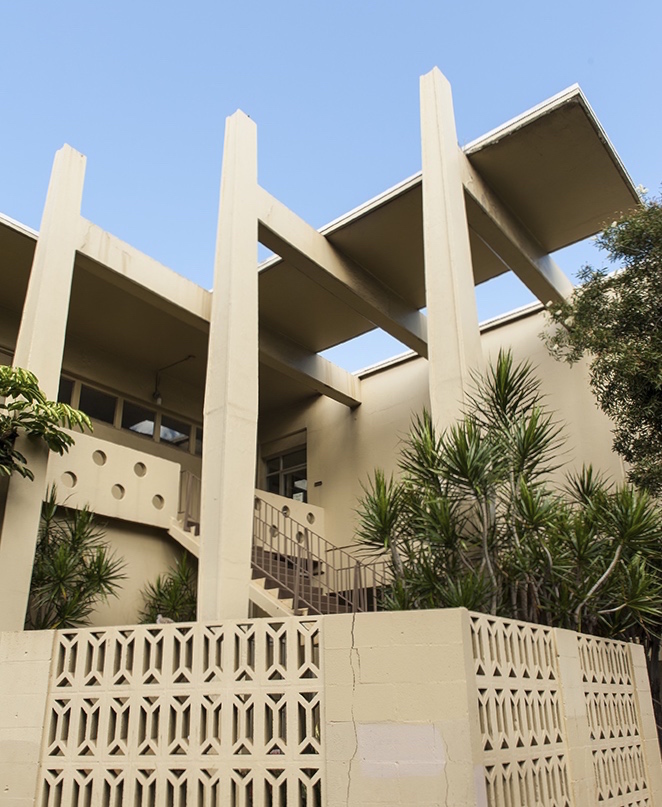
Fanciful holes punched into a thick concrete railing look like bubbles. A sculpted masonry support column — a splayed “H,” or an abstracted human figure reminiscent of a squat Hawaiian petroglyph — rises from a Japanese rock garden to support the landing of a simple exterior stairway. An inverted vee-shaped concrete awning that peaks above the roofline shelters another exterior stairway on the same two-story medical office building. It’s a small wonder of gestural insouciance.
These bits of expressive delight hide in plain sight among a jumble of low-rise medical-office and apartment buildings erected in central Honolulu’s Pawaa district in the ‘50s and ‘60s. They’re buildings we all know…and ignore.
Appreciating them took an organized architectural tour called “A Peek at Modern Pawaa,” presented in early October by a hui of local architecture buffs known as the Docomomo US/Hawaii chapter. The tour featured eight buildings, all within a compact, four-block area just makai of King Street and just west of its intersection with Kalakaua Avenue.
About 30 people showed up on a sunny Saturday afternoon for the two-hour tour. The event kicked off in the lobby of the Pagoda Hotel, on Rycroft Street, with an introductory talk by architectural historian Don Hibbard, who, with architect and author Dean Sakamoto, founded Docomomo Hawaii four years ago.
Hibbard explained how the landowner, the Bishop Estate, cleared the makai section of the Pawaa/Kaheka area of its cramped old lanes, wooden cottages and farms for redevelopment in the early 1950s, when the city widened King Street and removed the avenue’s old, wood-frame storefronts. The post-war, pent-up demand for convenient professional offices and homes quickly filled the void.
Docomomo Hawaii, part of the national Docomomo advocacy organization, now has about 60 members and more than 1,100 Facebook followers. The name is a contraction of the group’s mission, which is the “documentation and conservation of buildings, sites and neighborhoods of the Modern movement,” according to Alison Chiu, an architect with the Honolulu firm of Fung Associates and current president of the non-profit group.
“All the modern buildings in Hawaii, built in the post-war years through the mid-1960s when Honolulu grew so fast, are at least 50 years old now,” Chiu explained.
“There’s a lot of renovation and demolition going on, and we’re concerned about losing our prevalent building style from the statehood period. We want to raise awareness, study and document them, and treasure them, and just be a resource for people who want to learn more about them.”
“We’re concerned about losing our prevalent building style from the statehood period.” — Alison Chiu, president of Docomomo Hawaii
The group has put its photo archive online. The Pawaa “peek” was its fourth annual tour. Previous ones included a visual survey as seen from the top floor of the Capitol building, a tour of Kapiolani Boulevard’s “Miracle Mile” between Ward Avenue and Atkinson Drive, and a walk-around of Makiki’s cluster of post-war apartment buildings adjacent to Makiki District Park.
Architect Sid Snyder, the longtime business partner of the late, great Hawaiian modernist Vladimir Ossipoff, is one of the Pawaa tour’s six docents. The architect stood in front of the monolithic, 11-story Sandalwood Apartments, at 910 Ahana Street, and delivered a nuts-and-bolts mini-lecture about the innovative, pre-cast concrete building, designed by architect John Tatom in 1960.
He started by admiring the building’s strong vertical expression, its inset lanai, and the projecting “fins” at each corner that steel the building against the lateral forces generated by winds and earthquakes.
He talked about how the Sandalwood, built in 1963, was the first high-rise condominium in Hawaii; and how it’s a “single-load” structure with exterior corridors, because “they weren’t doing air conditioning then —the air just blew in one side of your apartment and out the other,” he said. “You control it with jalousies and windows.”
The stolid building’s floors and walls were assembled out of pre-cast slabs, engineered by Alfred Yee, a pioneer in pre-cast concrete construction not only in Hawaii, but around the world.
“He’s still around, at 90,” Snyder noted.
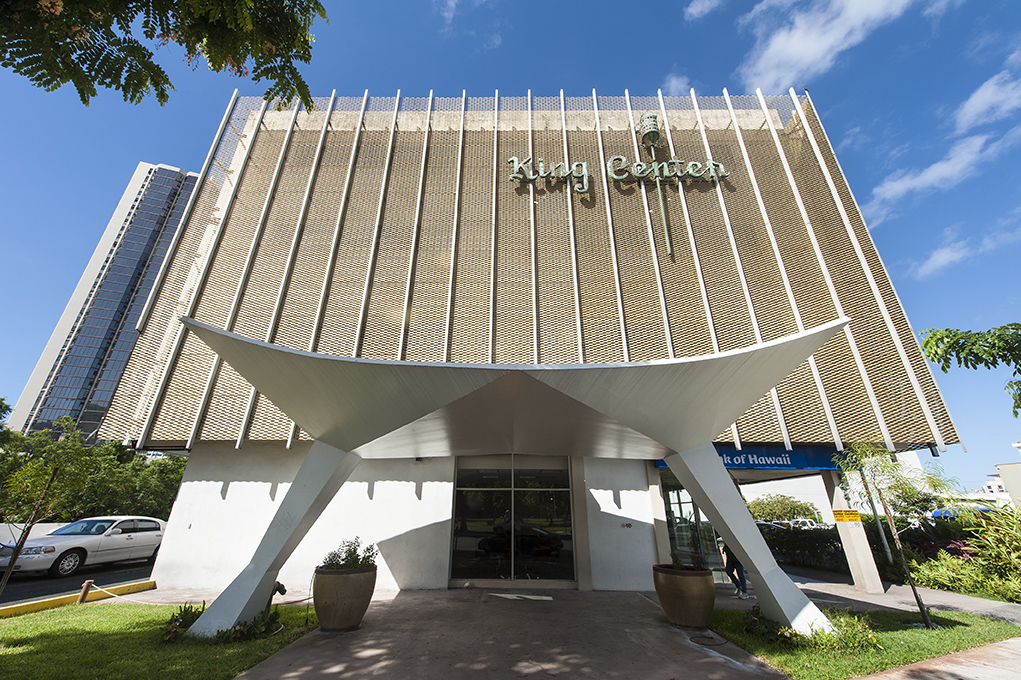
Next up was a five-story office building, the King Center, designed by Takashi Anbe in 1960. It’s that sort-of iconic, gold-anodized, offset cube of offices on the makai side of King Street.
Docent Julie Lam, an architect, pointed out the freestanding, expressionist concrete portico that seems to be dancing in front of the building on King Street. She led us into the glassy lobby to admire a sensational, abstract-expressionist ceramic mural by Isami Enomoto, the Honolulu ceramicist behind much of Oahu’s familiar — if disappearing — public-park signage and those brown, curly-cue, ‘70s glazed-tile wall panels at the airport.
A true modernist, Takashi Anbe was born in Wailuku in 1925, got his architectural engineering degree from Washington State University, and trained under the great Pete Wimberly. In addition to King Center, he’s also responsible for three other buildings on the tour, including the suave, low-rise Liona Apartments on Ahana Street, built in 1961, and a well-worn medical office building with an inconspicuous lava-rock frontage at 1532 Kalakaua Avenue. It’s this singularly modest building that showcases the flourishes I described earlier — the bubbles, the petroglyphic column, the vee-shaped awning.
All four Anbe buildings were designed for builder Herbert T. Hayashi, who put up several office buildings and apartments on acreage leased from Bishop Estate. Hayashi’s centerpiece, the Pagoda Hotel, was built around a pond off Rycroft Street by architect Hideo Murakami and engineer Harold Tanimura in 1964.
Other Anbe credits include the Astronomy and Plant Science buildings on the University of Hawaii at Manoa campus; the underground Honolulu Municipal Building Parking Lot, built in 1979; and the starkly elegant Maui Prince Hotel, built in 1986.
At the six-story Continental Hawaii Building on the corner of King and Kalakaua, docent John Williams brandished an enlarged, vintage photo of the Continental when it was new, before the ground floor was substantially altered. In the old photo (see the gallery), everything about the building is so schematic it looks like a crisp Bauhaus dream.
“I mean, it’s textbook Modernism,” the docent said. “It’s like, what’s the building about?” He went into some detail about the freestanding stairwell and elevator shaft pulled away from the building’s mass as its own vertical element.
“The building is intact, he said, “but they took out the contrasts of stone and glass on the first floor, so now it’s a monochromatic building.
“It could all be brought back.” — John Williams, Docomomo Hawaii board member
“It could all be brought back.”
Williams, a retired architect from San Francisco and avid historian who recently joined the Docomomo Hawaii board, noted that the Continental’s penthouse once had an ocean view; and that the attached, double-decked parking lot was a first in Hawaii.
After the tour, I talked to Graham Hart, a young architect who just got his doctorate in architecture from UH-Manoa. He’s now working at WCIT Architects in Honolulu, and joined Docomomo recently.
“It was awesome,” Hart told me, “a fun way to spend a Saturday afternoon. Granted, I’m an architectural dork.” He laughed.
What turned him on, I asked.
“How Docomomo found this little concentration of cool buildings that I’ve driven by a hundred times and never noticed,” he said. He cited the Asian- and tiki-inflected details on buildings like the Pagoda and 1523 Kalakaua, the use of lava-rock walls and A-frame motifs.
“The Modernism you find in Honolulu isn’t like the dry, International Style Modernism you find on the mainland,” he says. “It’s modern, but in a fun yet functional way that bridges back to pre-contact times.
“They didn’t rely on air-conditioning as much, so they used deep overhangs, outdoor stairs and corridors — cool design elements that are fun to look at but functional too.”
Fun, gestural buildings. Outdoor everything. Architectural insouciance. Gracious, mid-sized, modest housing designed for the trade winds. Indigenous materials…a real sense of place. Is it too much to ask?


