

Todd Simmons: Tulsi Gabbard Talks A Little Too Tough With Bill Maher
Hawaii’s second-term congresswoman didn’t mince words last Friday night on HBO. But as her national appeal grows, so does the importance of how she expresses herself.
By political standards, U.S. Rep. Tulsi Gabbard’s rise to national fame has been nothing short of dazzling. Since her improbable landslide win three years ago in the Congressional seat she was re-elected to last fall, she has combined a singular personal story with a charismatic, telegenic appeal that has now turned her into media gold from coast to coast.
The Honolulu Democrat was in the national spotlight once again Friday night as the lead guest on HBO’s long-running hit show, Real Time With Bill Maher. Gabbard quickly showed why she’s become such a force, one who seems to be able to speak provocatively and challenge party orthodoxy without any outward signs of significant repercussion.

Within the show’s first three minutes, she had called out Democratic presidential frontrunner Hillary Clinton as a regime-change loving interventionist and “cheerleader for the Iraq war when she was in the Senate” and accused the Obama administration of “working hand-in-hand with the Islamic extremists” trying to overthrow Syrian dictator Bashar al-Assad.
Did I mention that she’s vice chair of the Democratic National Committee? The one that works to get Democrats elected?
It’s hard to think of anyone else in party leadership who might survive such a public discussion, much less thrive. But then again, who else can claim to be one of the first two female combat veterans elected to Congress, the first Hindu and first American Samoan in Congress, and an articulate, ambitious 34-year-old who consistently shows up on Washington “most attractive” and “best dressed” lists to boot?
It’s no coincidence that her rise comes at a time when politicians such as Bernie Sanders and outsiders like Donald Trump and Ben Carson are enjoying unprecedented success. The public hunger for candor and authenticity today is such that candidates and electeds are often rewarded for blunt, critical rhetoric whether it rings true or not, so long as it lays waste to conventional wisdom (looking particularly at you, Mr. Trump). Gabbard satisfies that hunger, typically with well-grounded ideas and positions.
In Maher, Gabbard found a kindred spirit — an opinionated, left-of-center critic with a megaphone who enjoys poking unexpected holes in pretense and sticking a thumb in the eye of authority. He seemed genuinely surprised that Gabbard was as ready to be critical of Democratic leadership and current U.S. actions in the Middle East as he was, even prefacing his first question about Clinton’s opponents with, “Let me ask you a question I know you won’t answer.”
“Here is what I’m concerned about, Bill, is that we end up in November of next year with the frontrunner, Hillary, and many of the Republican candidates that we’re seeing who are essentially interventionists,” she said, “and who are taking positions that will put us in yet another position just as we’ve seen over the last decade of getting into a regime-change nation-building mission, which is essentially what they’re advocating for right now.”
She proceeded to offer persuasive arguments about the shortsighted focus of U.S. foreign policy in the Middle East. Sure, Saddam Hussein, Muammar Gaddafi and Bashar al-Assad were/are all bad guys, but pushing out Hussein and Gaddafi only led to chaos. Doing the same with al-Assad risks Syria falling under ISIL control.
“It will open the door wide open for them to come in and take over some very superior weapons,” said Gabbard.
Islamic Extremists, Part II
Maher also shared Gabbard’s well-known predilection for blunt talk when it comes to those driving armed conflict and bloodshed throughout the Middle East, with both incredulous that some still resist using the phrase “Islamic extremists.” For a few moments, it sounded like early 2015, when Gabbard was widely panned (including by Civil Beat) for her sharp, relentless criticism of President Obama for his refusal to use the phrase.
That period represented a rare PR stumble for Gabbard. While she’s largely backed away from lecturing the president over word choice, she chose a curious anecdote to prove her point about extremism and how different things are in the Middle East, one drawn from her own military service.
On her second deployment to Kuwait, her position as a military police officer included responsibilities for training the Kuwaiti army in counter terrorism, she explained.
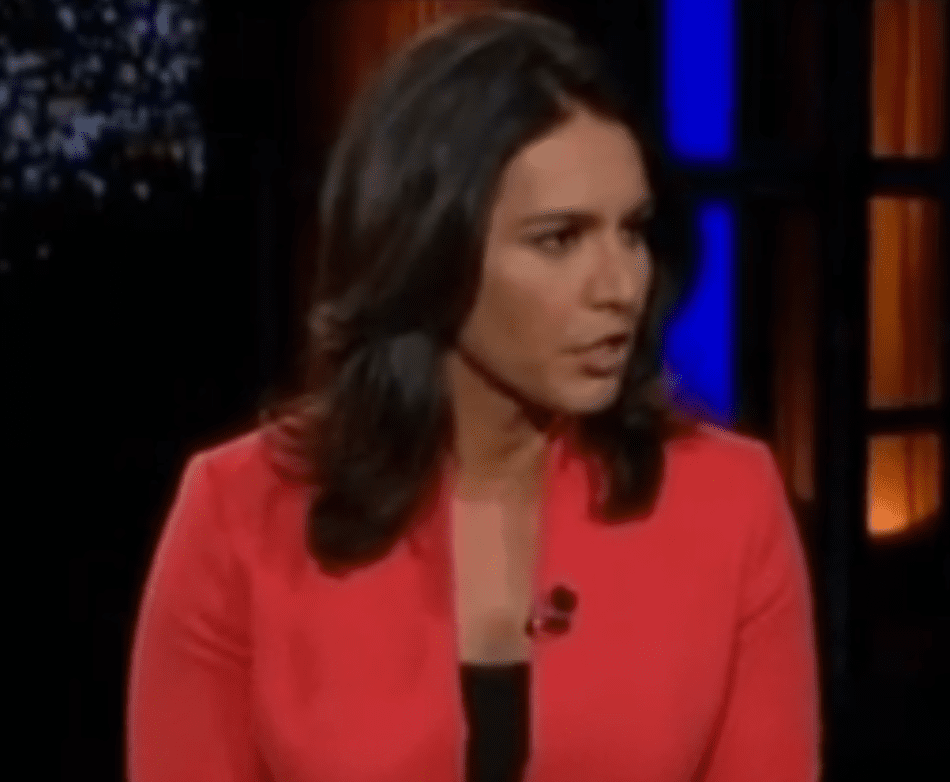
“I’ll never forget the first day I got there,” she told Maher. “First of all, no women are allowed on their military bases — period. So when I showed up in my uniform, my hair all tied up, the guard at the gate was kind of looking puzzled. But as I went in and met these men who we would be training over the next several months, at least half of them would not acknowledge my presence — I was invisible to them.”
Nevertheless, she remained focused on the training. “By the end of the several months that we had, not only were they speaking and we were having conversations and became friends, but their commander, a very conservative, bearded Muslim man, presented me with an award of appreciation for the contributions I had made for his troops, which I thought was progress.”
It certainly sounds like progress. But one suspects that if Gabbard had sauntered in guns blazing and condemning “Islamic extremists,” it’s progress that never would have been realized.
The restrained, sober language of diplomacy is never so important as when dissonant cultures come together, when the challenge of finding common ground is excruciatingly hard.
Many in the Middle East only know the United States as a superpower whose decadent streets are paved with gold and that has meddled relentlessly in the affairs of its many nations over many generations. Obama continues to strike the right tone in his public remarks regarding the Middle East — a tone that, at worst, doesn’t go out of its way to offend the millions of non-radicalized people in the region and that doesn’t contribute to terrorist efforts to wrap their actions in the Islamic faith.
As Gabbard’s star deservedly continues to rise and her influence grows, she would do well to consider the toxic cultural residue her blunt characterizations might leave behind in the very hearts and minds that are critical to peace, if it is ever to be achieved in that strategically important yet perpetually troubled part of the world.
As Gabbard herself told millions of viewers last Friday on the sort of platform that now seems available to her as often as she wants, how we describe our enemies matters. “Words mean things,” she told Maher. Indeed.

