Clearing The Path To Graduation With New Program Makes Sense
The University of Hawaii Manoa’s pilot effort is a smart use of data-driven technology to help students graduate sooner.
Time was, college students registering for an academic term formed long lines in gymnasiums, waiting to be manually enrolled in specific courses. If a particular course section was full, the unfortunate student went to the back of another line, hoping a second or third choice still might have room.
It wasn’t a very efficient system. Students often ended up taking courses they didn’t really need or particularly want, just to have a full academic load for the term.
While those pre-digital days are long gone, they’ve been replaced by computer systems that sometimes don’t offer much improvement beyond getting rid of the need to physically stand in line. Students still complain of being unable to take classes they want or need.
The University of Hawaii Manoa is piloting a new registration program that holds significant promise both for UH students and the university itself. The program could make graduation faster and cheaper, boost the school’s sub-par graduation rates and enable deeper, more meaningful interactions between students and academic advisers.
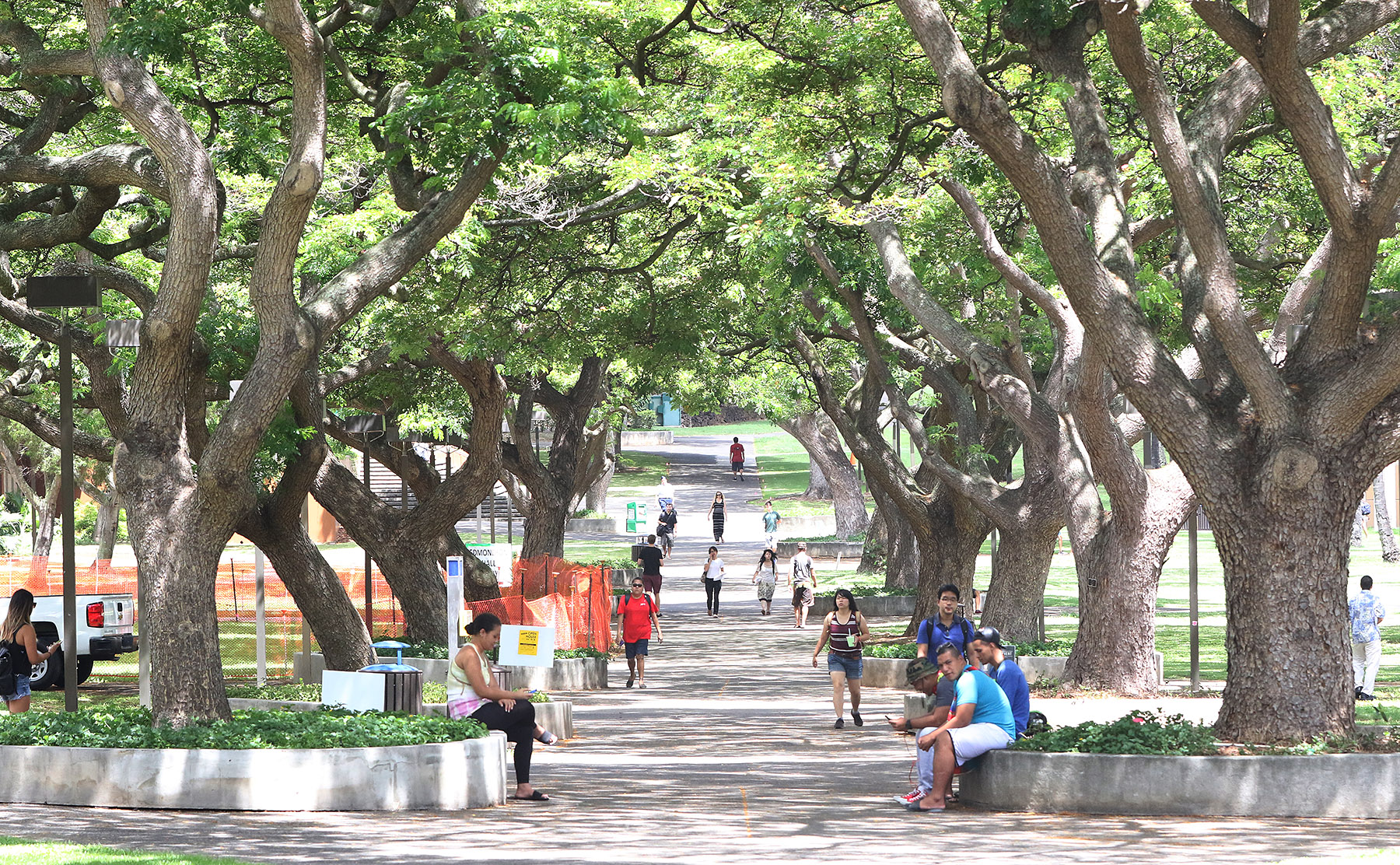
As Civil Beat education reporter Jessica Terrell reported yesterday, the pilot system supplies each undergraduate student with a list of five suggested courses each term that would facilitate the best path toward graduation in the student’s chosen major. Students could choose additional or alternative courses, but to do so, they’d have to opt out of the system’s recommended offerings.
That would provide better informed choices each term among the hundreds of course offerings that might be relevant for each student’s course of study, taking into account prerequisites, course availability, time conflicts with other classes and more.
The opt-out system, suspected to be one of the first of its kind in the country, promises help for students seeking to graduate in as little time as possible and keep college costs low. They also would help those who sometimes enroll in courses they think will count toward their degree only to find out belatedly that they don’t.
For all students, it would provide the most efficient advice on what courses most logically would help them progress from Point A to Point B. That would let students spend their limited time with academic advisers focusing on questions where human advice is more meaningful: Am I in the right major for my career choice? Which of these class choices that fulfill my program requirements makes the most sense for me?
Like all other Hawaii colleges and universities, UH Manoa struggles with graduation rates relative to its peers around the country. That is due in part to our islands’ exorbitant cost of living: Students working their way through school often lack the financial means to take sufficient courses to graduate in six years, much less the once-traditional four years.
Despite improvement over the past five years, only 28 percent of UH undergrads, in fact, earn their bachelor degrees in four years, according to UH Manoa Chancellor Robert Bley-Vroman. The university now claims a six-year rate of 57 percent — certainly better than its four-year performance, but still below the national average.
Like all other Hawaii colleges and universities, UH Manoa struggles with graduation rates relative to its peers around the country, due in part to our islands’ exorbitant cost of living.
Other Hawaii campuses perform similarly, according to federal measures drawn from 2014 data. The state’s largest private campus, Hawaii Pacific University, for instance, has a four-year graduation rate of 20 percent and a six-year rate of 42 percent. Chaminade University, which like UH has improved significantly in recent years, has a four-year rate of 29 percent and a six-year rate of 48 percent.
Such figures reflect the difficulties students face in completing their degrees, and they are a drag on the national reputation and standing of each institution. The influential U.S. News & World Report’s “Best Colleges” rankings, for instance, are one of many that take into account graduation rates, though not the cost of living in the area surrounding each institution.
By next spring, as many as 5,000 students are expected to be using the new registration program. Over the following year, the goal is to expand it to students throughout the system, including UH Hilo and UH West Oahu, where graduation rates lag significantly behind those of Manoa.
The university plans to use data from the program not only to help each individual students, but to more easily identify bottlenecks in specific programs that are impeding reasonable progress to graduation.
Some faculty and education experts are reasonably concerned that such a program not overly crowd out human judgment, placing students on a straight line to graduation from which no deviation is permitted. Ideally, the program will provide more time for such judgment to be exercised and for deeper conversations on matters such as the merits of one faculty member over another in selecting courses taught by multiple faculty. It might also help academic departments understand better such things as whether offering a specific course in any given term would significantly affect their students’ overall progress toward degree completion.
In an exchange with Civil Beat, UH Vice President of Academic Affairs Risa Dickson called the registration program “a game changer.” And while it might be too early to make that judgment, we’re inclined to agree. It’s a smart use of emerging database-driven technology, and we applaud its implementation by a university that’s doubling down on efforts to substantially improve student success and graduation rates.