

Luke Evslin: Going Off The Grid In Hawaii
Any practical solution to climate change is going to involve our utilities.
This is part two of a four part series on renewable energy. Check out part one on The Dark Side of Renewable Energy.
“Keep calm, and carry on.”
That was the morale boosting poster that the British government planned to plaster throughout London if the Nazis invaded England. We can all be grateful that they never had to use it.
Modern history is full of near misses. From the Cuban missile crisis to the (hopefully) failed candidacy of Donald Trump, we’ve become accustomed to treading right to the brink of disaster—and then managing to step back.

And so, with a daily barrage of news on how we’re approaching the point of no return on climate change, it’s easy to assume that we’re going to win this fight too. We saved the bald eagle, the hole in the ozone layer is shrinking, and acid rain is on the decline. Humans play best in the ninth inning. We got this. Or so I thought.
But, here in Hawaii, we’re already seeing the dire effects of runaway CO2 emissions: declining rainfall, sea level rise, record breaking temperatures, the collapse of trade winds. In a way that the Nazis never did with England, climate change has arrived on our shores.
And while we “keep calm, and carry on,” it’s only going to get a lot worse. If you drive a vehicle, consume manufactured goods or use electricity, then you are part of the problem. And in that stark realization of my own complicity in the endangerment of human civilization, I decided to go off-grid.
We have plenty of sun; and electricity is expensive. So going off-grid in Hawaii makes more financial sense than anywhere else in the country.
So, four years ago we cut the cord. I built a water catchment tank and installed six solar panels with a small battery bank. My wife boxed up our microwave and toaster oven. I learned to turn off every electronic device in the early afternoon. And when friends came over for dinner, I could bask in an aura of self-righteousness under the dim white glow of our single LED light bulb.
Yet it took just one rainstorm for me to realize the irony of own wasteful hypocrisy. After a night of pounding rain, I woke up at dawn to the sound of my overflowing catchment tank. The water was streaming over the side, hitting the ground, and creating a deep furrow in the dirt as it ran down the hillside. My precious water was being soaked up by the earth because my storage was full.
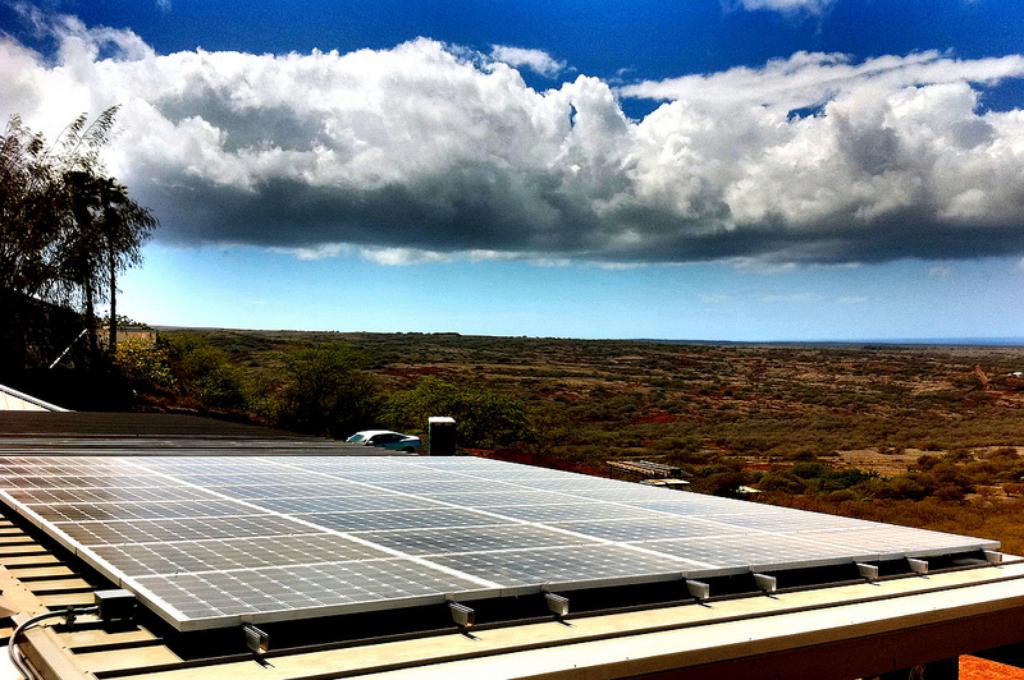
And then, in typical Hawaiian fashion, the clouds parted, the birds came out and my solar panels began cranking out electricity. Photons were making the eight-minute trip from the sun to my photovoltaic array, where they were knocking electrons out of their little atomic orbits. But as my batteries filled up, my charge controller began shunting those positively charged electrons through a series of electronic resistors. Just like the overflowing water being soaked up in my yard, my precious electricity was being lost as heat because my storage was full.
If I’m wasting water from an overflowing catchment tank— that’s OK. There is no method to get catchment water fed into our county water system and nobody would want to deal with the public health hazard of my unique liquid brew of bird poop and mosquito larvae. But electrons are all the same, whether they’re produced from the silicon of my PV panel, or from the steam turbine of a coal fired boiler. And there is a simple way to get those fed back into the grid— I just needed to hook up to the local utility.
By not feeding my excess power back into the grid, I make our local fossil fuel burning power plant work just a little bit harder to make up the difference. As long as Kauai isn’t running 100 percent off of renewable energy, then every available solar panel should be contributing electrons at its full potential.
My Off-Grid Life Is A Moral Failure
I went off-grid so that I could minimize my contribution to climate change. I was looking for a simple solution to a complex problem. Yet the brutal irony of my existence is that if I lived the same low-energy lifestyle while feeding my excess power generation onto the grid, then I would reduce emissions significantly more than being off-grid.
Eighteenth century philosopher Immanuel Kant was probably watching solar panels shunt electricity when he described his famous categorical imperative: “Act only according to that maxim by which you can at the same time will that it should become a universal law.” Because it would be a disaster if we all cut the cord to our utility, in Kant’s terms my off-grid life is a moral failure.
If everyone oversized their systems so that they never had to rely on back-up power—our island would have solar panels and batteries in triplicate. In a world of finite resources, we can’t afford that gross excess. And solar panels and batteries aren’t exactly biodegradable.
Yet if everyone undersized their systems, then we’d all be running off of inefficient household generators on cloudy days. If you lived on Kauai after hurricane Iniki, then you remember the roar and fumes from neighborhoods full of gas-powered generators.
As a friend recently described to me, the grid is the most efficient form of public transportation. But instead of moving people around, it moves electrons. And it works best when we all utilize it. Defecting from the grid is like running half-empty buses so that two cars can sit idle in your garage — the system loses efficiency.
The Utility Death Spiral
And, as I wrote last week, every customer who defects from the grid causes rates to rise for everybody else, because it leaves fewer customers to split the bill for the fixed and maintenance costs of the power plant and the transmission lines. In a domino effect of destruction, as rates rise, more people defect, causing rates to rise even more, causing more people to defect. Fittingly, this is called the utility death spiral.
Even though it makes me a hypocrite, I have come to realize that there is no foreseeable path to battling climate change that doesn’t involve our utilities. And every time a customer goes off-grid, it is one person less contributing to the good of the community.
But with increasing competition from batteries and rooftop solar, how do we ensure that our utilities can survive the renewable revolution? And how do we make sure that we’re not putting the burden on those who can least afford it?
It comes down to rate structures, demand response, and amortization. If those topics don’t get you excited—you’d better check your pulse. Check back next week.
Full Disclosure: Luke Evslin is a member of Apollo Kauai, a renewable energy advocacy group.

