Luke Evslin: A New Approach To Zoning Could Save Kauai’s Character
Focusing on the form of development could help us avoid becoming another Oahu.
This is Part 2 in a series on land use and transportation. Read Part 1 here.
I was born and raised in Wailua Homesteads. I played soccer at the nearby park, a 10-minute drive away. The nearest grocery store was in Kapaa, a 20-minute drive. I went to school in Lihue, a 35-minute drive.
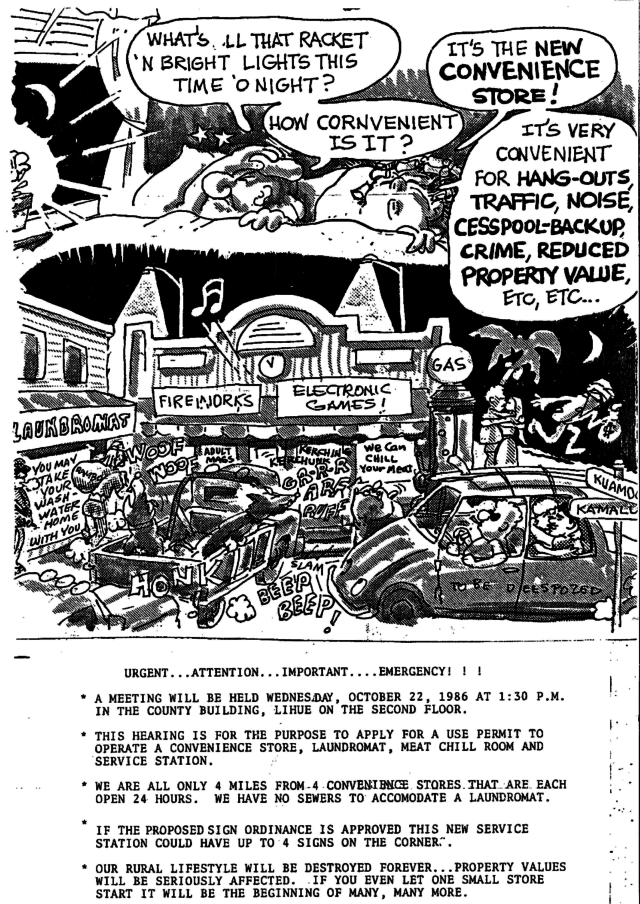
When someone wanted to open a small corner store down the street from us, the community freaked out. Our rural lifestyle will be destroyed forever! People will be loitering in the streets! The youth will be corrupted! And, gasp, our property values will plummet!
Because we all know that residential and commercial areas should never mix.
“Before zoning laws, private landowners did things like build factories next to people’s homes,” said Marie Williams, a long-range planner for the county of Kauai. “Naturally, poor people experienced the greatest impacts and had to deal with incompatible uses like factories and mills being sited where they live.”
The practice of urban planning is closely tied to protecting residents from harmful industrial practices. The solution, as Williams explained to me in an email, historically has been to “group and separate uses into commercial, industrial, and residential.”
Spend time amidst the noise and fumes of any of our industrial parks in Hawaii, and you can understand the importance of protecting residents from industry. But this complete separation of all uses is such an integral part of our vehicle-centric lives that we have a hard time seeing beyond our current zoning practices.
Although the community mobilized a valiant fight in defense of their “rural” principles, after seven years the corner store finally received its use permit. I didn’t get corrupted, but I did start riding my bike there in the afternoons to buy a slice of pizza.
It’s been nearly a quarter of a century, and The Wailua Country Store is now a treasured part of the community. Cows still graze nearby and roosters are the only creatures fighting in the parking lot. Property values for the houses adjacent to the store are $20,000 to $60,000 higher than the median home value for the rest of the block. The house across the street is currently for sale for $720,000.
Addressing Congestion Starts With Mixed Use
This isn’t another story about overblown fears, misguided activism, or NIMBYism in Hawaii. It’s about how deeply the ideology of separating uses is engrained in our suburban mindset, and how this separation is the root cause of both our decaying town centers and our growing congestion.
“Working places and commerce must be mingled right in with residences,” wrote Jane Jacobs, one of history’s most influential urban activists.
While The Country Store provides a convenient place to buy milk, eggs and local beef, if you live in Wailua Homesteads, you are still driving at least 15 minutes to get to work or a supermarket.
And so traffic, and the carbon emissions that come with it, is the price that we pay to live in a quiet suburban neighborhood. And, understandably, we have traditionally managed traffic by building new roads and widening old ones. Because “the simple needs of automobiles are more easily understood and satisfied than the complex needs of cities,” wrote Jacobs.
But Hawaii’s Department of Transportation only has funding for 20 percent of our necessary transportation projects; and a slim majority on our Kauai County Council repeatedly has blocked adequate funding for even basic infrastructure maintenance and bus service expansion. So we are being forced to look outside of the box.
‘The People Of Oahu Failed. Will The People Of Kauai?’
As I wrote last week, to reduce vehicle miles traveled, congestion and emissions from transportation, we need to rethink our development patterns.
This isn’t a new idea. Kauai’s first General Plan in 1970 included a dire warning for our island:
Oahu, it said, has been led “into a blind alley of unsolvable traffic problems and a hopeless dispersal of people and services which cannot possibly be served adequately by any economically feasible alternative to the automobile. The resultant destruction to the limited land and natural resources has not yet reached its inevitable limits, but the grotesque evidence of an environment spawned and predominately controlled by a helpless, psychological addiction to a pathetically inefficient method of transportation is there for all to see.
“The question should be asked. Should Kauai and the state continue to fund the development of roads and highways knowing full well that they eventually generate more traffic, more dispersal, more congestion than they are designed to alleviate?
“Or, should Kauai now, while there is time, move towards a better, more convenient, more efficient, safer and less destructive system of transport; and in so doing maintain and improve the quality of the environment, hence the quality of life?
“To those accustomed to the relative leisure and comfort of driving on Kauai, such foresight and imagination is as difficult as the foresight required on Oahu twenty years ago.
The people of Oahu failed. Will the people of Kauai?”
A New Direction In Planning
While the need for a paradigm shift in transportation was evident 45 years ago, the regulatory tools necessary for such a change hadn’t been developed. Until now.
“We’ve learned that people want to halt suburban sprawl, yet do not want to change the scale of their historic towns,” Marie Williams said to me. “And so the fundamental problem that we have to face is how do we protect and revitalize our historic town cores, while providing for more housing options?”
An alternative planning approach known as form-based codes could provide the tool to begin solving both ends of that issue. Kauai recently joined the less than one percent of municipalities around the country that are beginning to employ this new method of zoning ordinance.
“It’s a tool to implement the community’s desire to manage growth, while protecting what they love about their town,” said Williams. “It’s still zoning, but rather than focusing on separation, it focuses on creating a high-quality building, street, and civic space form.”
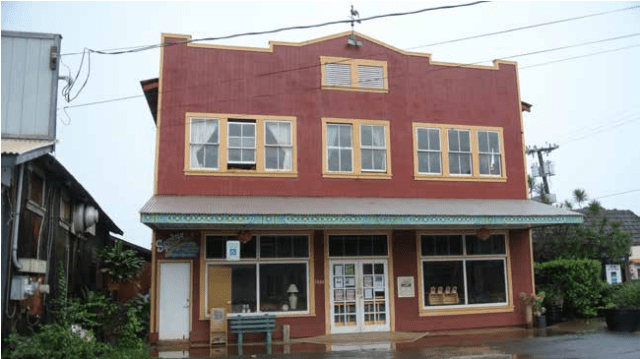
With traditional zoning, developers only have to conform development to the required use (residential, commercial, or industrial) and density restrictions, while the specific look of the development isn’t addressed. As a result, Kauai’s newest development is a Petco and Safeway strip mall, straight out of Anytown USA and accessible only by car.
Form-based codes, on the other hand, regulate the form, character, and diversity of development within our town cores.
Because each town is unique, the process requires that future growth is shaped and codified through intensive public input to match the existing character of the place — what’s known as individual community place typing. Once the form-based codes are set (as they currently are for Koloa and Kalaheo), developers just need to comply with the specific building requirements and can receive expedited over-the-counter permitting.
The final set of codes varies depending on proximity to the town center — with high-density buildings towards the middle shifting to lower density towards the outskirts. The purpose is to require specific types of structures and street set backs that have proven conducive to commercial activity and mixed use, as well as higher density housing types such as duplexes, apartment houses, cottage courts, and carriage homes.
Civic space, sidewalks, and shorter blocks are also mandated as a way to help promote connectivity and bring development back to a pedestrian scale.
There are 400 more births than deaths every year on Kauai. That growth has to go somewhere.
By requiring a diverse array of multi-family dwellings and apartment-style homes, while eliminating density restrictions within our urban cores, form-based code incentivizes future development and population growth to occur within a walkable perimeter of our towns.
As outlined in Kauai’s Multimodal Transportation Plan, reducing vehicle miles traveled depends on a land use program that “is guided by the three principal requirements for sustainable development: compactness, completeness and connectedness.”
Form-based code provides the route to achieve all three of those principles in order to reduce our reliance on personal automobiles while expanding housing and preserving the historic nature of our plantation era towns.
But, by doing so, will we sacrifice our rural atmosphere? We’ll look at that next time.