Reader Rep: Judging The Journalism, Not The Journalist
Once journalists publish or air their work, it’s fair game for public comment and criticism.
Sometimes, the comments and side discussions about these Reader Rep columns rival or surpass the source material. So, every once in a while, I want to recirculate and acknowledge some of these back-channel conversations as a way to address and elaborate on them.
I hope this will become a recurring method of bringing more of the interesting reader-generated ideas and topics into our debates about media issues in Hawaii and beyond. I hope this will encourage discussions among readers.
I also hope, at least in the case of this particular column, that addressing such feedback directly will help make clearer the approach I’m taking.

Journalists Are As Thin-Skinned As Anyone
In these columns so far, I have criticized (and praised) the work of local journalists. To me, this seems the key role of the ombudsman or media critic, of which I envision the Reader Rep to be a hybrid form. I try to be careful to separate the work from the individual and to comment only on the work. Journalists have a tough enough job to do without getting persecuted on a personal level.
Yet a couple of these journalists have taken offense to being criticized in these columns, creating some tense exchanges between us, via email, on the phone and in person. So I think it is worthwhile to explain my positions further on a few fundamental points, to illustrate where I’m coming from:
• Readers judge journalists on the work they share with the public, not the behind-the-scenes drama. And so will I.
To me, the backstory is often interesting, but it’s mostly irrelevant, because ultimately, what the public cares about is the journalism that was produced and delivered. So that is mostly what I’ll comment upon.
Most of the time, the work reveals exactly what the journalist did or didn’t do.
Unless a journalist wants to include a “how we did it” sidebar to a particular story, I plan to stay focused in this column on the product more than the process. Sometimes, I think significant lessons can be learned from investigating an unusual process. But most of the time, the work reveals exactly what the journalist did or didn’t do; that is what I think we all care about, rather than the myriad of readily available excuses often used to justify subpar work.
• Journalists don’t require a “courtesy call” when their work is going to be discussed, whether to be praised or criticized. Once the work is released to the public, it’s fair game for comment. Journalists get the big microphone and spotlight all of the time, so they should be open to reviews of their performances.
• Readers don’t need to have “worked in the field” to point out journalistic flaws. Like with the source material, it’s the quality of the comment that counts.
I have been struck by the knee-jerk reaction to criticism by some local journalists who dismiss commentary based on the reader’s personal background. From my perspective, whether a commenter has worked in newsrooms for many years, like me, or is a person with no direct journalism experience, if the point raised is mindful, well-articulated and backed by evidence, then it is valid enough to be discussed, regardless of who originated it.
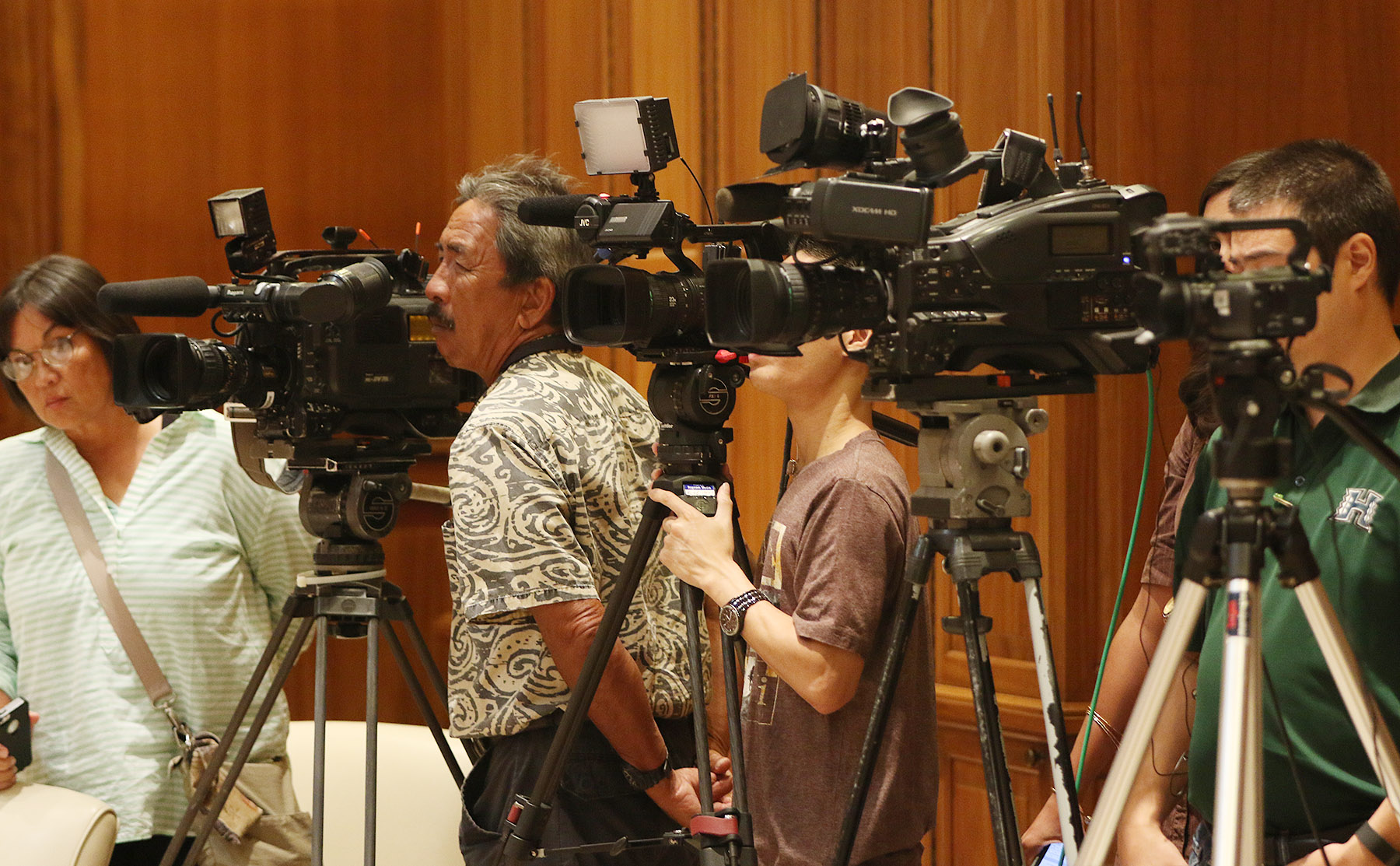
Engage In The Commentary, Don’t Avoid It
I was impressed (and so were fellow readers) to see the ways in which Clayton Wakida of KITV, for example, handled Reader Rep criticism of his web-publishing work when he copied and pasted a press release to the KITV site and put his byline at the top. Instead of being defiant, or defensive, Wakida was reflective in his comments about the column, owning the issue and publicly stating his desire “to do better.”
He added, “If I were to start this all over again, I would rewrite it as a much shorter article.”
Dropping below the Society of Professional Journalists Code of Ethics baseline simply shouldn’t be tolerated in any media community.
KITV (as Chad Blair of Civil Beat has reported) recently has been going through perhaps more turmoil than any other local media organization. Wakida could have blamed his situation, his station, his supervisors or many other circumstances. Instead, he took the full credit and blame for what happened and vowed to reassess his approach to rewriting press releases in the future.
Regardless of what you might think about that practice, I commend Wakida for participating in this dialogue about his work, rather than privately grousing about how this column somehow had wronged him.
Journalism Benefits From Feedback And Critique
Journalists constantly are on stage, in a metaphorical sense. But their audience doesn’t have access to – or really, much interest in – the nuances of the decisions journalists formulate on the fly or that are dictated by backstage circumstances or that arise as symptoms of a long and complicated production process.
Imagine how distracting and tedious it would be for an actor, for example, to forecast a scene, point by point, as that person worked through each moment in front of an audience. These annotations might come out like: “Here, I will walk to the spot that stupid director told me to stand. I don’t like being there at all.”
And, “Next, I will sing my solo, but I was really busy today and I didn’t warm my voice up well. So it might not be my best.”
And, “The author of this script really has a tin ear for dialogue. I can’t believe this is my next line.” And so on.
If an artistic example seems a stretch, consider quality benchmarks for other sorts of jobs. Can a carpenter stay employed long if the houses keep falling down? Can a plumber keep getting hired if the pipes keep leaking? Can a surgeon survive in that profession if patients keep dying on the operation table?
For the most part, customers, clients and readers just want the job to get done properly. Every once in awhile, great work is appreciated. But dropping below the Society of Professional Journalists Code of Ethics baseline, for example, simply shouldn’t be tolerated in any media community.

Readers typically don’t demand that much from their journalists. They want the fundamentals, such as answers to who, what, when, where, why and how. They want the information to be accurate. They would appreciate a quality performance, of course, and a bit of artistic flourish. But the inverted pyramid style of sharing news has dominated since the days of the telegraph, so innovative craftsmanship isn’t mandatory.
Excuses aren’t very important to readers. Consistent adherence to journalistic principles has much higher value. We should celebrate, of course, when the journalistic job has been done well. Yet we also all should feel empowered to comment on this work as is, including holding our local journalists to industry standards.
It’s the journalist’s job to create the work and, as with the products of any other artisan, it’s the audience’s job to interpret the meaning and quality.
Nobody needs special permission to do that. And no courtesy call is required.