Futile For Hawaii To Prepare For Nuclear Attack
The U.S. Congress should urge negotiations between America and North Korea.
Donald Trump and Kim Jong Un scare me.
I grew up in a military family knowing that America’s superpower status meant that my family as well as my country was always focused on conflict somewhere in the world. Life was precarious not just on a personal level but also globally.
And it is again. Let me tell you why.
Growing Up Scared
One morning when I was 9 years old, my dad slipped into my bedroom before the sun came up, leaned over my sister and me, kissed us and whispered, “Bye, sweetie. Love you,” and “Bye, baby. Love you.”
When I woke up a few hours later I wasn’t sure if that had really happened. I asked my mom and she said yes, that he had been called out “on alert.” This was not unusual since he was assigned to a Strategic Air Command Titan II nuclear missile site just outside of Denver. But he usually didn’t wake us up and kiss us on a workday.
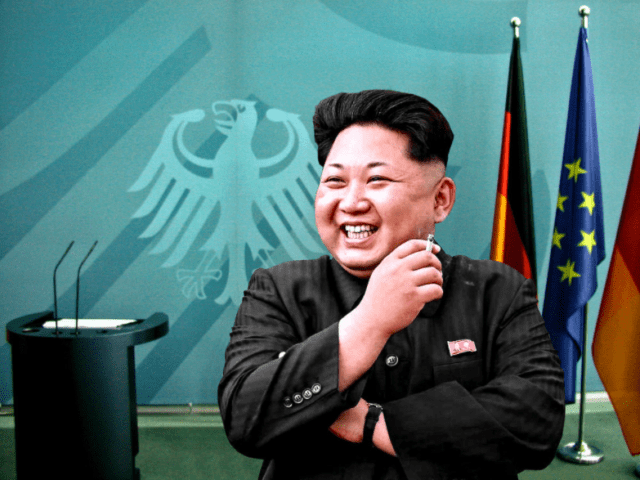 The author worries that President Donald Trump is as authoritarian as Kim Jong Un, picture.
It was Oct. 25, 1962. Three days earlier we had seen President John F. Kennedy’s announcement on television telling America that he was sending U.S. naval ships to quarantine Cuba because there was evidence that they were building missile sites there.
It wasn’t entirely clear if they had missiles or not; the quarantine was a preventive measure to ensure that no (new?) Soviet missiles reached Cuba. Kennedy also said that any missile fired from Cuba against any country in the Western Hemisphere would be seen as an act of war instigated by the Soviet Union.
Thus began what came to be called the Cuban Missile Crisis.
The U.S. military was on DEFCON-2 status (it stands for defense readiness condition) when Kennedy spoke on Oct. 22, meaning that nuclear war was likely. That seemed pretty scary to me, but Daddy was home that evening and said not to worry too much, the U.S. military was strong enough to protect us.
Three days later when he kissed us goodbye, he didn’t tell us that SAC was already in DEFCON-3, signaling that the threat of nuclear war had been upgraded to imminent. Only later did I learn that his commander had ordered his men to be sure to say goodbye, not see you soon, to their families that morning.
This was not a drill; it was the real thing. Nor did he mention that if Soviet missiles were already installed in Cuba they could possibly reach as far as Seattle and Los Angeles, making Denver, where we lived, clearly within range.
After a lot of negotiations, the Cuban Missile Crisis formally ended on Nov. 20, 1962, when the Soviets agreed to not install their missiles and to remove their nuclear-bomb-ready airplanes from Cuba and the U.S. agreed to remove its missiles from bases in Turkey. Thus the U.S. ended the quarantine.
A Very Scary Side Note
Both U.S. and Soviet forces were stunned decades later to learn how inadvertently close they had come to starting a nuclear war. During the crisis, a U.S. naval ship had been dropping depth charges on a Soviet submarine near Cuba. The sub’s crew had disagreed about what action to take against the U.S. ship: either launch its nuclear torpedo at the ship or surface peacefully.
They chose the latter, persuaded by a lower ranking officer against the wishes of his superior. An excellent decision, especially since the crew of the American ship had no idea the sub was carrying a nuclear weapon.
So, What About Hawaii?
The United States and North Korea are both headed by authoritarian men who act based on their emotions instead of accurate information. Both are surrounded by people who are more concerned about assuaging their fits of temper rather than providing them with thoughtful guidance.
This leaves our precious island state much too close to the intersection of their insanity.
I hate to be critical, but the tepid efforts recently launched by the state of Hawaii to prepare for such a threat are as futile as the “duck and cover” drills of the 1950s and ’60s where we hid under our school desks to protect us from nuclear annihilation. And now the weapons are much bigger, if not more accurate, as is the case with North Korea’s errant missiles.
We should shelter in place? Stock up on supplies? Stay tuned to the radio? Listen for the new civil defense sirens? Such actions might buy you a few minutes or seconds of protection at best.
I believe it is far more helpful to do everything possible to mobilize Congress to insist that our country follow in the footsteps of President Kennedy, who negotiated with the Soviet Union and other global stakeholders for a full month to bring the Cuban Missile Crisis to a peaceful end. May cooler heads prevail all around.
 GET IN-DEPTH
REPORTING ON HAWAII’S BIGGEST ISSUES
GET IN-DEPTH
REPORTING ON HAWAII’S BIGGEST ISSUES
Community Voices aims to encourage broad discussion on many topics of community interest. It’s kind of a cross between Letters to the Editor and op-eds. This is your space to talk about important issues or interesting people who are making a difference in our world. Column lengths should be no more than 800 words and we need a current photo of the author and a bio. We welcome video commentary and other multimedia formats. Send to news@civilbeat.org. The opinions and information expressed in Community Voices are solely those of the authors and not Civil Beat.