

Big Island: Hawaiians Step Up For Sacred Park In Face Of Shutdown
Cultural practitioners who have long revered and protected Pu’uhonua O Honaunau National Historic Park are redoubling their efforts.
HONAUNAU, Hawaii Island – Serving as a steward of the land is a traditional Hawaiian philosophy currently being practiced on a sacred site caught up in the federal government’s partial shutdown.
With the political impasse in Washington, D.C., now in its second month, a group of Hawaiian practitioners has increased its role caring for Pu’uhonua O Honaunau National Historic Park on the Big Island’s west coast.

The volunteers, some of whom trace their linage directly to this 182-acre site, have become cultural interpreters, unofficial rangers and even custodians.
“There’s a sense of pride in this culture and respect for history and how this part of the world just differs,” said Shaye Reilly, one of dozens of people who walked around a gate to visit the officially closed park on a recent day. That attitude doesn’t exist, Reilly said, in her Oklahoma community despite having an Air Force base employing federal workers.
The Hawaiian word pu’uhonua means a place of refuge, which is how this South Kona coastline was used before the first Western contact. Anyone who broke laws called kapu could avoid execution by reaching the area, the National Park Service writes on its Puuhonua O Honaunau website.
“As you enter, the great wall rises up before you marking the boundaries between the royal grounds and the sanctuary,” adds the website left inactive by the shutdown. “Many kii (carved wooden images) surround the Hale o Keawe temple, housing the bones of the chiefs that infuse the area with their power or mana. If you reached this sacred place, you would be saved.”
Salvation wasn’t easy, however. Fugitives had to successfully navigate sharp lava, shark-patrolled waters and their pursuers just to reach the refuge, where they had to remain long enough to be sufficiently rehabilitated before attempting the return trek.
Today, a quick walk through the sacred grounds can leave visitors with “chicken skin.” Part of that experience is because of volunteers.
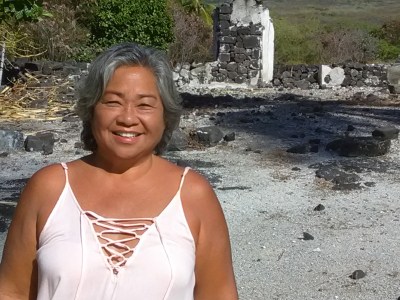
“We know that our presence is important for people who think this place has been abandoned,” said Rae Godden, a lineal descendant of the area and board member of Na Hoa Aloha, a nonprofit “friends of the park” group she helped to create in 2006.
“We’ve been helping the park all this time,” she said. “We’re still volunteering to help the park.”
The roughly 30-member group had kept a low profile while working with the National Park Service, but that changed following a recent newspaper story highlighting overflowing trash, clogged bathrooms and site desecration that resulted from the government shutdown, Godden said.
“We just want people to know we’re here and we’ve been here,” she said.
Godden’s connection to Pu’uhonua O Honaunau is longstanding and deeply personal.
“My great-grandmother is buried on the heiau there,” she said, adding her mother also lived on the land before becoming the first female Hawaiian ranger employed there once it became a park. Godden said she still attends religious practices at the site and also worked there as a ranger before retiring.
“If this was not given to the federal government, there would be one owner with a closed gate and no access,” Godden said.
During a recent visit, park conditions were immaculate, with no rubbish visible, nearly empty trash and recycling bins, and fully functioning restrooms. The NPS has restored sanitation services at Pu’uhonua O Honaunau, Godden said.
At least two uniformed rangers patrolled the park, interacting with patrons while saying they were prohibited from talking with reporters. Park staff are not currently receiving paychecks.
An empty parking lot and locked gate were the only indications of the closure, enough to leave some visitors unsure about entering. For most, the hesitation was short-lived.
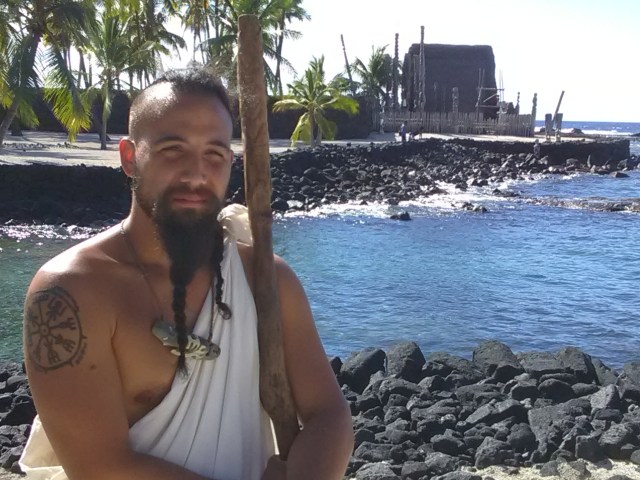
Among the Na Hoa Aloha members helping visitors was Kahakaio Ravenscraft, who wore traditional garments and carried a staff.
“Just about all of my days off, as much as possible, I’m coming down to the site,” said Ravenscraft, another lineal descendant who also belongs to a nonprofit tasked with maintaining South Kona temples — heiau.
“We have to steward the spiritual practices of these areas,” he said. “Part of the result of the shutdown has been a need to increase our presence. Our presence here is for … the bones that are put to rest on these grounds. We’re here for our ancestors.”
Other volunteers, including some Hawaiians who also share ancestral ties to Pu’uhonua O Honaunau, have recently conducted cleanups and performed security functions. This has displeased Na Hoa Aloha members, who feel the other groups lack standing and have shown disrespect.
“They’re coming here and using the site without working with the National Park Service,” Godden said. “So, it’s starting to be a kanaka versus kanaka kind of thing.”
Ravenscraft agreed, saying it’s taken his group many years to reconnect people to the special place.
He said others are “coming in without understanding the work their fellow kanaka have been doing” while “having an air about them as if they’re trying to take over.”
Still, Ravenscraft said the shutdown provides a “great opportunity” for all of the park’s Hawaiian stakeholders to achieve unity – regardless of what’s happening in the nation’s capital.
“This place will never be abandoned,” he said.

