Chad Blair: Honolulu Was Already Transformed By Tourism In 1969
National Geographic’s profile of Hawaii’s capital city 10 years after statehood was a preview of things to come.
July 25, 2021 · 7 min read


About the Author

The year 1969 saw man walk on the moon, more than 350,000 hippies gather at Woodstock, the Stonewall riot in New York City, the Manson murders in Los Angeles, the Chappaquiddick affair of Ted Kennedy, the trial of the Chicago Seven, the debut of “Sesame Street,” the release of “Easy Rider” and the inauguration of Richard Nixon.

Busy year, eh? And that’s just in the United States.
It was also the year that National Geographic published a 32-page article that October titled “Look what happened to Honolulu!” It was written by Hawaii journalist Jim Becker with illustrations from the magazine’s photographer Bates Littlehales.
The article focused on how, just 10 years after statehood and with the arrival of the jet airliner, Hawaii’s capital had transformed from “a picturesque Pacific crossroads to something approaching an outpost of Southern California.”
As Becker observed:
“A tourist searching a postcard rack for a typical Honolulu scene might as accurately select one showing cranes flinging up new buildings as one of palms swaying in the balmy breeze. And he might hear the wham! of pile drivers as frequently as happy rhythms strummed on ukuleles.”
Becker described Honolulu as a boomtown whose 3% annual population growth was more than double the national average. New construction was valued at $415 million. And more than 1.2 million visitors in 1968 made tourism the second largest “enterprise,” trailing only federal money going to large military installations.
Mike McCartney, the director of the state Department of Business, Economic Development and Tourism, told me about the 1969 article after reading my recent column (“A 30-Year-Old Rant On Hawaii Tourism Still Rings True”) on Haunani-Kay Trask’s 1991 essay lamenting the tourism industry’s desecration of Hawaii and Native Hawaiians.
“I found it in my mother-in-law’s trash one day back in 2011,” said McCartney, who at the time led the Hawaii Tourism Authority. “I put it up on the walls of the HTA office as a reference where we could all see it as a reminder to keep the balance.”
Keeping the balance is top of mind these days as Hawaii experiences a faster return to full tourism than expected after 16 months of COVID-19. The Hawaii Legislature gutted the HTA’s budget even as the agency is embarking on efforts to better manage the damaged brand.
Like Trask’s 30-year-old scholarly analysis, reviewing the ’69 National Geographic piece more than 50 years after its publication is helpful in understanding just how much tourism has changed Honolulu and Hawaii. It also illustrates how iconic imagery continues to define perceptions of our island state but also can distort the reality of what it is actually like to live and work here.
The article features gorgeous photos of the Ilikai, Royal Hawaiian and Hilton Hawaiian hotels, hula dancers, Diamond Head, the Arizona Memorial, flags and flowers at Punchbowl cemetery, the making of lei, Don Ho and — of course — surfing at Sunset Beach. It’s like the opening credits to the original “Hawaii Five-0” series without the soundtrack.
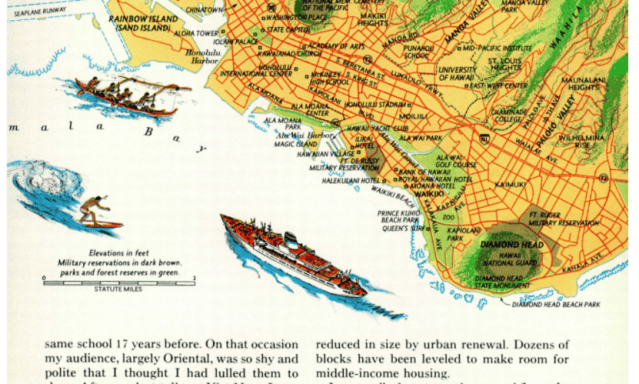
But there are also insightful interviews with local luminaries of the day such as Chinn Ho, Neal Blaisdell and Tom Gill. Especially sweet are revealing, intimate surprises like photos of a Shinto blessing for a newborn, two children in a family furo and a Colorado woman at Fort DeRussy (spelled “Fort De Russey”) anxiously awaiting the arrival of her Army captain husband from Vietnam (or “South Viet Nam,” as the article called it).
In that last series of photos, the wife flies into her uniformed husband’s arms, “tossing a lei that just misses being a ringer,” the caption reads. “Their poignant reunion is but one among many; each month 10,000 battle-weary men arrive for ‘R and R’ in Honolulu.”
It’s a reminder that, whatever image Americans may have of Hawaii, the Pearl Harbor attack remains central to our modern history, as does the large military presence on Oahu.

Other details underscore just how much has changed — and how little:
- High intermarriage rates among Hawaiians, Japanese, Filipino, Chinese and “haoles” have contributed to a “notable lack of prejudice” among these groups.
- “Agriculture workers in Hawaii are the highest paid in the world, and strongly organized.”
- Honolulu living costs were estimated to be 20% higher than on the mainland while the city itself was the most expensive based on U.S. Labor Bureau statistics.
- “Practically every thing islanders use … must be shipped 2,500 miles from the mainland.”
- Ala Moana Center had 155 stores. (The figure today is well over double that.)
- A roundtrip “economy fare” airline ticket from the West Coast averaged $200. (Adjusted for inflation today, that figure is much higher.)
- The year 1967 saw visitor arrivals to Hawaii top 1 million for the first time. It increased 20% the following year.
- Mayor Frank Fasi proposed a “tourist tax” to help manage growth.
I agree with McCartney’s view that the 1969 portrait of Honolulu is “perhaps more relevant today than back then.” His hope — and mine — is that we have “a safe and respectful civic space” so everyone can contribute to discussing what’s best for the islands.
‘Sugar Cane Is King’
It was not the first time Hawaii had been depicted in National Geographic, of course. It’s also illuminating to compare the 1969 profile with one published in July 1960, barely a year after statehood. “Hawaii, U.S.A.” was by Hawaii journalist Frederick Simpich Jr. with illustrations by photographer Thomas Nebbia.
The 1960 article is more of a loving introduction to Hawaii for an audience that probably knew very little about the 50th state. You will learn what mauka and makai mean, for example. And it includes good interviews with local luminaries like Herb Cornuelle, Hung Wo Ching and Bill Quinn.
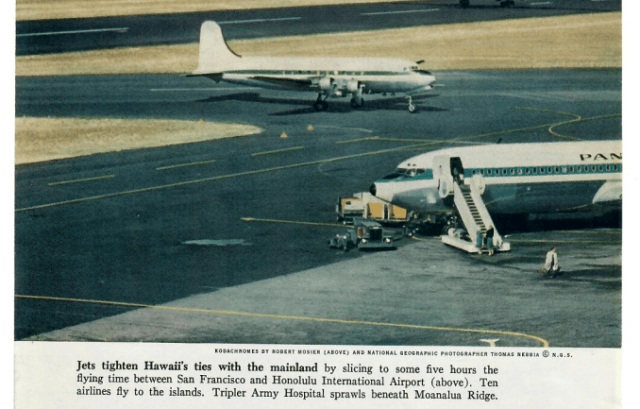
Both articles highlight the burgeoning tourism industry and Hawaii’s military history. Other comparisons are sometimes striking and show how rapidly things can change:
- It’s a state “where pineapple is queen and sugar cane is king,” the latter crop covering 200,000 acres.
- Tourists numbered 240,000 in 1958, a 20% increase since the end of the Korean War in 1953.
- There are no telescopes visible in the photos of Mauna Kea and Haleakala.
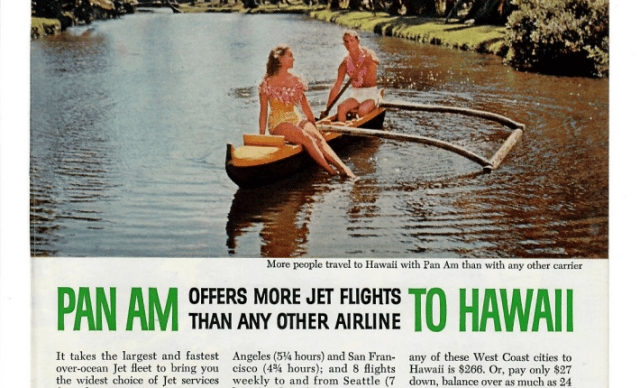
But what is also striking is a photo taken at a University of Hawaii graduation ceremony showing an ethnically diverse population. Contrast that with the advertisement for flights to Hawaii on Pan Am that features a white couple bedecked in lei and leisurely paddling an outrigger.
My primary takeaway from both articles is how quickly Hawaii shifted from an agricultural breadbasket to an import-dependent state reliant on tourism. For today’s policymakers, the challenge of diversifying the economy, supporting its residents and mitigating the negative impact of 10 million-plus visitors a year is immense.
What will National Geographic have to say in 2030?
 Sign up for our FREE morning newsletter and face each day more informed.
Read this next:

Local reporting when you need it most
Support timely, accurate, independent journalism.
Honolulu Civil Beat is a nonprofit organization, and your donation helps us produce local reporting that serves all of Hawaii.
ContributeAbout the Author