The Pandemic Is Taxing Pacific Nations’ Already Strapped Health Systems
Island nations have long been hard-pressed to deal with serious medical conditions and disease. The coronavirus is not helping.
The Covid-19 situation remains a tense one for many Pacific nations, with medical evacuations from French territories, periodic internal lockdowns in Fiji, heavily regulated quarantine procedures throughout the Pacific and many countries generally lacking medical facilities.
Although several Pacific nations were successful in staving off the virus by locking their borders early in 2020, the fragility of health systems on the small islands is apparent as the pandemic has diverted resources from other prevalent health problems.
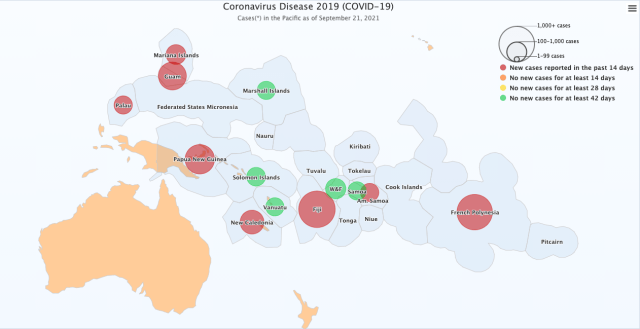
As of Tuesday, there had been about 134,000 coronavirus cases across the Pacific, with New Caledonia, Guam and Fiji reporting 10,000 new cases in the past 14 days.
Last week, French Polynesia evacuated 12 patients to Paris. Fifty people were already in intensive care and 167 people were hospitalized. Samoa locked down for two days, as part of a door-to-door vaccination drive. Meanwhile, pockets around the Pacific have refused vaccination and an estimated 2,500 people protested against compulsory vaccinations over the weekend, objecting to a law scheduled to take effect Oct. 23.

Dr. Adam Craig, an infectious disease epidemiologist at the University of New South Wales, published a study last year modeling potential hotspots within the Pacific by assessing air traffic.
Despite pressure from the tourism and cruise industries, those that closed their borders early managed to weather the pandemic unscathed, health-wise.
“It was one of the best moves they could have done,” said Craig, who has worked for 20 years across Asia and the Pacific.
Though many borders closed since his paper was published, some opened, such as French Polynesia, New Caledonia and Fiji.
The highest risk nations or territories for the importation of Covid-19 were Micronesia, Palau and Guam in the northern Pacific. Papua New Guinea, French Polynesia, New Caledonia and Fiji were most in danger in the South Pacific, according to the paper. Guam was the busiest Pacific territory or nation, as it was the main port of entry to northern Pacific nations and territories.

And though the cases caused significant strain throughout the islands, Craig said it was just one of “two juggernauts of issues.” The other was the preexisting strains on the health system, such as diabetes, heart disease, stroke and cancers, before the pandemic pulled resources away.
The consequences of the lockdowns and the pull of resources would expose further issues in the future, such as reductions in routine vaccinations, said Craig.
The World Health Organization found that the number of routine vaccinations had dropped by 3% in 2020, which left 23 million children unvaccinated. Meanwhile, a Lancet study published last year predicted double-digit percentage increases in rates of tuberculosis, HIV/Aids, and malaria — all of which occur in the Western Pacific.
“In developing countries, in circumstances of crisis, the indirect effects are far worse than the direct effects. There’s no doubt that will be the case with Covid-19,” Professor Brendan Crabb, chief executive of the Burnet Institute and chair of Pacific Friends for Global Health, told the Guardian last year.
Dr. Neal Palafox, who has advised various Pacific nations and territories on public health for the past two decades, says the struggle of the donor-reliant nations or territories that rely on their mainland government for funding is a historical issue.
“They’re struggling for resources to maintain hospitals, maintain ICUs, and oftentimes they don’t have enough beds or staff,” said Palafox, a professor at John A. Burns School of Medicine at the University of Hawaii. “The core infrastructure of hospital systems is not what we’re used to seeing in the West.”
He said many island populations were genetically and environmentally prone to a suite of illnesses. Increasingly sedentary lifestyles combined with highly processed and imported foods and increased alcohol and tobacco use were major causes.
Though Palafox acknowledged the hard work that has been done by these nations and territories, the reality was they were difficult environments for overwhelmed and under-resourced governments.
In 2018, for example, per capita health expenditures in U.S. territories and affiliates ranged from $261 in the Commonwealth of Northern Marianas Islands to $2,012 in the Republic of Palau, compared to $10,637 on the mainland.
They typically rely on aid to help with health problems at the best of times. “I don’t know of any donor nation that brings … their colonies or anything to the same level that their country is,” said Palafox.
Fiji had a per capita spend of $215 in 2018, slightly lower than Tonga and Samoa.
Palafox recently authored a case study comparing U.S. Navy ship responses to Covid-19 outbreaks with island nations and territories. The similarities between populations on ships and islands — people living in close proximity and in relatively isolated places — meant that various outbreaks on Navy ships could provide lessons for the islands.
Palafox assessed containment strategies of the USS Ronald Reagan, USS Kidd and USS Theodore Roosevelt, as well as the cruise ship Diamond Princess. When commanders took a hard line, they were more successful in managing the virus, Palafox found, similar to Palau or American Samoa.
American Samoa “took to heart that if this thing enters our health infrastructure, the way that our people interact, how they’re socialized and so forth, we wouldn’t be able to handle this level of … transmission of illness,” said Palafox.
American Samoa opened to international flights on Sept. 13, and one case was detected, having arrived on a flight from Hawaii that same day. Meanwhile, Samoa and Kiribati have both announced they would open to tourism at the beginning of 2022.
The USS Ronald Reagan and USS Kidd’s aggressive prevention, detection, containment and response plan was the best response. But Palafox acknowledged one key naval advantage: an ability to evacuate their people and restock their populations.
“I think some of the islands don’t quite have that ability. One is, their hospital facilities take time to build up. It’s not just a matter of fly equipment in and or fly people out,” said Palafox. “Because they are the country.”