

Hawaii Officials Urge Vaccines And Boosters Amid Rising Covid Cases
Cases are particularly high in Waimanalo and Waikiki on Oahu.
With the holiday season in full swing, Hawaii is seeing a rise in coronavirus cases that many fear could signal the start of another surge, driven in part by the omicron variant.
The state recorded 395 coronavirus cases Thursday. The last time Hawaii reported that many cases in one day was in September, as the state was coming off a surge of the delta variant. Two new deaths were reported, raising the total to 1,065.
Brooks Baehr, spokesman for the Department of Health, said some of Thursday’s cases included delayed cases from previous weeks.
“Today’s number was 395 and 130 of those were backlogged cases from late Nov. to Dec. 13 that were not previously reported because a testing provider had trouble with the electronic reporting system,” Baehr said.

Still, there’s an undeniable upward trend in cases.
Baehr said that the holiday season, loosened restrictions and the extremely transmissible omicron variant are driving cases up.
Upward Trend
On Dec. 8, Hawaii reported 72 cases and a day later on Dec. 9, that jumped to 143 cases, Baehr said.
“Dec. 9 is two weeks to the day after Thanksgiving and we have not been below 143 since Dec. 9,” he said.
The delta variant is still the dominant variant in Hawaii, according to the state’s latest variant report released Wednesday. But Baehr cautioned that the report’s analysis was conducted on Dec. 4 and omicron is guaranteed to have spread since then.
“We want to spread joy and not Covid. So if you’re indoors wear your mask, only take it off while you’re eating and drinking,” he said. “If you can gather outside, gather outside.”
Rising cases on Oahu are driving the statewide surge, up more than 200% during the first two weeks of December. Cases in Hawaii County have risen slightly, but both Maui and Kauai are still seeing downward trends over the past 14 days.
The increase mirrors the rapid spread of the omicron variant worldwide, with many countries shutting their borders again.
Dr. Anthony Fauci, President Joe Biden’s chief medical adviser, said the United States was on alert for omicron while still battling outbreaks of the delta variant.
“We are already in a delta surge,” Fauci, the director of the National Institute of Allergy and Infectious Diseases, told CNN. “And then you have, looking over your shoulder, the Omicron variant, which we know from what’s going on in South Africa and in the UK, is a highly transmissible virus.”
Hawaii’s seven-day positivity rate rose to 3.1% on Thursday. The last time the state’s positivity rate was that high was on Oct. 3.
Oahu’s test positivity rate was even higher at 3.6% Thursday over the past 14 days. Waimanalo and Waikiki have the highest rate of coronavirus cases per their population sizes over the past 14 days.
Islandwide, Oahu had 164 Covid cases per 100,000 people on Thursday, including 309 per 100,000 in Waikiki and 415 per 100,000 in Waimanalo.
Nationwide Concerns
Mary Oneha, executive director of the Waimanalo Health Center, said the area had a 4.5% test positivity rate and her organization was responding by continuing to provide vaccination and booster opportunities.
“It’s really difficult to see that and then to determine is there something different we can do to help affect that,” she said.
Honolulu Mayor Rick Blangiardi said in a press conference Thursday that he thinks the community is more protected than ever given Oahu’s high vaccination rate.
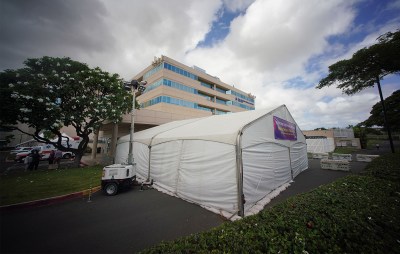
Blangiardi encouraged people to get vaccinated and boosted and to wear masks but said there were no current plans to tighten restrictions again.
“I choose to be more positive than negative about this, but we are going to keep a really close eye on it,” Blangiardi said, adding that one key unknown is the lethality of omicron. “As I’ve said all along, hospitalizations will be a key metric for us. Case counts will shift a pandemic to an endemic.”
He said he would consider reintroducing restrictions such as bans on large gatherings if daily Covid hospitalizations reach between 350 and 400 but noted “we are a long way from that.”
But Hilton Raethel, head of the Healthcare Association of Hawaii, a membership organization for Hawaii hospitals, said that hospitalizations always lag behind other cases and could start to rise as soon as next week.
That’s worrisome because Hawaii hospitals are already relatively full with cases not related to Covid. At the delta surge’s peak, Raethel said Hawaii had 2,365 hospitalizations statewide. Currently that figure is 2,274 hospitalizations, which includes just 40 Covid patients.
Raethel thinks that figure is so high because many people have delayed health care visits since the pandemic began, and many of those patients are suffering from cardiovascular disease and kidney disease.
Eleven of the hospitalized Covid patients Thursday were vaccinated. Raethel said that’s a relatively high rate of breakthrough hospitalizations — over 20% — but noted vaccinated people hospitalized with Covid tend to be less sick and have much shorter stays than unvaccinated people.
Just over 73% of the state’s population has been fully vaccinated, and more than 300,000 booster shots have been administered, according to the health department.
Keeping An Eye On Hospitals
He said another spike in Covid hospitalizations would really stress resources.
Staffing also is a continued concern, he said. Hawaii’s emergency order allowing health care professionals who are licensed out-of-state to work here is expected to expire at the end of January. If that coincides with a surge in hospitalizations, that could worsen the staffing shortage at hospitals, Raethel said.
“The good news is that we have enough statistics out there and enough indicators to give us a heads-up so if these numbers do continue to climb, we know what we need to do,” he said.
Monique Chyba, a mathematician who is part of the Hawaii Pandemic Applied Modeling group, said that the organization’s current model — which is based on many factors and assumptions that may change — suggests that daily cases could rise to 500 daily by the end of the year.
“We are really raising a red flag here,” she said. But she cautioned that many things, including people’s decisions to get vaccinated, get booster shots and to wear masks could change the scenario and that the purpose of sharing the model is to encourage the community to make safer decisions.
“A lot of what is going to happen is in people’s hands,” she said. “It’s an exponential nature so a small change (now), eventually two months down the line can have very large and significant value.”
Even though Chyba’s team is expecting a surge, they are anticipating that there will be fewer hospitalizations than the delta surge because current data suggests that while omicron is more transmissible than delta, it may be less lethal.
Baehr said he’s hopeful that omicron is less lethal but said its transmissibility means it still has the potential to overwhelm the state’s hospital system.
“This is another reminder that this is a pandemic, it’s not an endemic, it needs to be treated as such, and we really need to be careful over the holiday season,” he said. “Please if you’re eligible for a booster, please go get it. Don’t wait. Get your booster.”

