Naka Nathaniel: The Humbling And Helpful Power That Comes From Ho‘oponopono
When things fall out of harmony, restitution and forgiveness helps restore balance.
March 29, 2023 · 5 min read


About the Author

I was lucky to be sitting in rocking chairs in Waimea on Kauai looking out onto the ocean with Aunty Sabra Kauka, when I asked her about one of the most humbling events I had experienced as a teenager.
Aunty Sabra and I had last seen each other 30 years ago and we were sadly reconnected during the illness and passing of her daughter Mehana. Mehana and I had first met when we were participants in a youth legislature program that convened at the State Capitol building in Honolulu.
Aunty Sabra was an adult leader and a photojournalist.

The Aha Opio o OHA program brought together enough delegates to fill both chambers of the legislature and the students were set loose to learn the ins-and-outs of governance. Most attendees had a little familiarity with the legislative process, while others were overly familiar political geeks from Texas used to Molly Ivins’ version of “sumbitches doing bidness in the lege.”
I was one of the kids that perfectly fits the latter description. I stepped on so many toes (more like feet) as House speaker, that the kumu and kupuna had to stave off a revolt.
If you’ve seen the excellent documentary, “Boys State,” you’ll get an idea of the feelings that fly in those compressed quarters and timelines.
Aunty Sabra and the kupuna called for a hoo‘oponopono. Things weren’t right and needed to be made right. It was the first time I’d been introduced to this special Hawaiian process of restorative justice.
In this instance, the delegates were gathered and the justified grievances were aired. I was told I was moving too fast, yelling out for votes before discussions had been had, and otherwise being a political bully.
I pleaded my case, but eventually understood I was in the wrong and asked for forgiveness. I was humbled and learned a valuable lesson in seeking forgiveness and, most importantly, the power of ho‘oponopono.
Aunty Sabra didn’t remember all the details the way I did, but she’s become one of the foremost practitioners of ho‘oponopono and a go-to person on Kauai for Hawaiian cultural practices.
Aunty Sabra said, “It’s so much better to use ho‘oponopono to solve (family) disputes than filing lawsuits.”
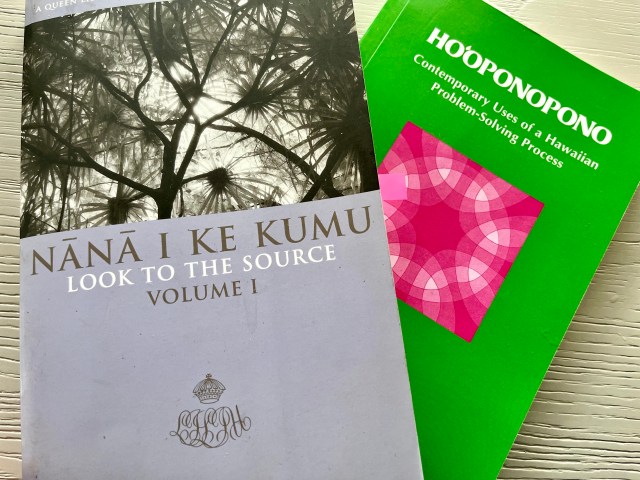
My siblings and parents have used ho‘oponopono to restore balance when things have fallen out of harmony. It happens on occasion, in a family with five kids. The hardest part is finding the time to all gather without spouses and children.
While there are many good written sources, like Victoria Shook’s book “Ho‘oponopono,” it’s a practice that is hard to learn via a text or web site. A great guide is Mary Kawena Pukui’s version found in “Nana i ke Kumu: Look to the Source, Volume 1.”
For her, “ho‘oponopono has specific requirements. Some concern procedure; others attitudes.”
Ho‘oponopono begins with a pule (prayer) and then a statement of the pilikia (trouble) to be resolved.
She emphasizes that there needs to be oia‘i‘o (the very spirit of truth and sincerity.) Disruptive emotions are controlled by channeling the discussion through a mediator or elder using hoomalu (a period of silence.)
At the end of the discussion, immediate restitution would be arranged and, importantly, forgiveness would be granted. The “repenting-forgiving-releasing is embodied in the twin terms, mihi (repentance) and kala (to release.)”
And a pule closes the process.
I’ve seen a distilled version of a ho‘oponopono prayer (it’s not in “Nana i ke Kumu”) saying, “E kala mai i‘au, E kala mai i‘au, Mahalo iā ‘oe, Aloha au iā ‘oe (I am sorry, please forgive me, thank you, I love you.)”
Ho‘oponopono is a tool my large family has used to make things right in our ohana. I warn that it’s a powerful experience. My mother had a heart attack on Christmas Day a few years ago after we had a ho‘oponopono after I caused religious strife earlier in the year.
Fortunately, there was no Nabokovian (ho‘oponopono, heart attack) ending for my mother and she got the best care possible because the hospital was empty that evening. Just to be clear, the ho‘oponopono didn’t cause her heart attack, but it was a very beneficial coincidence because our ohana had cleared the air and we were in harmony and able to deal with my mother’s emergency.
My ohana has continued to use ho‘oponopono and I’m glad to know that my family knows we have a process to resolve disputes and mitigate tensions between us.
I’ve seen several instances where people have called for ho‘oponopono to address pressing problems. I hope those involved have the courage to follow through on those calls and engage in ho‘oponopono.
Gathering people to listen, speak, love and forgive is a powerful process that is humbling and helpful.
 Sign up for our FREE morning newsletter and face each day more informed.
Read this next:

Local reporting when you need it most
Support timely, accurate, independent journalism.
Honolulu Civil Beat is a nonprofit organization, and your donation helps us produce local reporting that serves all of Hawaii.
ContributeAbout the Author