Naka Nathaniel: The Settlement In The Youth Climate Case Against Hawaii Is A Pretty Big Deal
The outcome of the Navahine lawsuit signaled a return to living by some of the fundamental concepts of the aloha spirit.
June 26, 2024 · 5 min read

About the Author

Forgive my abbreviation, but last week a BFD happened in Hawaii that deserves more attention for valiant efforts past and present.
Last Thursday, the plaintiffs and defendants in Navahine v. Hawaii Department of Transportation announced a settlement. This was a case that was slated to go to trial this week after the plaintiffs had been given standing to sue HDOT in April 2023 for not upholding the constitutional right to “a clean and healthful environment.”
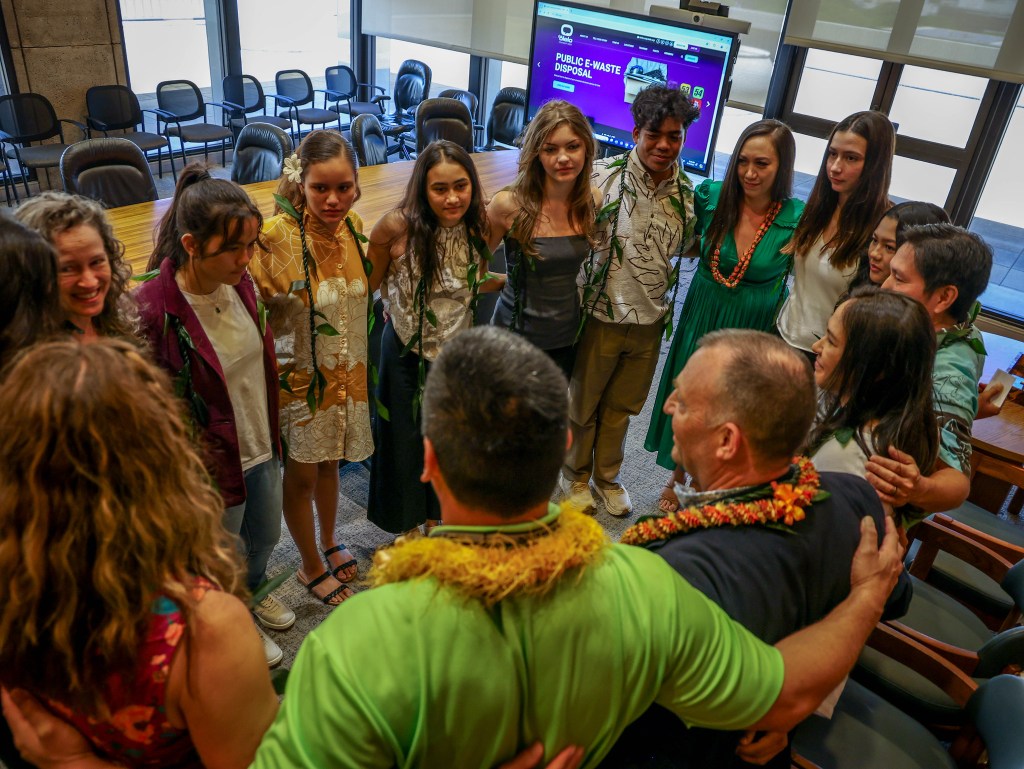
Instead of being in court on Monday, the young plaintiffs were celebrating their victory with mele and popsicles on the grounds of Iolani Palace. As they celebrated, the rest of us are starting to catch up to what is in the settlement and what it means for Hawaii.

Words like “historic,” “unprecedented” and “landmark” were used by news organizations around the world to describe this settlement. And to use a term from the plaintiff’s generation, that isn’t glaze.
The centerpiece of the settlement is the Greenhouse Gas Reduction Plan which is supposed to achieve zero emissions by 2045. But there’s even more B in this BFD because of the where, how and why of the deal.
While the young plaintiffs, Gov. Josh Green and Ed Sniffen, the director of HDOT, deserve credit, the substantial credit also lies with the people who wrote, and then successfully ratified the section in the Hawaii Constitution that granted the right to a “healthful environment” in 1978.
Climate change wasn’t a consideration in 1978. Now in 2024, it’s an existential crisis for many of us that call Pacific islands our homes.
The state constitution ratified in 1978 most notably created the Office of Hawaiian Affairs, but there were other seeds that were planted in it that are now just starting to bear fruit five decades later.
Those constitutional elements sat quietly in the state of Hawaii’s governing document for decades.
In an opinion in February, the Hawaii Supreme Court ruled that “the Law of the Spirit of Aloha” was more consequential than the Second Amendment in the U.S. Constitution.

The definition of “aloha” was authored by Pilahi Paki and became law in 1986. She prophesied that “in the 21st century, the world will search for peace and they’ll look to Hawaii because Hawaii has the key and that key is ALOHA.”
Is this settlement a demonstration of the aloha-driven leadership that Pilahi prophesied?
Quite possibly.
Sniffen said that when he first learned of the suit while head of highways for the HDOT, he wondered: “Why are you suing us? I mean of all states to sue, why Hawaii?”
He realized Hawaii was chosen because of the constitutional requirements.
Sniffen said that when the plaintiffs and defendants met, they quickly realized they were in alignment and that millions of dollars could be saved by not going to trial.
“I think that once we were able to really start talking honestly about ideas without really being weighed down by the weight of the adversarial proceeding, we were able to make progress,” said Leina’ala Ley, an attorney for the young plaintiffs.
Ley credited HDOT, led by Sniffen, for being ready to be innovative.
“I think we’re lucky that we filed this case when we did,” Ley said. “We had this administration, and particularly this director (Sniffen) come in who’s really wanting to look at how can we meet the state’s clean energy goals, how can we tackle greenhouse gases? And had the humility and the open-mindedness to make this happen.”
Humility. When Ley said this I automatically thought of the definition of the H in the acronym for ALOHA as defined by Pilahi: Ha’aha’a.
As we look east across the ocean, we are too often reminded of our differences when it comes to the constitutional obligation to embody aloha. I’m happy to walk into public places and see signs of how Pilahi defined “The Law of the Aloha Spirit.” A was for Akahai (kindness expressed with tenderness), L was for Lokahi (unity expressed with harmony), O was for ‘olu’olu (agreeable expressed with pleasantness), H was for ha’aha’a (humility expressed with modesty) and A was for Ahonui (patience expressed with perseverance.)
We’ve asked a lot of that last A, ahonui. The deep breaths of patience are now coming to bear here in Hawaii.
Anyone who has spent time in Hawaii knows that our population has struggled with blending the collectivist island society that existed here for centuries and the individual-based capitalist society that has dominated for decades. And the other groups that have been welcomed here have added remarkable flourishes to Hawaii Nei.
“Seeing the aloha between our counsel, our staff and the plaintiffs and their counsel brought everything together for us in government,” Sniffen said.
He said both sides’ desire to reestablish and reset the shared culture that they grew up with in Hawaii led to an agreement they expect to serve as a model for others.
It’s remarkable that these keiki and their legal team took up the lessons of kupuna, like Aunty Pilahi and Alvin Shim, and brought them forward five decades and they found a willing partner at the state.
It’s an election year, so candidates battling for votes will repeatedly invoke the necessity for looking toward the future and the world we will bequest to our mo’opuna (grandchildren).
These politicians would be well served to look at the example set by Aunty Pilahi. Her prophesy might actually be coming true and isn’t that wonderful for the world of challenges we are facing together?
 Sign up for our FREE morning newsletter and face each day more informed.
Read this next:

Local reporting when you need it most
Support timely, accurate, independent journalism.
Honolulu Civil Beat is a nonprofit organization, and your donation helps us produce local reporting that serves all of Hawaii.
ContributeAbout the Author