The Sunshine Blog: An Ethics Complaint Against An Ethics Board
Short takes, outtakes, our takes and other stuff you should know about public information, government accountability and ethical leadership in Hawai‘i.
January 4, 2026 · 8 min read


About the Author

Ethical dilemma: Lauren Akitake has only been the executive director and legal counsel of the Maui County Board of Ethics since July, but she’s already the target of an ethics complaint against her office and a petition seeking to remove her and board leaders.
The Change.org petition, posted Dec. 6, comes from Sam Small, an Upcountry resident and director of Maui Causes, a self-styled government watchdog. The complaint, filed Dec. 11, comes from Christopher Salem, a Lahaina resident, a staffer with former Maui Mayor Mike Victorino and a self-described government accountability advocate.
Both matters are centered on a 2024 charter amendment approved by Maui County voters that called for independent staffing of the Maui Board of Ethics. It allows for the nine-member board to hire its own full-time staff, including an executive director, a secretary and an investigator to facilitate ethics training of county employees and investigations of ethics violations.
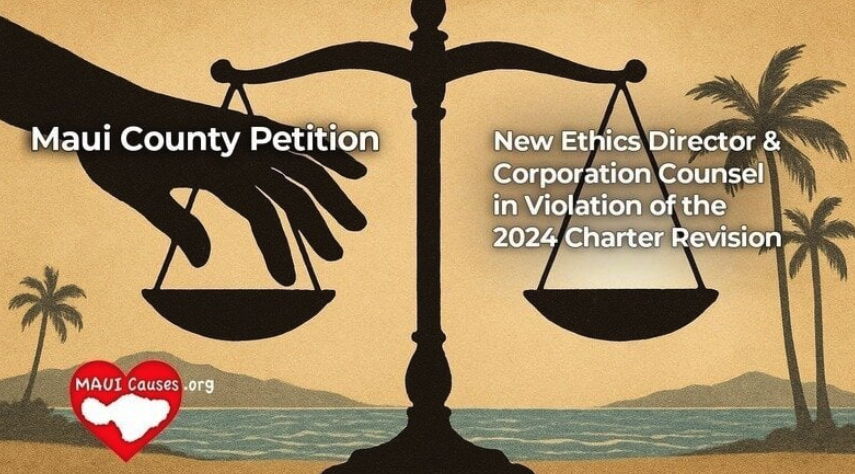
In the view of Small and Salem, the charter amendment intended to give the ethics board its own independent legal counsel so that it would not be subject to the influence of the Maui County Department of the Corporation Counsel.
Corp Counsel is the county’s chief legal advisor for the mayor, the County Council, all departments, boards, commissions, officers “and employees in matters relating to their official duties,” according to the department’s website.
“I want them out of the room,” Small told The Blog on Tuesday, alleging that Corp Counsel has a long history of conflicts of interest and meddling in Maui politics. His petition had 163 signatures as of last week.
Similarly, Salem claims the purpose of the charter amendment was to restore trust in the Maui board of ethics and thus ensure impartial ethics oversight. Salem and Small both refer to Corp Counsel as “the 800-pound gorilla in the room.”

“The people of Maui voted for an independent Board of Ethics, not a continuation of the same misdealings that shield conflicts, silence whistleblowers, and protect political allies,” Salem said in a press release about his complaint last month.
Salem told The Blog on Tuesday that he had not received a formal response from Maui County to his complaint, which is not his first before the ethics board.
“So who reviews whether my complaint has merit against the director?” Salem said, suggesting it would be a conflict of interest for the ethics board to do that.
Asked for a response to the petition and the complaint, county spokesperson Laksmi Abraham said in a Dec. 24 email to The Blog that “Lauren Akitake is unable to comment on complaints before the Board of Ethics.”

The reasons, Akitake said, are to “keep details of ongoing investigations confidential.”
In October Civil Beat reported that the ethics board was backing away from a new rule that would have essentially blocked anyone who filed an ethics complaint against a county employee or elected official from talking about it.
Maui Now reported last month that the board is fielding “a significantly higher volume of inquiries than in previous years, prompting the executive director to call for expanded staffing” in the upcoming fiscal budget.
Michael Lilly, the board’s vice chair, is a big fan of Akitake. In a Dec. 9 press release, he said that “under the capable leadership of our Executive Director and Legal Counsel Lauren Akitake and her staff, we’re poised to fulfill all of our noblest dreams about the effectiveness of this Board of Ethics.”
Ethically challenged: Speaking of ethics and government, a new report from the nonpartisan Campaign Legal Center finds that ethics commissions across the country continue to face new threats and challenges to “their fundamental role in upholding democratic accountability.”
The threats come in three major types, according to a Dec. 8 press release:
- enforcement power threats — attempts to limit the ability of ethics commissions to investigate or penalize violations of law within their jurisdiction;
- subject matter jurisdiction threats — attempts to limit the kinds of laws ethics commissions can administer and enforce, “leading to less transparency and oversight”; and
- existential threats — attempts “to completely strip” ethics commissions of their power.
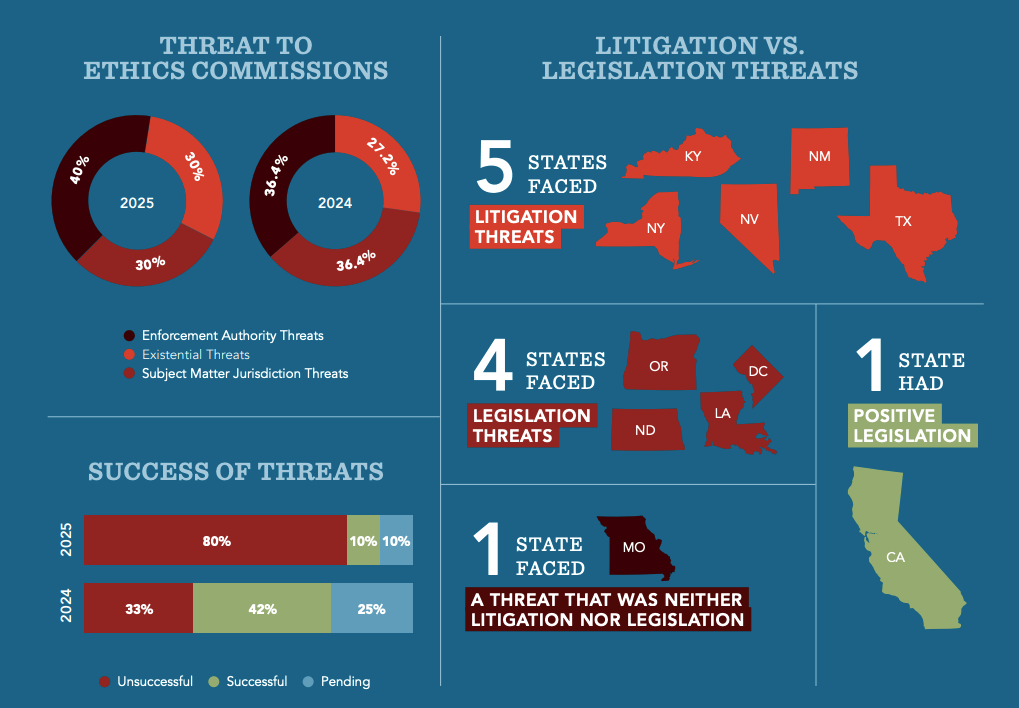
A half dozen states were identified as falling short when it comes to ethics, including Kentucky, where “a legislator sued to halt an ethics investigation into his misconduct.”
Hawaiʻi is not mentioned in the 2025 report, but it did get noticed in the 2024 report — specifically, a threat to gut the state ethics commission’s ability to enforce ethics laws against the Office of Hawaiian Affairs, which argued that trustees had sole discretion over their resources that come from ceded land proceeds.
As Civil Beat reported, the Hawaiʻi Supreme Court ruled in September that OHA trustees are indeed bound by the state ethics code. No more threat.
An early look at ConCons: Every 10 years Hawaiʻi voters are asked if they’d like to hold a constitutional convention, and the next chance doesn’t come until 2028.
But that’s not stopping PBS Hawaiʻi from shining a light on the process now. It plans to rebroadcast programs the station produced about the 1968 and 1978 ConCons in the weeks leading up to a new production Jan. 29, “Is It Time For a Constitutional Convention?”
Chuck Parker at PBS tells The Blog they are still working on the lineup of guests for the live roundtable discussion.
Here’s the schedule:
- “Hawaiʻi Report: 1968 Constitutional Convention, Part 1,” Thursday, Jan. 8, 10 p.m.
- “Hawaiʻi Report: 1968 Constitutional Convention, Part 2,” Thursday, Jan. 15, 8 p.m.
- “ConCon78,” Thursday, Jan. 22, 10 p.m.
- “Is It Time For a Constitutional Convention?”, Thursday, Jan. 29, 7:30 p.m.

All the shows will become available at pbshawaii.org and on the PBS Hawaiʻi YouTube page the night of the scheduled broadcasts and will stay there going forward.
ConCons allow citizens to go over the head of the often-stagnant Legislature by electing delegates who can propose their own constitutional amendments to voters.
Voters approved constitutional amendments following the ’78 ConCon to establish a right to privacy, create the Office of Hawaiian Affairs, make ʻōlelo Hawaiʻi an official state language, establish a state water commission, give counties the exclusive right to levy property taxes, set up campaign spending laws and establish term limits for the governor.
In 2018, voters rejected the idea of holding another ConCon after being barraged with a well-financed campaign of scare tactics by defenders of Hawaiʻi’s political status quo.
The Blog is hoping for a different result in 2028. If PBS Hawaiʻi wants to get the conversation started early, more power to them!
Show us the money, Part 1: Effective with the new year is Act 119, which requires political candidates or their treasurers to file a preliminary campaign finance report Feb. 28 in general election years.
That means there will be a fourth preliminary primary report for candidates this year in addition to April 30, July 9 (30 days before the Aug. 8 primary) and July 29 (10 days before the primary).
The original bill, authored by Democratic Sen. Les Ihara and Republican Sen. Brenton Awa, would have required incumbents seeking reelection to the Senate or House of Representatives to file a report within 10 days of getting a contribution of more than $500 from any person during a legislative session.
The donor would have been required to report not only their name but their occupation, address and the purpose of the contribution. But that was too much transparency, and so lawmakers decided to just add the extra reporting date.
Show us the money, Part 2: The Honolulu City Council is considering a measure requiring the Honolulu Department of Budget and Fiscal Services to create a free, online budget database accessible to the public.
Proposed by Council Chair Tommy Waters and Budget Committee Vice Chair Val Okimoto, the database would allow for perusing city revenues and expenditures, “updated monthly, open-checkbook style,” with required expenditure details and protections for confidential information.
Ted Kefalas of the Grassroot Institute of Hawaiʻi likes the bill, writing in testimony that it “would go a long way” toward making Honolulu’s government more accountable to island residents. But Natalie Iwasa, a CPA and longtime observer of city politics, has reservations.
“In essence you are requiring the city to create a second set of books for public consumption,” she wrote in her testimony. “It would be required to be updated at least monthly. With smaller entities, that may not be too difficult and would likely involve exporting reports to spreadsheets. For the city, where IT support is often a challenge, this may take a huge effort. The question is whether there would be enough public involvement to justify that effort.”
 Sign up for our FREE morning newsletter and face each day more informed.
Read this next:

Local reporting when you need it most
Support timely, accurate, independent journalism.
Honolulu Civil Beat is a nonprofit organization, and your donation helps us produce local reporting that serves all of Hawaii.
ContributeAbout the Author