Biki Deserves More Funding And Better Oversight
What is overlooked amid discussions is that no one has ever died riding Biki.
June 15, 2026 · 4 min read

About the Author

Biki was a gateway to bicycling for me. Before 2019, I had not bicycled since 2004, even then only cycling in parks.
After relearning how to balance (it took me 45 minutes, I fell down so frequently that security at the place I was practicing asked me to leave for fear of liability reasons) and how to turn (another 15 minutes), I started becoming a bicycle commuter for the first time ever.
Even then I was still nervous, and told myself I would only use Biki for three months, stopping after I got hit by a car or had a serious injury.

Ideas showcases stories, opinion and analysis about Hawaiʻi, from the state’s sharpest thinkers, to stretch our collective thinking about a problem or an issue. Email news@civilbeat.org to submit an idea or an essay.
However, nothing happened. It is a fun way to explore the city and get exercise (climbing the hill to University of Hawaiʻi while I was in graduate school was a great workout!).
To this day I am still an avid bicycle commuter, at one point delivering food as a full time job before I became a transportation and land use planner.
Today, I own two electric bikes but still use Biki, if only to go home and back to the bike shop when one or both my electric bikes are being fixed.
What is overlooked amid discussions about Biki is that no one has ever died riding Biki (the closest being a pedestrian who was standing on a pedestrian island with a Biki bike; however, if you are not riding a bike you are technically a pedestrian.)
This is similar to how no one has ever died riding Skyline, and historically annual deaths of bus riders in Hawaiʻi is zero. This is while transit riders have no seatbelts, and bike-share users have a low rate of helmet users.
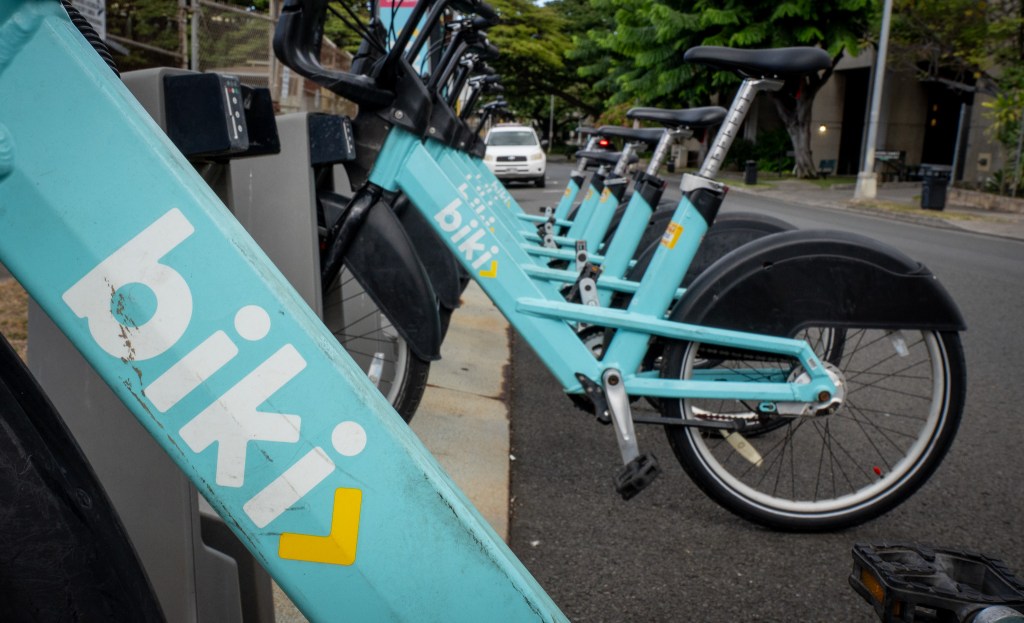
Biki in many ways acts as public transit because of its fixed stations and these stations have likely been placed around good bicycling infrastructure (bike lanes, roads with few cars or cars moving slow, popular transit routes), making routes Biki riders use pretty limited and predictable.
Last year, amid record traffic fatalities, the increase did not come from bicycling fatalities, and in the City and County of Honolulu there was an overall decrease. This follows an overall United States-wide trend of having literally only one death for all bike-share systems in the United States, despite there being millions of rides since bike-share first launched across over 415 cities.
Factoring the explosive popularity of e-bikes, there was an overall giant net decrease in per capita bicycle ridership in terms of cycling deaths in Hawaiʻi — a sign that the improved infrastructure is working despite driving behavior still being poor.
As of the date of publishing this piece, there have been zero bicycling fatalities in all of Hawaiʻi this year.
One of the more common complaints is that Biki stations sometimes occupy parking spots. However, that same Biki station usually has about a dozen or more docks, and most cars cannot hold that many people.
If those who use Biki use it instead of driving, the one parking spot occupied by a Biki station effectively saves multiple parking spots. This is also not factoring that most people in Honolulu drive alone.
Parking spots occupied by Biki support a small local non-profit, whereas parking spots for automobiles are yet another subsidy for non-Hawaiʻi based large corporations (car manufacturing companies, car rental companies etc), never mind road repaving, police, and emergency services all needed to subsidize car use.
Biki has many benefits, from reducing traffic congestion and improving health (people switching from their cars to Biki), to reducing pollution (the stations are solar powered, and bicycles obviously have no emissions), and yes, improve overall safety (besides no one dying riding Biki, no pedestrian or other cyclist has been killed by a Biki rider).
While it has seen better days, Biki at one point was the sixth-most used bike-share system in the U.S. Its massive dip in ridership first began because of the pandemic, and from there never really recovered (as other nonprofits haven’t).
To return to its previous ridership numbers and thus expand the aforementioned benefits, Biki should get more funding and have better oversight, similar to what the City Department of Transportation Services has been doing with TheBus nonprofit Oʻahu Transit Services for decades.
 Sign up for our FREE morning newsletter and face each day more informed.
Community Voices aims to encourage broad discussion on many topics of community interest. It’s kind of a cross between Letters to the Editor and op-eds. This is your space to talk about important issues or interesting people who are making a difference in our world. Column lengths should be no more than 800 words and we need a photo of the author and a bio. We welcome video commentary and other multimedia formats. Send to news@civilbeat.org. The opinions and information expressed in Community Voices are solely those of the authors and not Civil Beat.
Read this next:

Local reporting when you need it most
Support timely, accurate, independent journalism.
Honolulu Civil Beat is a nonprofit organization, and your donation helps us produce local reporting that serves all of Hawaii.
ContributeAbout the Author