Campaign Signs Boost Candidates But Come With Liabilities
Vandalism has marred at least four Oʻahu races this election. The Outdoor Circle advises, “Be legal and courteous.”
June 21, 2026 · 9 min read

About the Author

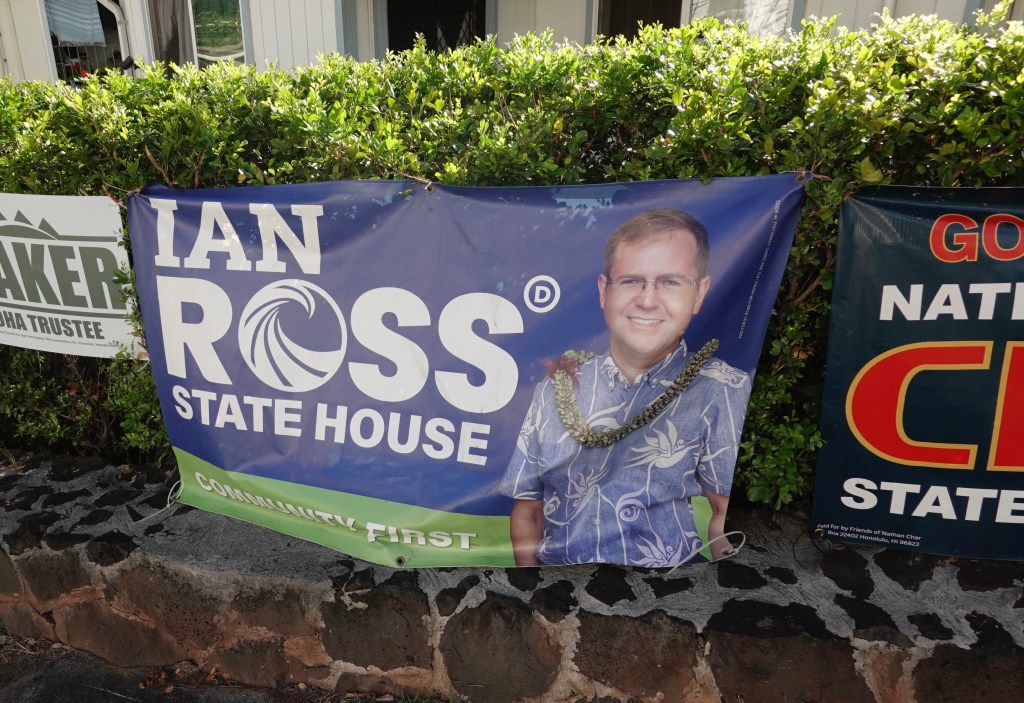
Having twice run unsuccessfully for the Legislature, Ian Ross is hoping his third try this year will finally get him elected. You’ll find his smiling face on his campaign banners plastered all over House District 26 representing Makiki and the Punchbowl area.
When Ross knocks on doors, the recognition from the outdoor messaging helps him connect with voters.
But some of Ross’s banners and yard signs were recently removed without his permission. Others were defaced, his photo getting a blackened eye and a scar.
“It wasn’t a big deal,” Ross said. He declined to speculate whether he was the victim of supporters of one of his two Democratic primary opponents, or the two Republicans also running for the seat being vacated by Rep. Della Au Belatti.
As it turned out, Ross said some of his own supporters, upset by what happened to his signs, ended up contributing money to his campaign so that he could purchase more signs.

Banners and yard signs, which are popping up all over the state this election year, aren’t the only way that Ross and other candidates are appealing to voters. Ross advertises on digital radio and mails out campaign brochures, for example.
But anyone driving along, say, busy Prospect Street that circles much of Punchbowl can’t help but see his signage.
“It helps voters remember my name,” said Ross, a former Makiki/Lower Punchbowl/Tantalus Neighborhood Board chair who works as public affairs director at the Waianae Coast Comprehensive Health Center. “And it starts the conversation on the issues the voters say are most important to them.”
Winning office has a lot to do with name recognition, and campaign signs are a relatively cheap and effective way to raise awareness. It’s a particularly useful strategy when politicking in legislative races, where raising money can be difficult except for the most established and well-heeled incumbents.
In 2024, for instance, candidates for the House spent on average about $25,000 on their campaigns. The state Senate average, where districts are larger, was $52,000.
When candidates add up the cost of printing fliers and mailing them, setting up a website and email services, obtaining voter lists, making T-shirts, holding fundraisers and providing snacks and drinks for campaign volunteers, donations are quickly used up.
But in a district like Ross’s, campaign signs provide a lot of bang for the bucks. They also help spread the word in neighborhoods that are dominated by condominiums and apartment buildings (there are many, especially on Oʻahu), where security systems restrict entry and make canvassing impossible.
While Ross has used local companies for printing services, when he ran for the House in 2024 he paid an Austin, Texas, company called Banners on the Cheap around $2,000. According to its website, a vinyl banner 3 feet by 6 feet can be bought for around $30 while a corrugated plastic yard sign 18 inches by 24 inches can cost as low as $10.
More and more campaigns are ordering their signs in bulk online. The downside, however, is that it is easy to steal or destroy signs in the dark of night. And, depending on the size and detail, that can represent a significant financial loss.
The manufacturing of signs has evolved over the years in order to make them harder to remove or to be damaged by man or nature. Some campaigns now use PVC pipes secured with rope and metal eyelets and hammered securely into the ground.
Signs and banners are also getting more colorful, and many feature logos or photos of the candidates and even their families.
Silencing Viewpoints
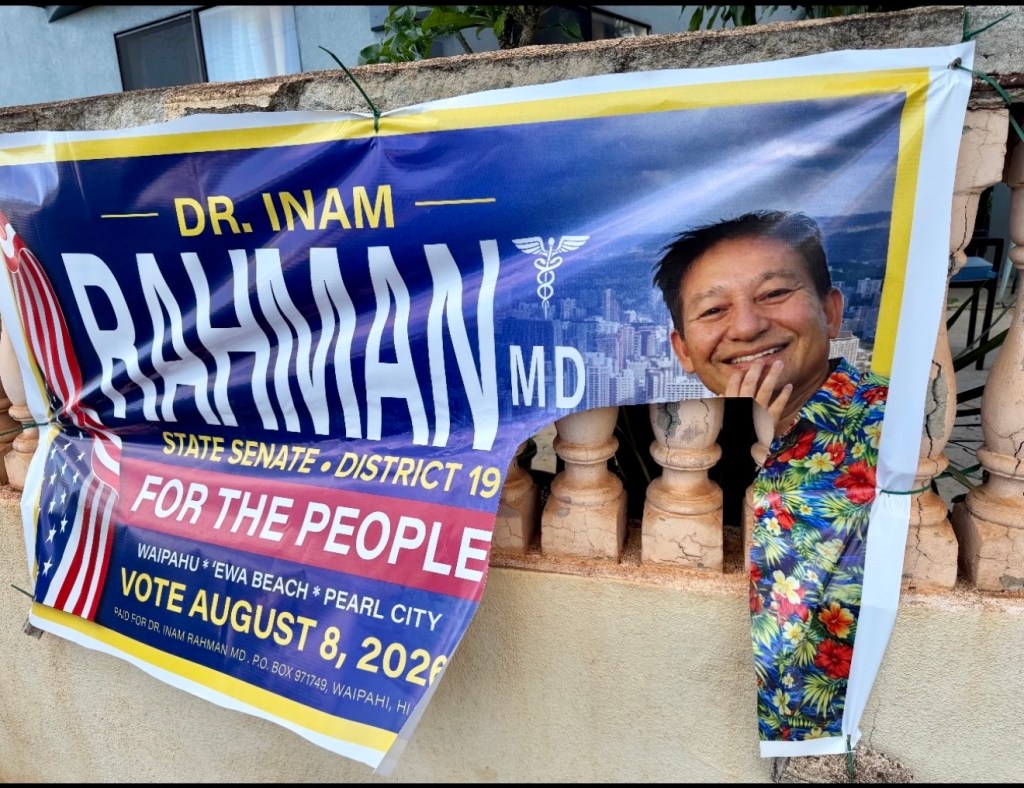
Inam Raham, a doctor running for the Senate District 19 seat in the Pearl City and Waipahu area, said he has signs that have been ripped up and torn down this election season.
He wanted to file a police report but he said it was difficult to prove who did it — even though he believed it may have been recorded on a closed-circuit TV system at one housing complex.
The cost impact is not a small one, especially for campaigns like his that are not heavily funded. Rahman said his largest banners cost about $300 each.
He says vandalism also amounts to a violation of First Amendment rights.
“It is an attack on free expression and civic participation,” he said in an email. “Democracy depends on the ability of individuals to express their views openly and peacefully. When someone removes or destroys a political sign because they disagree with its message, they are attempting to silence a viewpoint rather than engage with it.”
Sen. Rachele Lamosao, who Rahman is trying to unseat in the Democratic primary, said her campaign was not involved in what happened with his signs.
“It was mentioned to me that there was one sign that was placed on my auntie’s house, and she didn’t approve of it,” she said. “She said that they just put it up, and so she had someone take it down, so that was it. And I don’t know what happened after that.”
Lamosao, a former representative who is defending a seat she was appointed to fill just last fall, agreed that signage is important. But it’s just part of the political mix.
“The most important part about campaigning, in general, isn’t about putting up signs,” she said. “Putting up signs allows people to know who’s running, but the most important part is to really get to know the people in your district and walking and talking to them personally. So signs are important, but not as important as making that face-to-face interaction.”
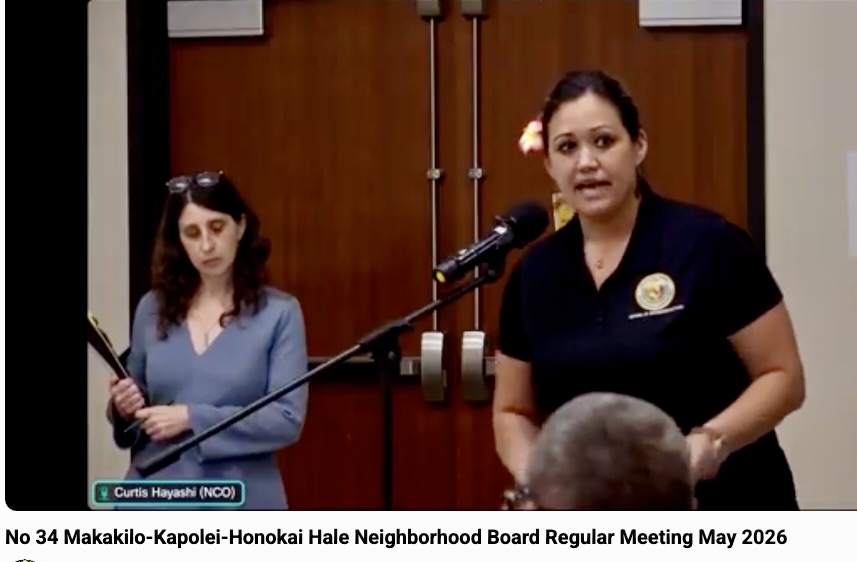
Perhaps the most pronounced dispute over campaign signs this election season so far involves House District 43, where Republican Rep. Kanani Souza is once again being challenged by Sheila Medeiros. Complaints about signs have been aired at several Makakilo-Kapolei-Honokai Hale Neighborhood Board meetings this year, primarily about a Souza sign that was taken down without her permission.
The sign was screwed onto the wooden fence of a home, but two of the occupants said at a May meeting of the board that Souza did not have permission. Souza, who was also at the meeting, defended her campaign and inferred that the Medeiros campaign or one of her supporters may be orchestrating a smear campaign against her.
Souza told me in an email that she received permission to place banners on a certain fence “and acted in good faith based on that permission.”
“For that reason, it is disappointing to see what should have been a routine campaign matter turned into a manufactured controversy. Campaign banners are a lawful and longstanding part of the democratic process, helping candidates communicate with voters and allowing residents to publicly express their support.”
For her part, Medeiros texted me, “Please know that out campaign has absolutely nothing to do with the property damage regarding the incumbent’s signs.”
She added, “Our campaign is focused on serving District 43 through consistent, positive engagement — sign-waving, door-to-door canvassing and community events.”
Avoiding Visual Blight
The Outdoor Circle, a nonprofit that has preserved to protect the beauty of Hawaiʻi for over a century (it’s because of the Circle that Hawaiʻi does not allow billboards), has taken a leading role in advising political candidates how to best handle signage.
It’s website offers laws and advice on posting signs and contact information for government agencies. It is also available to host or cohost candidate forums, “with special emphasis on our environment,” the group’s executive director, Winston Welch, texted me last week.
“We get lots of calls every year on this,” he explained, noting that he rewrote the page on signage recommendations (reproduced below with permission) a couple of years ago in response to the growing concern over political signs.
The Outdoor Circle states at the top of its section on signage the following helpful information:
- “Hawaiʻi law prohibits the placement of political signs on any public property, including median strips, sidewalks, fences and rights of way. Officials will issue citations for and/or remove any signs posted on public property.”
- “There are no laws regulating the size or number of signs placed on private properties, which include businesses and residences. Signs are legal on private property year-round and for any duration of time.”
The Circle also advises that no sign be erected more than 45 days before the day of the election, and all signs should be removed by 10 days after the election.
Based on anecdotal evidence, I’d say that advice has already been rejected by some candidates. Political signs have become part of our landscape, albeit once every two years, and are not likely to go away.
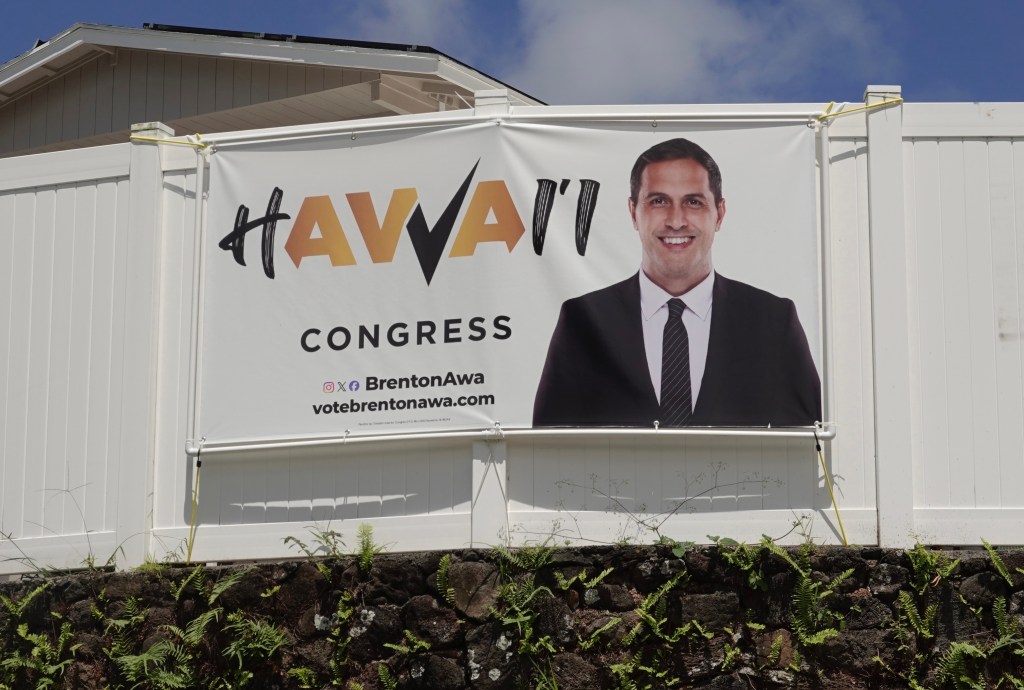
They are especially appealing to underdogs like Brenton Awa, the Republican state senator who expects to face U.S. Rep. Jill Tokuda in November for the 2nd Congressional District seat.
“A lot of our supporters are everyday people, and a lot of them don’t vote, but what they can do is they can put up a sign,” Awa told me. “What that does is it gets us out in the community and it gets us exposure to those people who are participating.”
But Awa has also seen some of his signage disappear. A supporter along the Waiʻanae Coast told him she has seen the signs used as tents for homeless encampments.
“She actually tracked them down — this is her word telling me,” he said. “I was like, ‘You know, if that’s going to happen, I’ll wait till closer to elections to replace them. Hey, no worries’.”
 Sign up for our FREE morning newsletter and face each day more informed.
Read this next:

Local reporting when you need it most
Support timely, accurate, independent journalism.
Honolulu Civil Beat is a nonprofit organization, and your donation helps us produce local reporting that serves all of Hawaii.
ContributeAbout the Author