CSI Cats: How Experts ID The Animal Culprits Killing Hawaiʻi’s Seabirds
Cat lovers often sow doubt when felines are found to be the culprit, especially in mass slaughters like the one recently on Kaua‘i. But every predator leaves behind evidence.

First come the killings. Then, inevitably, the comments.
Whenever feral or free-roaming cats are deemed the culprits in a high-profile killing of Hawaiʻi’s native wildlife, such as the recent mass slaughter of ʻuaʻu kani seabirds on Kauaʻi, plenty of vocal feline enthusiasts raise doubts on social media and in posts below stories.
Was it really cats? How can you be so sure?
Wildlife managers in the islands constantly come across those scenes and, much like a forensic crime investigator, they know which clues conclusively reveal whether a cat, a dog or some other invasive predator killed the animal in question.
Tell-tale signs are immediately there. Cats leave behind a grisly mess for ʻuaʻu kani and other similarly-sized seabirds. Dogs leave those carcasses remarkably intact. Pigs, barn owls and mongoose all have their own calling cards. Rats don’t kill the valuable adult birds who breed – they prey on their chicks and eggs.

Beyond that, there’s often even more, slam-dunk evidence to collect such as video footage, tracks or feathers found in animal scat nearby.
That was the case this spring at Shipwreck Beach on Kauaʻi, where more than 200 adult ʻuaʻu kani, or wedge-tailed shearwaters, have been found torn apart right as they were preparing to nest.
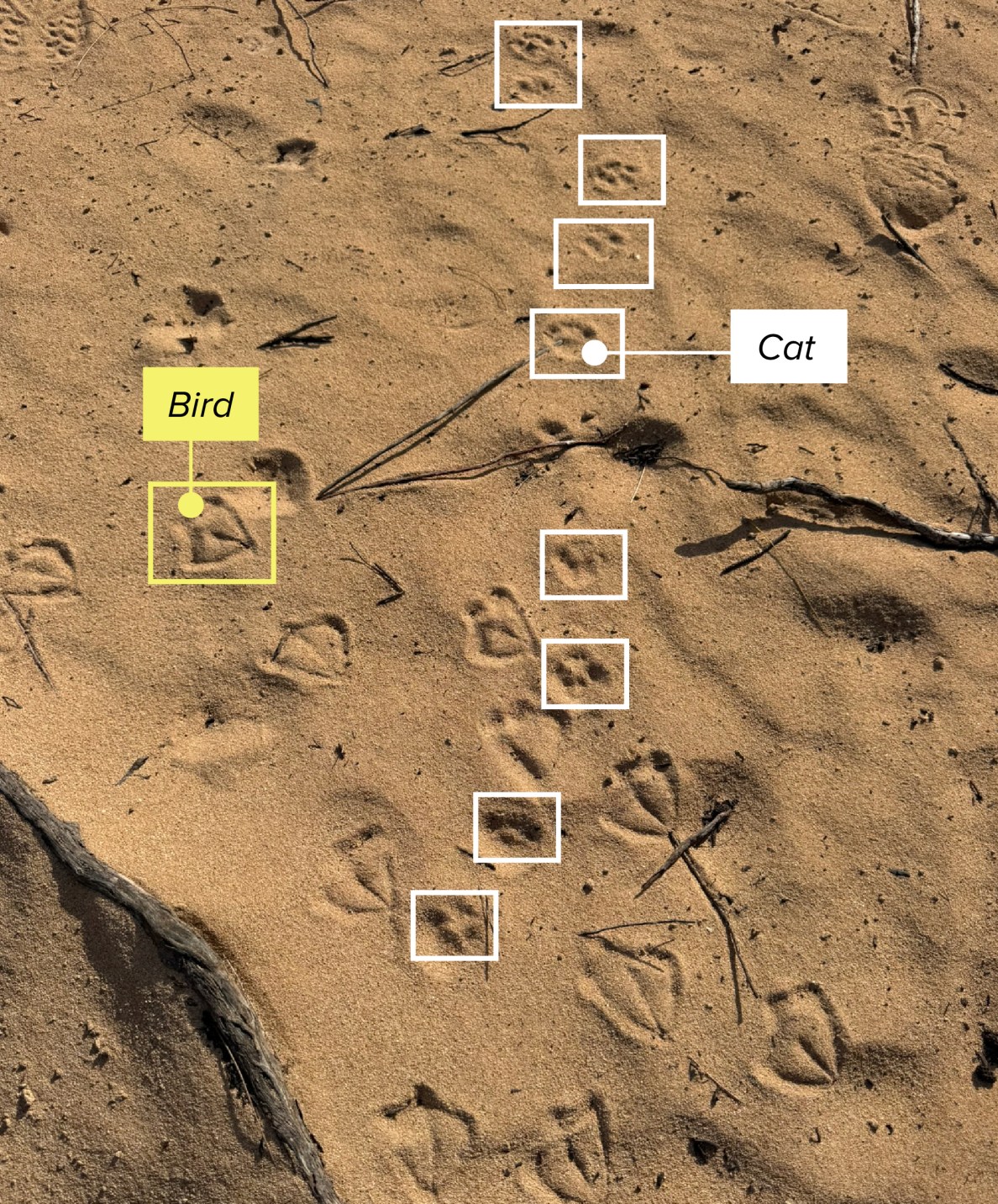
Wildlife managers from the Kauaʻi-based group Archipelago Research and Conservation didn’t just find the mess of feathers and wings that often points to cats – they confirmed it with follow-up video that showed at least two cats treading through the unprotected burrow site at night and paw prints that crisscrossed with bird tracks in the sand.
People nonetheless posted comments on news stories and social media, raising doubts based on a widely shared ARC photo that showed most of the bird carcasses grouped together. Cats, they correctly noted, don’t kill that way.
However, ARC workers had gathered the bird remains there and took the shot after studying the scene to convey the extent of the loss. They determined the kills had occurred over several weeks based on the various states of decay.
Some accepted the explanation, said Hob Osterlund, founder of the nonprofit Kauaʻi Albatross Network. Others didn’t.

Other people posting comments pointed to mongoose as the possible predators in the Shipwreck Beach killings. Those were easy to rule out. Mongoose don’t live on Kauaʻi.
The weasel-like predators are only found on Hawaiʻi island, Maui, Molokaʻi and Oʻahu, according to the state’s invasive species council, after the sugar industry introduced them to the Big Island in 1883 for rat control.
But what about the other potential suspects? Here are the clues wildlife managers at ARC and other organizations look for when they encounter dead shearwaters and other endangered seabirds across Hawaiʻi.


If the remains are found atop a tree stump or some similar perch, ARC Science Director André Raine said, it’s a dead giveaway that a barn owl killed the ʻuaʻu kani or similar seabird. They’re the only invasive predators in Hawaiʻi that do that, he said.
Some owl kills wind up on the ground, too. Raine said they’re identified by two other key clues distinct to the owls’ predation: a neck that’s stripped clean and a keel, or breastplate, that’s picked clean.

Barn owls were brought to Hawaiʻi in the 1950s, according to state officials, for rodent pest control. That move, just like bringing mongoose for pest control, had unintended consequences.
The invasive owls can fly between Kauaʻi, Niʻihau and the nearby islet seabird sanctuary of Lehua, Raine said, where they can take a toll on ʻuaʻu kani and other native birds.
That’s despite a successful, state-funded effort to eradicate the rats that were causing so much of the harm to those birds on Lehua five years ago by eating the eggs and the chicks.


Dogs, unlike other invasive predators, hardly leave any damage, Raine and others said, when they kill seabirds in Hawaiʻi. The carcasses are left intact but signs of the attack remain, such as puncture wounds from where the dog bit the bird and saliva on the feathers.

Raine found the ʻuaʻu kani in the above photo at Shipwreck Beach two weeks after the separate, mass kill by cats was discovered there. He was able to distinguish it as a separate kill by a dog based on the bird’s intact body.
Dogs usually snatch the seabirds when the birds are on the ground, Raine said, because most of the bird burrows are too small to enter. The dogs aren’t interested in eating the birds, he added. Instead, they violently shake the birds in their mouths, playing with them as if they’re toys and breaking their necks in the process.
Then the dogs just drop the birds and wander off.

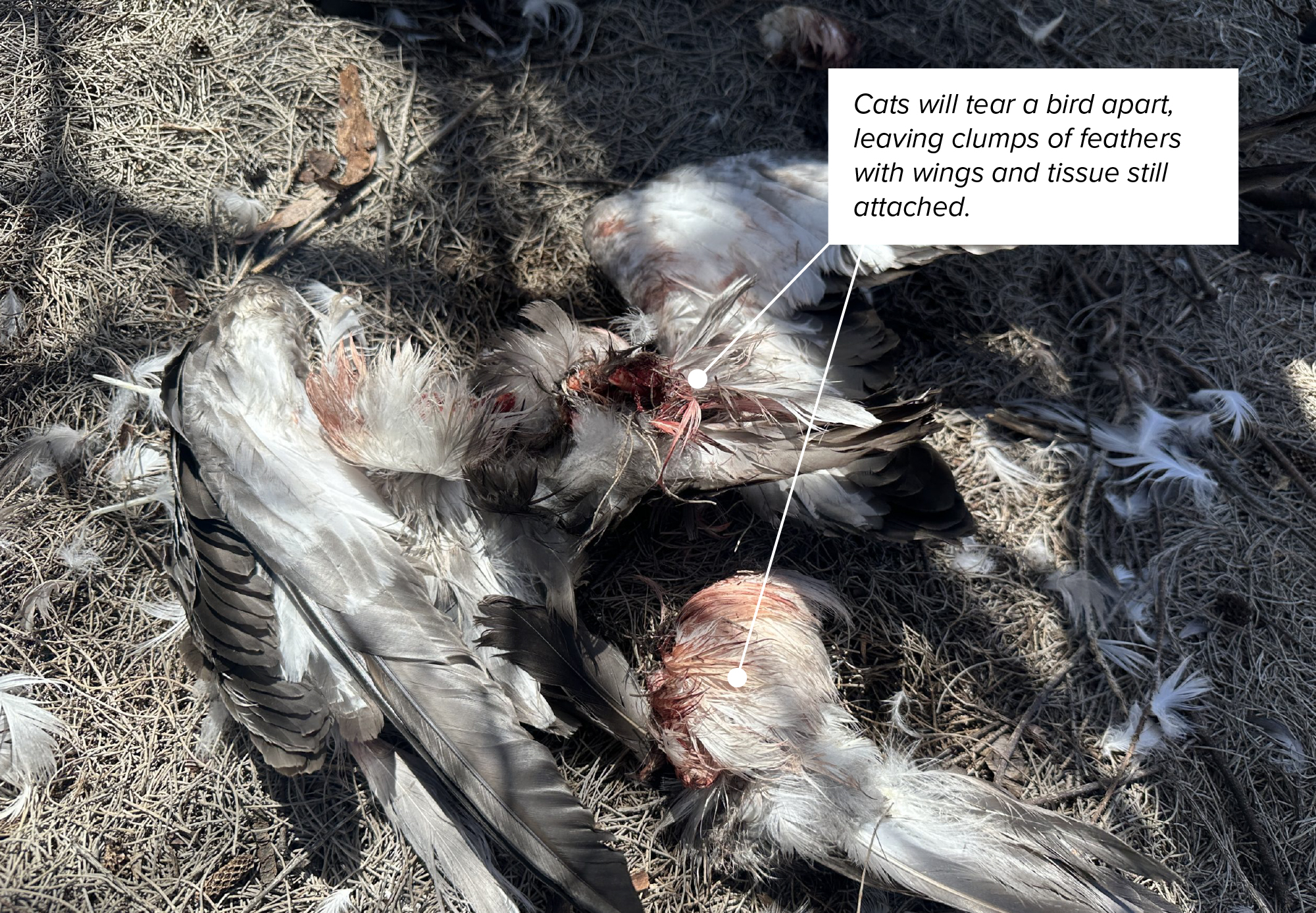
A cat’s seabird kill, Raine and other wildlife managers said, is especially messy. Cats tear the carcass apart, shearing off feathers that blanket the ground near bloody clumps and chunks of bird remains.
“You get these big balls of feathers,” Raine said. “They pull the feathers in the big chunks of meat out, and so it’s all balled-up.”
The felines sometimes bring the birds they kill back to a separate area they consider safe to eat, Raine added. Occasionally, he and his colleagues will find dead birds with the back of their heads bitten off. That’s another common sign of a cat kill, Raine said, because the cats often look to eat the brain.

Raine said he and his ARC colleagues found cat prints all over the site of the Shipwreck mass kill, including prints that overlapped with ʻuaʻu kani tracks. That corresponds with the multiple cat sightings caught by ARC cameras set up there, he added, after the dead seabirds were found.
Wild pigs also leave messy kills when they prey on seabirds, Raine said. A key difference, he added, is that the pigs also dig up the burrows. Cats, by contrast, enter the burrows and drag the birds out.
“It’s as if someone stuck a hand grenade in the burrow, because the burrow is just, like, blasted,” he said of the pig kills. “Then you’ll just get bits and pieces of bird everywhere.” The pigs also leave their hoof prints and droppings as tell-tale signs, Raine said, plus broken-up bits of wing from when the animals chew them up and spit them out.
At Shipwreck, the burrows remained intact, Raine said. That’s more evidence that cats did the killing.
On other islands, when mongoose do the killings they rarely leave the bird carcasses behind, said Jay Penniman of the Maui Nui Seabird Recovery Project.
“We see them in the game cameras taking the birds,” he said.
Don’t Blame The Cats, Though
A 2019 study that Raine co-authored in the Journal of Wildlife Management found cats killed a little more than a third of the endangered Newell’s shearwater and Hawaiian petrel birds on Kauaʻi between 2011 and 2017. Some 309 of those two bird species were killed on the Garden Island in that period.
The study found black rats had killed half of the birds. Nonetheless, it concluded cats caused the most harm because they mostly killed breeding adults.
The rat “is killing more individuals, but it’s taking out the chick or the egg,” Raine said. “It’s sad because the adult pair only have one a year, but at least the next year that bird can come back to breed again.”
Pigs killed just over 10% of the birds, the study found, and barn owls just under 4%.
Many local cat welfare groups fear the growing attention on felines as one of the main threats to native wildlife has helped demonize the animals across Hawaiʻi and led to isolated incidents of cat torture and killing.
Those groups and local conservationists said the people who first introduced cats – as well as those who regularly abandon and release them – should be held responsible for the subsequent wildlife deaths, not the cats themselves.
“To me, we’re reneging on the contract we made with cats by dumping them on the landscape and thinking that’s any kind of life,” Osterlund said. “I think more people see that now.”
The online cat comments don’t sow as much public confusion as they once did, Osterlund and other conservationists say, because Hawaiʻi residents are seeing more free-roaming cats and feral cat colonies across the island landscape.
“People are more akamai (smart) about it,” Osterlund said.
Civil Beat’s reporting on Kauaʻi is supported in part by a grant from the G. N. Wilcox Trust; coverage of climate change and the environment is supported by The Healy Foundation, the Marisla Fund of the Hawai‘i Community Foundation and the Frost Family Foundation.