

Former Honolulu Employee Pleads Not Guilty To Defrauding Hawaiʻi Foodbank
Attorney says that Dexter Kishida did not benefit personally and got caught up in ‘complex government bureaucracy and red tape.’
A former Honolulu government employee pleaded not guilty on Monday to charges of theft, forgery and professional misconduct in telling the Hawaiʻi Foodbank that $800,000 in pandemic relief funds were available, then covering up the fact that it wasn’t after the food had already been distributed.
An attorney for Dexter Kishida, 46, entered his plea of not guilty in Circuit Court to all three counts, which combined carry a possible sentence of 20 years.
Kishida was simply doing his job getting CARES Act funds and food to people who needed it during the Covid-19 pandemic, his attorney, Addison Bonner, told Civil Beat after the arraignment at Kaʻahumanu Hale, the courthouse on Punchbowl Street.
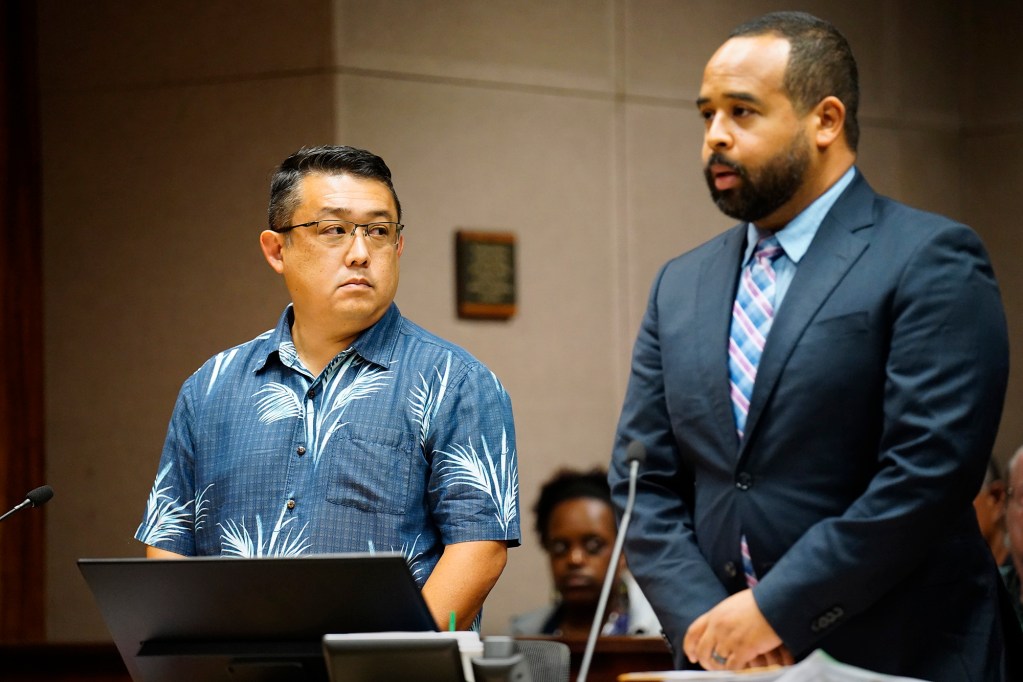
“In this context, that was advancing the food bank’s mission of feeding Hawaii’s hungry,” Bonner said. “The government has chosen to prosecute him in connection with his efforts, and we’ll have to deal with it in court.”
Kishida was present in the courtroom Monday but did not speak to the charges, only affirming to Judge Ronald Johnson that he understood the terms of his release on $15,000 bail.
The CARES Act was part of a $2.2 trillion economic stimulus package Congress passed in March, 2020. Initially, the funds had to be spent by that December, a deadline later extended to December 2021.
Bonner told Civil Beat that after securing an initial $800,000 for the food bank, Kishida learned of another $800,000 that was available and worked to get it for the nonprofit so it could buy and distribute more food from local farmers.
“Unfortunately, for reasons unrelated to anything Mr. Kishida did, the government later decided to withdraw this second round of funding, a decision entirely outside of Mr. Kishida’s control,” Bonner told Civil Beat in a statement. He said he believed it was the federal government that withdrew the funding.
He declined to comment directly on the forgery and misconduct charges but said Kishida “has been caught up in a situation arising out of complex government bureaucracy and red tape.”
At the time of his alleged crimes, Kishida was working for Honolulu’s Office of Economic Revitalization, which was set up to help handle the flow into the city and county of hundreds of millions of dollars of CARES Act funds.
The pandemic shutdown had forced tens of thousands of Hawaiʻi residents out of work or into part-time employment. Food insecurity was climbing. As the Food Security and Sustainability Program manager, Kishida’s job was to make sure vulnerable residents got the food they needed, including through steering funds to nonprofit service providers.

The state Attorney General’s Office has said that he falsely told the food bank — with which he had already been working to ensure it got federal money for hunger relief — that more funds were there to buy food from local farmers.
When the food bank billed the city for the purchases, though, it found the money wasn’t on hand. Kishida then altered a purchase order and fabricated emails from city officials to make it appear the reimbursement was being processed, prosecutors said in a news release last week.
On Monday, Bonner acknowledged that the food bank was out $800,000 but said that Kishida hadn’t received money or any other benefit from what took place.
“He did his best to help the community,” Bonner said. “Unfortunately, his reward is having his name smeared and having to deal with these charges in court.”
‘A Changemaker’
The charges — spanning from December 2021 to August 2023 — have stunned those who know Kishida.
“He didn’t make promises that he didn’t think he could keep. And that’s why this story doesn’t make any sense,” Julia Alaimo, who worked for Kishida as a sustainable food systems specialist from 2022 to 2023, told Civil Beat. “He would never have promised this to them if he didn’t truly believe that this was going to be possible.“
Alaimo, who joined the revitalization office through the federal AmeriCorps Vista community service program, said the main effort she worked with Kishida on was a $3.1 million agricultural initiative in which local farmers received $50,000 grants to help them stay afloat when they were losing customers because of the pandemic’s economic impact.
She and Kishida also worked closely with the Hawaiʻi Foodbank, Alaimo said, on programs to help them procure from local farmers most of the food they were distributing to Oʻahu residents.
“He didn’t make promises that he didn’t think he could keep. And that’s why this story doesn’t make any sense.”
Julie Alaimo, former staffer, Honolulu Office of Economic Revitalization
“It was like I was working with someone famous because no matter where we went, there was someone just wanting to talk to him because they knew that he was a changemaker,” said Alaimo, who now works with an environmental issues nonprofit in California. “To be in Dexter’s circle meant that you were going to make something good happen.”
She said the process of approving the distribution of funds involved a number of city personnel in and out of the economic revitalization office.
“I don’t know how this is all getting pinned on him when he was just one,” Alaimo said. “He was a program manager, but he didn’t have a high ranking position, he couldn’t personally authorize for $800,000 to go through.”
One Hawaiʻi attorney who specializes in white collar crimes, suggested that the theft charge, which carries the most severe penalty — up to 10 years in prison — would be the toughest to prosecute.
“You have to have the intent to defraud and if, speaking hypothetically, he mistakenly believed the federal funding was available and therefore told the food bank, then he is not intentionally deceiving the food bank,” Megan Kau said. “He’s making a mistake.”
She added: “Even if we do speculate that that’s what happened, the cover up is always greater than the crime itself. And now he’s being charged for fraud. If in fact that was the cover up.”
On Monday, Kishida’s jury trial was set for the week of Aug. 31.

