Green Signals He May Veto Bill To Add $50M To Rainy Day Fund
The governor also approved the new state budget, and announced he may veto measures dealing with school closures and teacher licensing.
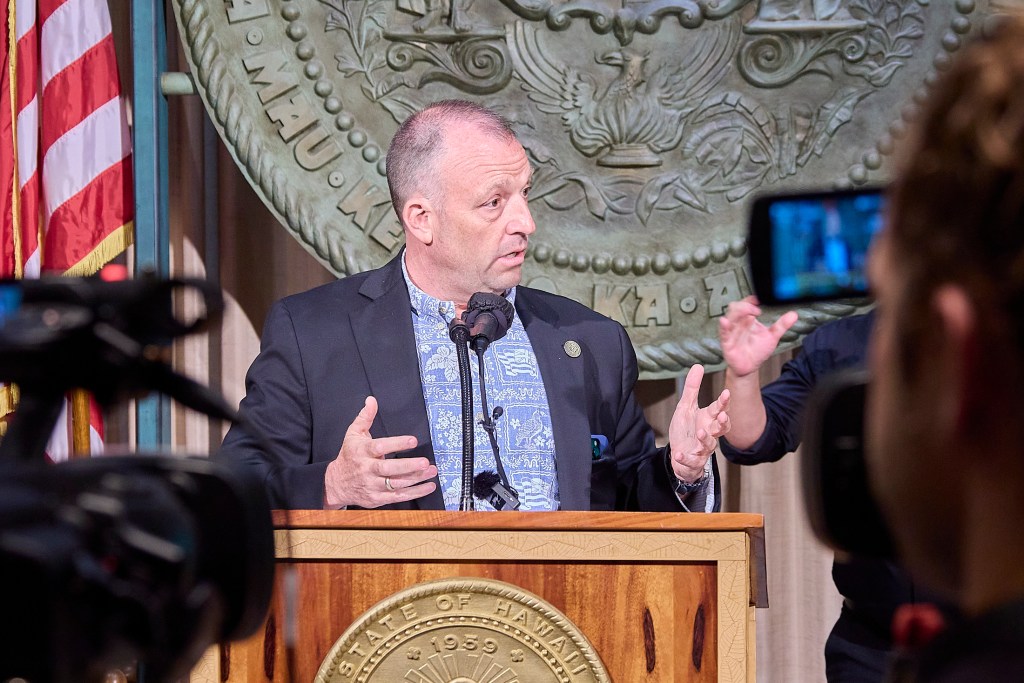
Gov. Josh Green on Friday signed the new $20.3 billion state budget for next year, but announced he may veto a separate measure to transfer $50 million into the state’s “rainy day” budget reserve fund.
Green said in a written statement he may also veto a handful of other measures approved by state lawmakers this year, including one that would create a temporary Public School Realignment and Closure Commission to recommend closures of underutilized public schools.
The new state budget includes $4.53 billion for construction projects across the state, and Green said in his statement it “continues to invest in Hawai‘i’s priorities, including affordable housing, support for local families, public health initiatives and economic development opportunities, particularly amid reductions and uncertainty in federal funding.”
The budget also includes funding for dozens of conservation and other projects that will be financed with $129 million from the new “green fee” that was approved by the Legislature in 2025. The green fee is financed mostly from an increase in the state hotel room tax, and that money is earmarked to pay for 91 projects.
If history is any guide, not all of the money lawmakers included in the new state budget will actually be spent. Green has the power as governor to withhold and lapse funds if he chooses, and has used that authority aggressively in recent years.
The administration lapsed $863 million in the fiscal year that ended June 30, 2024, and lapsed another $533 million the following year. That action effectively carries cash forward into future years, which helps boost the state’s bottom line at a time when federal funding has been cut or may be threatened.
Green has already signed more than 160 bills into law this year, including measures to amend the state income tax cuts approved by the Legislature in 2024, and another measure to allow for a series of automatic rate increases for interisland shipper Young Brothers.
But Green announced Friday he intends to veto Senate Bill 2600, which would transfer $50 million from the state general fund into the Emergency and Budget Reserve Fund, better known as the state rainy day fund.
Green explained in his written statement that “given disaster recovery efforts and other state priorities such as affordable housing and reducing the cost of living for our residents, it would be financially imprudent” to make that transfer.
The administration has projected the rainy day fund will hold more than $1.6 billion in reserves when the current fiscal year ends on June 30, which would be the largest cash balance it has ever had.
Possible Education Vetoes
Green also said he may veto Senate Bill 3262, which would require Senate confirmation for the executive director of the Hawaiʻi Teacher Standards Board. That board is tasked with licensing educators and setting requirements for their certifications.
Currently, the standards board director needs no legislative approval. The director instead is selected by the standards board and must receive approval from the state Board of Education.
The standards board strongly pushed back against the bill, which was introduced by Senate Education Committee Chair Donna Kim. No education officials – including the schools superintendent – require Senate confirmation, the board said in its testimony.
“The precedent across Hawai’i’s education-related boards and commissions is clear and consistent: executive directors are appointed by their respective governing boards, not by external political bodies,” said standards board licensing specialist Mitzie Higa in written testimony.
But teachers and education professors have said the standards board has made it unnecessarily difficult for prospective educators to earn their licenses, particularly in high-demand areas such as special education, Hawaiian immersion and instruction for English language learners. Schools are increasingly relying on unlicensed teachers to fill their vacancies.

Those concerns culminated earlier this month, when the board decided not to renew executive director Felicia Villalobos for another four-year term. Leading up to the vote, lawmakers urged the board to hold off appointing Villalobos for another term, arguing that Senate Bill 3262 would significantly change the process of appointing an executive director if it were signed into law.
But Green included the bill on his list of possible vetoes, saying the measure requires a more in-depth review of the responsibilities of the state education board and teacher standards board.
“Additional evaluation is needed to assess how the proposed changes may affect the respective roles, authorities and oversight functions of each entity to ensure that any changes are clearly defined, appropriately structured and do not create ambiguity regarding governance and accountability,” Green said in his written statement.
Lawmakers also tried to take school closures into their own hands with House Bill 2344, which was introduced by Rep. Kyle Yamashita. But that bill may also be on Green’s hit list.
The bill would establish an independent commission to study the potential closure and consolidation of schools. If the commission proposed school closures, the education department would be tasked with implementing its recommendations by fall 2029.
Currently, school closures are the responsibility of the education department and state education board. Superintendent Keith Hayashi raised concerns about the proposal, arguing that the department already has a process for closing schools that takes into account campus resources and students’ access to learning opportunities.
Green echoed those comments in his veto rationale and said the proposal creates requirements that already fall under the education department and Board of Education.
“These changes may create duplicative processes and administrative burdens without providing a clear benefit,” Green said.
The education department hasn’t closed a school since 2011, even as enrollment falls. Last fall, the education department said it was looking into redistricting schools instead of studying campus closures.
Last fall, the education department enrolled 150,280 students, down from nearly 170,000 a decade ago. The state is also projected to see the nation’s largest drop in high school graduates by 2041.
The deadline for Green to veto bills is July 15. After that date the measures will become law without his signature.