Hawaiʻi’s Imperiled False Killer Whales Are Going Hungry
The endangered whales’ numbers are still trending in the wrong direction. Researchers just found a new piece of the puzzle as to why.
A false killer whale that researchers call “PWF#0109” shed about 500 pounds in just 10 weeks as it sought the increasingly scarce mahimahi, ono and other large fish it needed to survive in the waters off the Main Hawaiian Islands, according to new research.
The loss represented more than a quarter of the endangered animal’s body weight, Pacific Whale Foundation Chief Scientist Jens Currie said, and it highlighted a growing problem for the unique population that lives solely off the main islands.
Those false killer whales, which are already trending toward extinction, aren’t finding enough food as they compete with nearshore commercial fishers who pursue the same, dwindling catch, according to a new study by Currie and other marine mammal researchers. Warming seas tied to climate change are also driving down the available nutrients, they found.
The study, published this month in the journal Endangered Species, adds to a previous and possibly related finding: that the local false killer whales — which are actually dolphins — now get hooked and injured by gear from nearshore commercial fishing boats at a troubling rate as they pursue food around the islands.
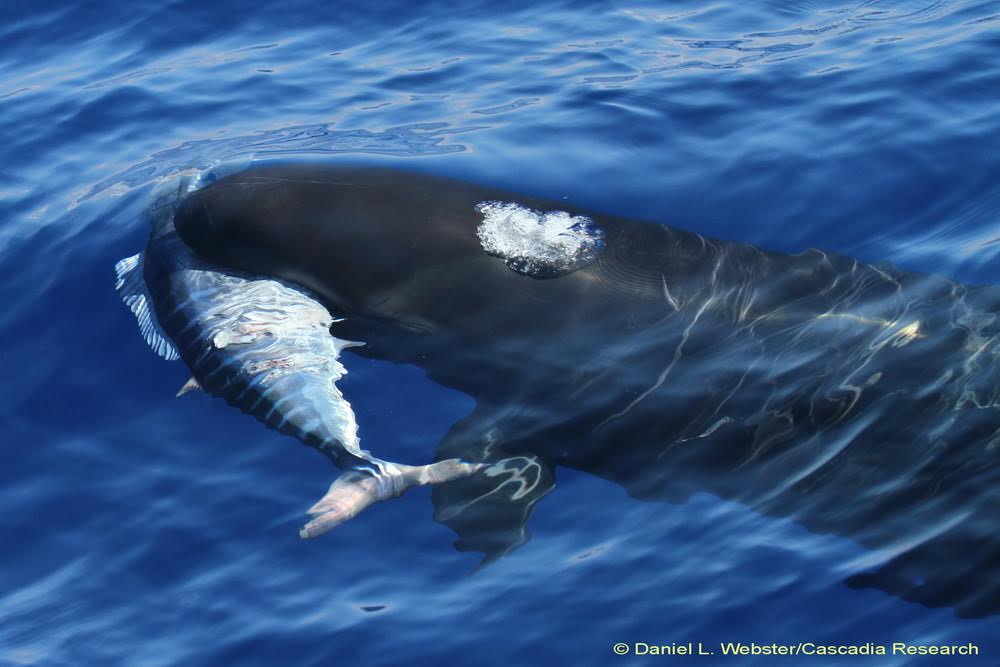
“This helps fill an important piece of the puzzle,” said Robin Baird, a biologist with nonprofit Cascadia Research Collective. Baird helped lead the previous study on the hookings, and the new study heavily cites his research.
For their findings, Currie and his colleagues analyzed the weight of at least 69 false killer whales around Hawaiʻi using high-resolution overhead drone pictures of the animals taken between 2019 and 2025. They compared those shots with 3-D imagery of separate false killer whales kept in captivity in Japan, according to a Pacific Whale Foundation press release, to calculate the individuals’ size and weight changes.
The animals’ weight would have stayed the same or even grown over time, Currie said, if they had enough fish. Instead, many of the local whales had unhealthy fluctuations, the report found, especially PWF#0109.
In most cases false killer whales managed to survive the weight loss, Currie said. That likely includes PWF#0109, whose dramatic weight loss was tracked 2021 and, according to Currie, was last seen about six months ago in poor health.
The animals, both he and Baird said, can be pretty resilient. Still, Baird said, false killer whales are slow to reproduce and that poses a big challenge for the endangered local population that hasn’t been able to rebound. Female false killer whales don’t start birthing calves until they reach about 10 years old, according to Baird, and then only have a new calf once every seven years or so.
Malnutrition could hamper their ability to birth or rear calves, Baird said, making the false killer whales’ already slow reproduction rate even slower.
“Prey availability is, in feeding and survival, going to lead to reproduction,” Baird said. “It’s going to allow animals not to die from malnutrition or other associated things.”
Turning The Tide
Two other groups of false killer whales live or visit Hawaiian waters besides the group that Currie and his colleagues studied. One inhabits the waters around the Northwestern Hawaiian islands and another pelagic group migrates between the islands and the deep ocean.
However, only the population that hugs the Main Hawaiian Islands is listed as endangered. In fact, Baird said, itʻs the world’s only endangered population of false killer whales.
The two groups nearest Hawaiʻi’s main and northwestern islands, he added, are the only ones scientists know of that exclusively inhabit an island chain without migrating elsewhere.
Only 139 or so individuals remained in the endangered main island group as of researchers’ most recent estimate in 2022. That group would need to see steady population gains over 50 years and then grow to at least 430 individuals, Currie said, to no longer be considered endangered.
So far, the group has trended in the opposite direction. It’s declined at an annual rate of 3.5%, researchers say, since federal fisheries managers listed the group as endangered almost 15 years ago.

Baird and others have publicly pressed those federal managers to step up efforts to protect the local false killer whales. Those managers had already flagged decreases in available fish to prey on as a potential risk to the local animals’ well-being about two years before declaring them endangered.
At the same time, the National Oceanic and Atmospheric Administration has been stretched thin due to budget and resource cuts during the Trump administration.
Currie specifically called on state and federal fisheries managers to more closely examine just how abundant mahimahi, yellowfin tuna and other big fish stocks are around the Main Hawaiian Islands – and see how those numbers compare with catch data reported by the commercial vessels that fish there.
“The goal isn’t to shut down the fisheries,” Currie said. Instead, he said, it’s to get a better sense of how much fish is available and manage those resources so that Hawaiʻi’s false killer whales have the food they need to recover and help rebound their numbers.
“There’s a problem here,” Currie said, “but I think there’s a solution if we can work together.”
Record-breaking heat waves and ocean warming fueled by climate change are only making things worse, Currie’s study found. The local false killer whale group collectively lost its most weight and saw its biggest population drop in 2020.
That followed one of the hottest years ever recorded in the islands, Currie said, and it could’ve meant even fewer of the large fish they prey on were available in Hawaiian waters at the time.
Baird said he’d be interested in studying whether there was also an uptick in injuries from fishing equipment around that same time as the false killer whales sought to take more catch directly from vessel hooks and lines. Cascadia currently can’t do that research, he added, due to its own funding and staffing shortages related to the federal cuts.
“The time for action is now,” Currie said. Referring to PWF#0109, he added: “If all the other lines of evidence haven’t been enough, perhaps this one individual that’s enduring so much can serve as a beacon of awareness.”
Civil Beat’s coverage of climate change and the environment is supported by The Healy Foundation, the Marisla Fund of the Hawai‘i Community Foundation and the Frost Family Foundation.