Hawaiʻi Must Build Smarter After The Floods — With Trees As Infrastructure
Many natural systems have been replaced with hard, impermeable surfaces that shed water quickly. What is missing is absorption.
June 8, 2026 · 5 min read


About the Authors


When entire communities face evacuation or emergency warnings, we tend to ask whether our infrastructure failed. After last month’s Kona low storms, that reality is unavoidable across Oʻahu and Maui County. A more important question is this: what kind of infrastructure did we build in the first place, and what did we leave out?
As communities recover, the scale of disruption is clear: evacuations and flooding across Oʻahu and Maui, from Haleʻiwa and Waialua to Lahaina, Kīhei, ʻĪao Valley and East Molokaʻi.
What these storms revealed, once again, is that many of our communities are not designed to absorb water. Instead, our landscapes have been built to move water as quickly as possible off roofs, across roads and into drainage systems that are increasingly pushed beyond their limits. When those systems fail, they fail all at once because they are designed to move water away, not absorb it.

Ideas showcases stories, opinion and analysis about Hawaiʻi, from the state’s sharpest thinkers, to stretch our collective thinking about a problem or an issue. Email news@civilbeat.org to submit an idea or an essay.
For generations, water in Hawaiʻi was managed through the ahupuaʻa system, an approach that recognized the deep connections from mauka to makai. Forested uplands captured and slowed rain. Vegetation zones with different functions called wao absorbed and filtered water as it moved downslope. Nearshore systems depended on what happened above. It was a system designed to use water wisely and support life.
Today, our built environment often works against those same principles. Many natural systems have been replaced with hard, impermeable surfaces that shed water quickly and concentrate it into drainage infrastructure. The result is faster runoff, higher flood peaks and greater strain on public systems.
We cannot solve this problem with pipes alone. Drains, culverts, and channels are essential, but they are designed with limits. As rainfall intensifies, those limits are exceeded more often. What is missing is absorption.
Trees and healthy soils provide that function. They intercept rainfall, increase infiltration, stabilize slopes, reduce runoff and help recharge aquifers. Spread across a landscape, they act as distributed infrastructure, working everywhere at once rather than only where pipes are installed. This approach is not without risk.
During severe storms, trees can fall, damaging property and disrupting power. But removing trees does not eliminate risk; it often shifts and amplifies it. Landscapes without trees shed water faster, erode more easily and contribute to more severe flooding. The answer is not fewer trees. It is better-managed trees.
Right tree, right place, with the right care:
• Select appropriate species and locations
• Remove invasive, failure-prone trees such as albizia
• Maintain trees and protect root zones
A well-managed urban forest reduces overall risk while providing essential stormwater benefits. The question now is whether recovery efforts will repeat past patterns or intentionally take a more resilient path. We have clear opportunities to act.
On Oʻahu’s North Shore, in Haleʻiwa and Waialua, flood-prone corridors can be retrofitted with expanded tree canopy, permeable surfaces and increased soil volume to absorb stormwater before it overwhelms drainage systems.
In Wahiawā and surrounding mauka areas, reforestation and watershed restoration can reduce the volume and speed of water moving downstream.
In Kīhei, expanding urban tree canopy can directly reduce flood risk. In the wake of the fires, revegetation of fire-impacted lands in Kula and mid-elevation ranch lands is needed to stabilize soils and slow runoff.
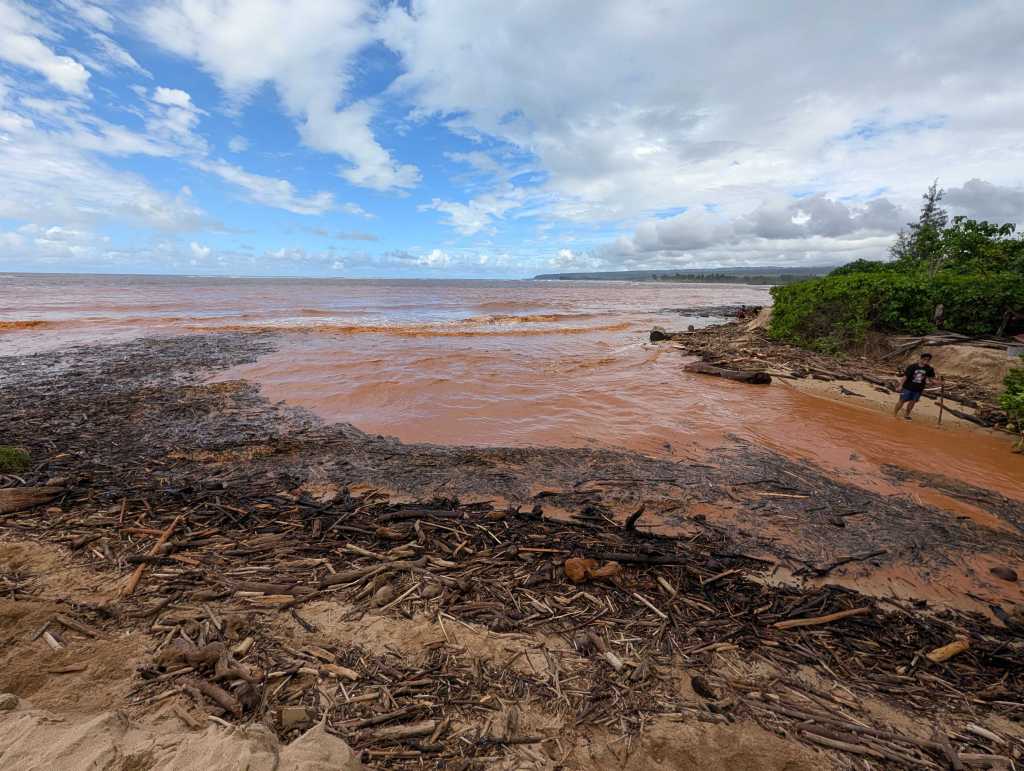
In Lahaina and across West Maui, revegetation of fire-impacted and cleared lands is urgently needed before the next major storm. Recent flooding near housing for Lahaina fire survivors underscores the need to integrate trees, soil restoration and green infrastructure into rebuilding efforts.
In ʻĪao Valley, restoring and protecting riparian buffers can help manage high-volume flows from steep terrain.
What happens on land does not stay on land. During major storms, runoff carries sediment, debris, nutrients and pollutants into nearshore waters. When drainage and sewer systems are overwhelmed, impacts to reefs, fisheries and water quality increase. These same landscapes accelerate contaminants into the ocean. Protecting mauka systems with green infrastructure is essential to protecting makai resources.
These are practical solutions that can be implemented now. Hawaiʻi should take three immediate steps:
- Recognize trees and healthy soils as infrastructure and maintain them alongside traditional stormwater systems.
- Require redevelopment projects to maintain or increase permeable surfaces and tree canopy.
- Prioritize green stormwater retrofits in communities most affected by recent flooding.
These steps reflect what Hawaiʻi has long understood: water is best managed across living systems, from ridge to reef.
We can continue rebuilding the same systems and accept the same outcomes: repeated flooding, damaged infrastructure and growing impacts to our reefs, fisheries and communities. Or we can invest in landscapes that absorb and slow water before the next disaster.
The next storm is not a question of if, but when. What we build now will determine whether Hawaiʻi is better prepared or left exposed once again. Trees are critical infrastructure.
 Sign up for our FREE morning newsletter and face each day more informed.
Community Voices aims to encourage broad discussion on many topics of community interest. It’s kind of a cross between Letters to the Editor and op-eds. This is your space to talk about important issues or interesting people who are making a difference in our world. Column lengths should be no more than 800 words and we need a photo of the author and a bio. We welcome video commentary and other multimedia formats. Send to news@civilbeat.org. The opinions and information expressed in Community Voices are solely those of the authors and not Civil Beat.

Local reporting when you need it most
Support timely, accurate, independent journalism.
Honolulu Civil Beat is a nonprofit organization, and your donation helps us produce local reporting that serves all of Hawaii.
ContributeAbout the Authors