

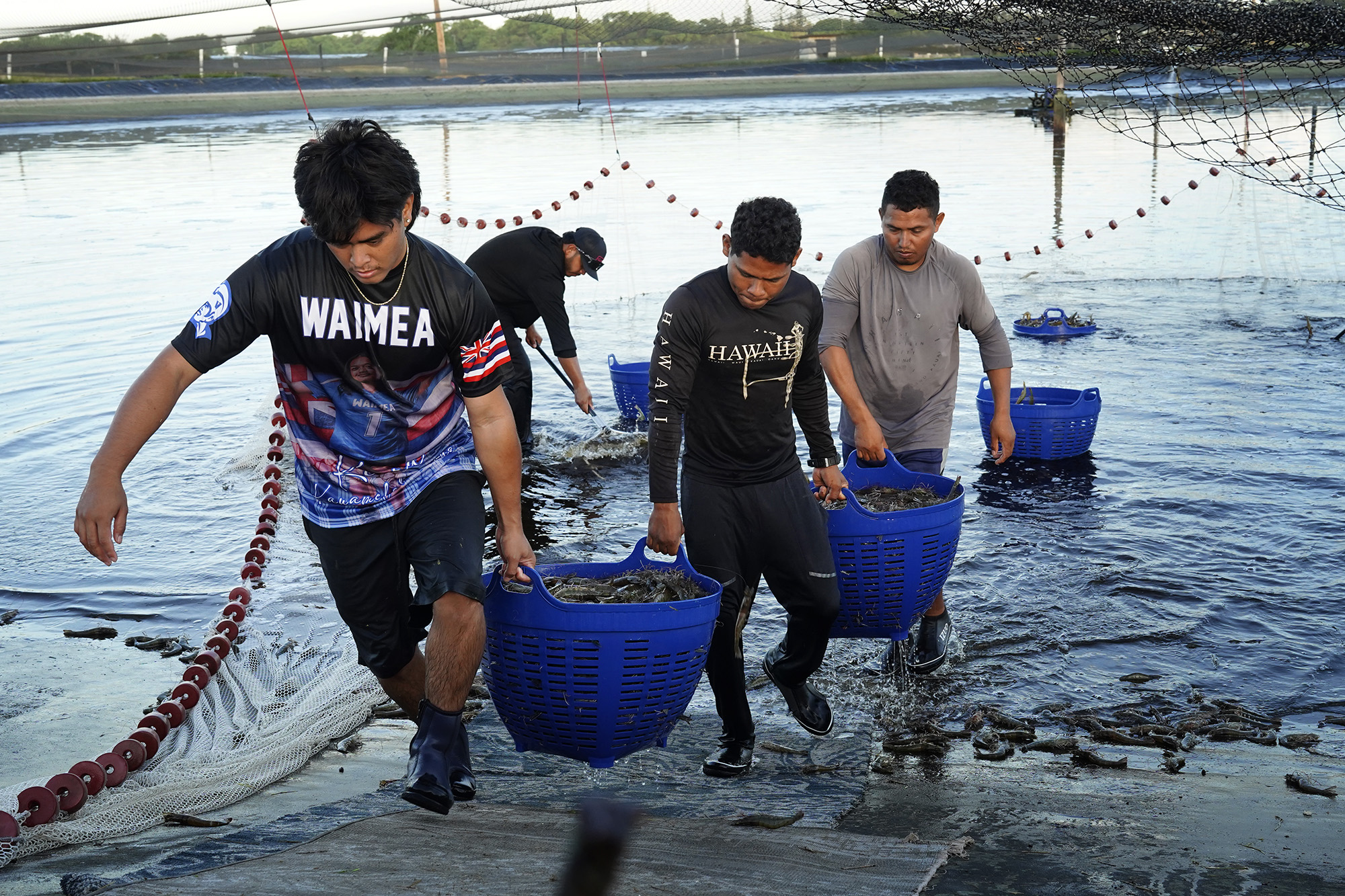
All’s quiet at 6 a.m. as a crew of five men trudge knee deep in a 1-acre pond, preparing to harvest 1,500 pounds of shrimp.
They’re part of Kaua‘i Shrimp, a nearly 30-year-old farm on the Mānā Plain. The farm currently has 12 employees who raise Pacific white leg shrimp in lined ponds that pull saltwater from deep wells.
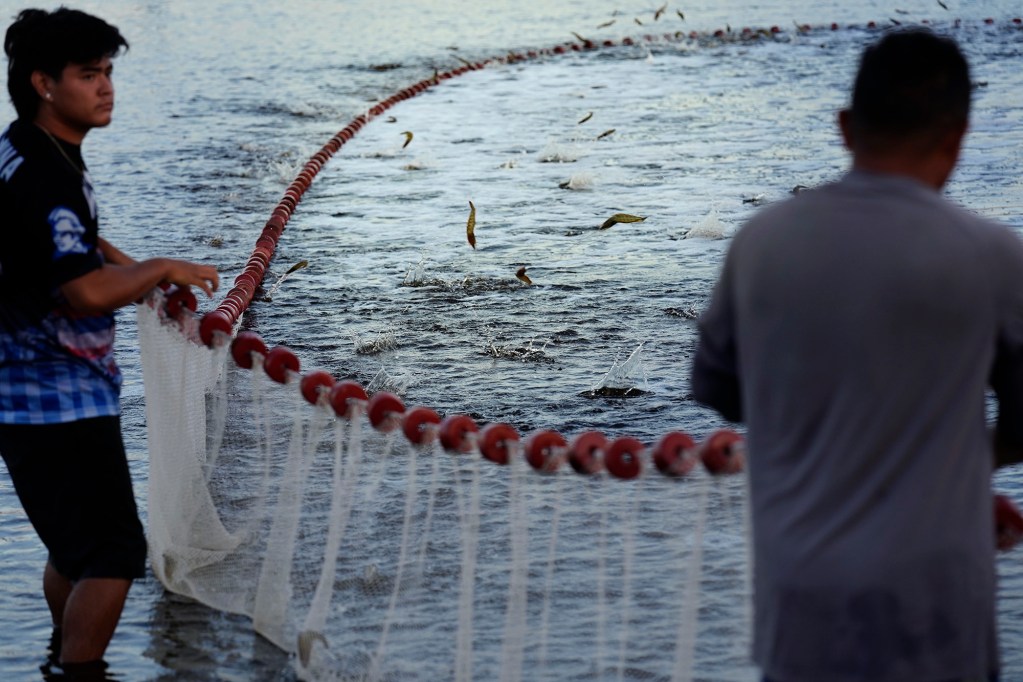
The pond’s water level was lowered for the harvest. Four paddlewheels aerate the saltwater and create currents to help push the fish toward a large net. Hundreds of shrimp jump out as the crew, which has grown to seven men, pulls the net.
They use scoop nets to collect the shrimp and put them in plastic baskets. Each individual shrimp weighs roughly 1.4 ounces.

Workers call out the weight of each basket before emptying them into a large plastic bin filled with salt brine and ice, which quickly kills the shrimp and keeps them fresh. “91 pounds.” “95 pounds.” “96 pounds.” An eighth crewmember stands next to the bin, keeping track of the amounts on his phone.

By 6:33 a.m., the crew had harvested the required 1,500 pounds of shrimp. On Monday, they’ll return to the pond to harvest 3,000 more pounds, said Robert Kanna, the farm’s manager. Each 1-acre pond can hold 7,000 pounds.

From here, the harvested shrimp are taken to Kaua‘i Shrimp’s Hanapēpē processing facility, where a separate team will pack them up. The shrimp, which are sold with their heads on, are shipped to buyers fresh or frozen the same day. Norpac Fisheries Export, which supplies Costco, is the farm’s main buyer, Kanna said.
Prior to Aloun’s purchase, the farm’s goal was to harvest 800,000 pounds of shrimp a year. Kanna said it’s hard to say exactly how much the farm harvested in recent years as shrimp breeding was its larger focus and revenue driver.

The shrimp farm got its start just as the area’s sugar plantation was winding down. The area was seen as a good location for aquaculture because it gets year-round sun and has warm water.
Kaua‘i Shrimp’s roots date back to Sunkiss Shrimp Co., which Kanna managed and had a small site a couple of minutes down the road. Four quarter-acre ponds were initially stocked with selectively bred, disease-free Pacific white leg shrimp developed by Oceanic Institute, another one of Kanna’s former employers. The farm later added shrimp breeding to its operations.

Kaua‘i Shrimp is now on its fifth owner, Aloun Farms, and only consists of the meat operations. Breeding continues at Sunkiss’s original site under Kaua‘i Shrimp’s former owner, Sunrise Capital.
The farm continues to get young shrimp from there, around 21 days after hatching. At that age, the shrimp are about one inch long and as thin as a fingernail clipping, Kanna said. They are placed in the farm’s eight half-acre nursery ponds for five to seven weeks. Once they reach two grams in weight, they are moved into the 40 1-acre grow-out ponds, where they’ll stay for roughly 12 weeks.

In 2024, Hawai‘i shellfish sales totaled $27.5 million — more than half of the state’s total aquaculture sales — but it’s hard to say how much shrimp contributed to that. Todd Low, aquaculture and livestock support services manager with the Hawai‘i Department of Agriculture and Biosecurity, said shrimp for food production in Hawai‘i has been limited in the nearly 20 years he’s been with the department. Kaua‘i Shrimp is likely the largest commercial operation, though there are smaller entities raising shrimp for their food trucks or other businesses.

“As a department, we’re cognizant that we import too much food,” he said. “And, of course, with seafood it’s the same, and the demand is always so high, so we’re always trying to figure out how to get more production.”
It’s also a tough market to be in because local producers must compete against cheap imports, in addition to dealing with the high cost of doing business in Hawai‘i, Low said. Hawai‘i’s shrimp industry is largely driven by breeding operations that globally supply broodstock selectively bred to be free of disease.
Cold-water shrimp and prawns are Hawai‘i’s second-largest food export, according to HDAB. In 2024, the state exported 1.15 million pounds of shrimp and prawns, totaling $10.9 million in sales.

Kaua‘i Shrimp is one of the original members of the 23-year-old Kekaha Agriculture Association. Mike Faye, who manages the agricultural cooperative, said Kaua‘i Shrimp has been a long-time pillar of the region and credits the farm with keeping the land — which was once part of a 12-parcel agricultural park under the former state Department of Agriculture — in production. Kanna said the farm got the land after only one other person was interested in farming there.
“We hope they hang in there and become more successful,” Faye said.
Kaua‘i Shrimp has a state Department of Health permit to discharge up to 20 million gallons of wastewater each day, though for the last two years, the farm has discharged less than 5 million gallons a day, according to the U.S. Environmental Protection Agency.
Each pond has a central drain that carries wastewater to a canal that surrounds the property. The effluent then travels north and eventually joins the wastewater from the broader area’s agricultural operations before being discharged into the ocean.

Kanna said the farm has experienced periodic fish kills in its on-site canals, which are home to tilapia that graze on organic matter. Those kills are often caused by a lack of oxygen in the water. Phytoplankton produce oxygen during the day, and their deaths result in such low oxygen levels at night that the fish can’t survive. He said that happens when the canals’ carrying capacity is reached as the tilapia otherwise would continue to multiply.
The farm’s wastewater discharge permit requires regular water quality monitoring on-site and where the wastewater discharges into the ocean to minimize impacts on fish, wildlife and recreational activities.
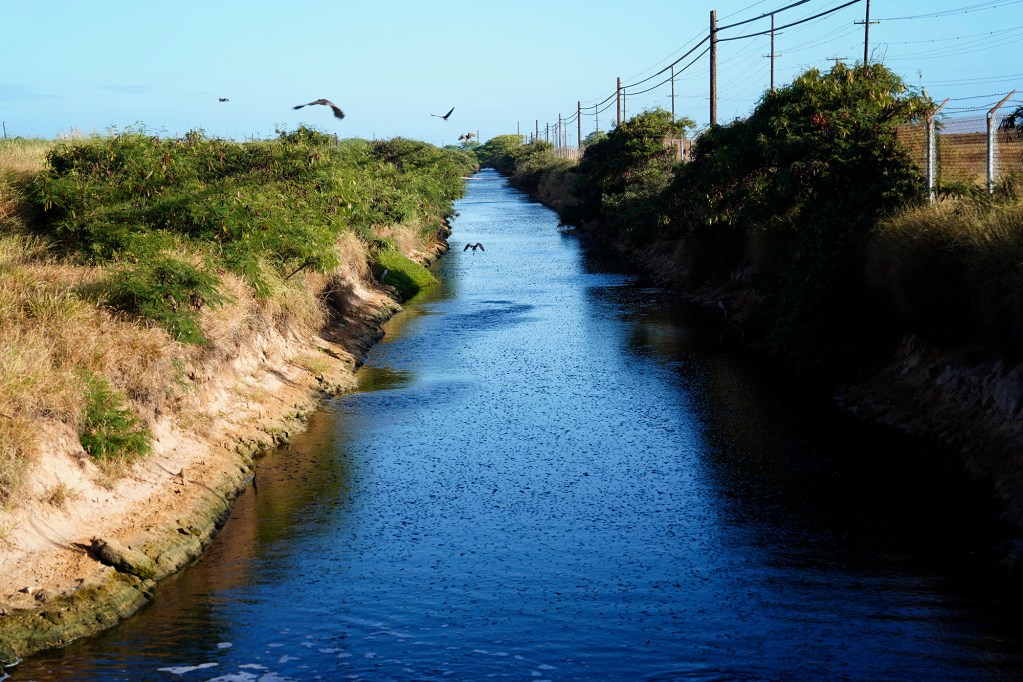
Its latest monitoring results from this spring show that measured items were below permitted levels.
“The limits we have is to make sure that we’re not over doing it in our discharge to a point where it’s going to create an algae bloom where then that can have a die-off in the ocean,” Kanna said.
Civil Beat’s reporting on Kauaʻi is supported in part by a grant from the G. N. Wilcox Trust. “Hawai‘i Grown” is funded in part by grants from the Stupski Foundation, Ulupono Fund at the Hawai‘i Community Foundation and the Frost Family Foundation.
About the Authors
Noelle Fujii-Oride is a Kaua‘i reporter for Civil Beat. You can reach her at nfujiioride@civilbeat.org.
What it means to support Civil Beat.