

Labor Shortages Stymie Building Of Schools, Hospitals In Micronesia
Audit also finds that high levels of out-migration led to rising costs for government services.
The U.S. has pledged to spend more than $6 billion through 2043 to help three Micronesian nations promote economic advancement.
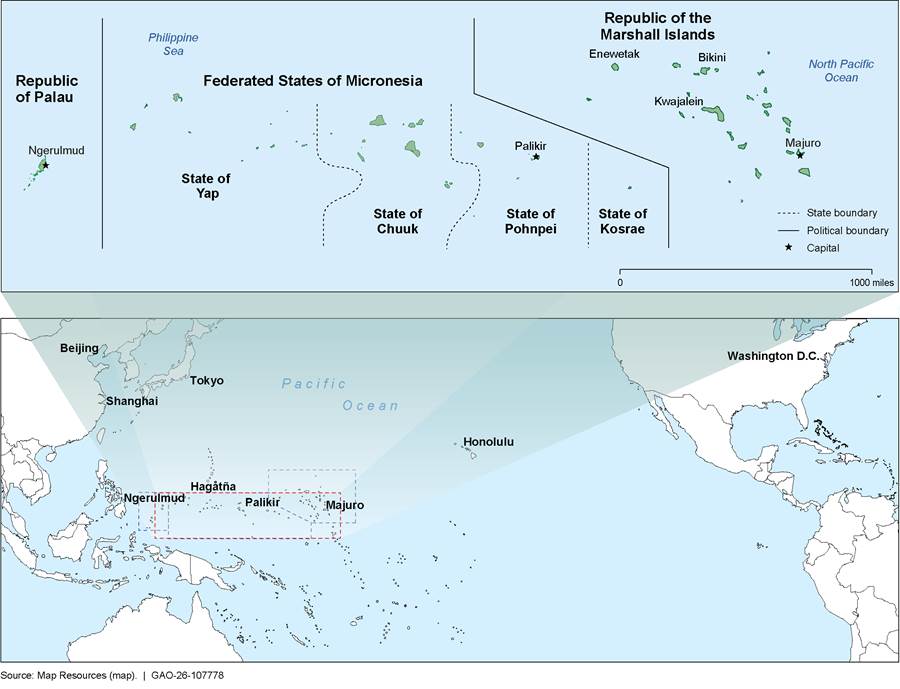
It’s part of signed agreements secured in 2023 with the Federated States of Micronesia, the Republic of Palau and the Republic of the Marshall Islands.
But a new government report, a performance audit conducted from August 2024 through May 2026, says that severe population loss and economic decline have made it difficult for the FSM (Chuuk, Kosrae, Pohnpei and Yap) and the RMI to find enough skilled workers to help maintain schools and medical facilities, where much of the money is targeted.
And, while Palau’s population has remained stable, a large drop in tourism during the Covid pandemic resulted in an 18% decline in gross domestic production from 2019 to 2022. During this period all three countries’ public employment sectors relied on increased foreign aid, including from the U.S., while the effects of the pandemic lowered private sector growth.
The report could have repercussions for relations between the three nations and the U.S., particularly as interest in the Asia-Pacific region grows. Congressional funding, for example, could be curbed if members object to critical findings. And greater out-migration will add to the fiscal and social challenges of places like Hawaiʻi that have endeavored to accommodate Micronesians who move here to study, work, obtain healthcare and live permanently.

The decline in revenue and workforce, the Government Accountability Office report explains, is exacerbated by the failure of the three nations to meet oversight requirements that are part of the amended Compacts of Free Association between them and the U.S. government. The inability to track the spending is compounded because the findings of several required audits from the islands have been delayed.
U.S. Rep. Ed Case of Hawaiʻi said the GAO report confirms the need for independent oversight of the compacts for the COFA nations, which are also known as the Freely Associated States, or FAS. That oversight is more essential than ever, he said, in an evolving geopolitical situation in the Pacific.
“The central lesson of this report is that successful Compact implementation requires accountability and sustained effort over time on both sides in a changing environment,” Case said in an email Wednesday. “This remains essential to our strategic interests, our treaty commitments, and our longstanding relationships with the peoples of the FAS.”
Case, who co-founded and co-chairs the Congressional Pacific Islands Caucus, said the report confirms “many of the challenges that policymakers and stakeholders have been facing for years” — primarily, that the greatest obstacles to the COFA nations are persistent population loss and the migration of skilled workers to the U.S. and elsewhere.
That is why, said Case, the three governments struggle to maintain the workforce necessary to administer programs, complete audits and implement major infrastructure projects. He also pointed out that the report notes that the U.S. has also not fully met its own implementation responsibilities, and he cast the blame in part on the Trump administration.
An interagency group on the island nations, established under 2024 federal legislation to coordinate implementation across various executive branch agencies, “has not operated with the urgency that Congress mandated, and the State Department, the lead implementer, acknowledges that implementation efforts have been slowed by hiring freezes and operational constraints that can only be described as self-inflicted by this administration,” he said.
It’s not clear whether the new report will impact COFA funding for fiscal year 2025, which includes $51 million for the RMI, $140 million for the FSM and $29.5 million for Palau.
But previous GAO reports critical of the compact spending have been used by Congress to debate whether to continue COFA, and how much to pay for it. In 2023, for example, a GAO report faulted U.S. agencies for failing to track millions of dollars in misspent funds. And out-migration has a direct impact on Hawaiʻi and other states that are favored destinations for Micronesians moving to the U.S.
The GAO said that officials with the three nations are “taking steps to improve the reports’ timeliness, such as by increasing financial accounting capacity.” U.S. agencies have also begun to implement oversight efforts, it said.
But Michael Walsh, an affiliated political science faculty member with the University of Alaska Anchorage, said the GAO report substantiates concerns he has had about the COFA nations and lack of U.S. oversight for decades.
“There are structural challenges that the FAS countries face in actually fulfilling their own obligations under the compacts and reaching their full potential,” said Walsh, who has written extensively on the region. “It’s a huge issue.”
Walsh warned there could be consequences from the GAO report for the COFA nations. In addition to the presidents of the three nations, copies of the GAO reports are sent to appropriate congressional committees and the U.S. secretaries of state, defense, homeland security and the interior.
“When you don’t fulfill the provisions that are set forth for you, when someone makes a claim that you’re not fulfilling your end of the bargain, that’s grounds to come back and say, ‘You know, we’d like to renegotiate the terms or to impose sanctions for what you fail to do’.”
Hawaiʻi And China
The economic stability of the FSM and the RMI in particular also impact Hawaiʻi, other U.S. states such as California, Oregon and Arkansas, Guam and the Commonwealth of the Northern Mariana Islands. All have seen significant arrivals from the COFA nations in recent decades, especially from Chuuk in the FSM and the Marshall Islands.
Under the COFA agreements, which are international treaties between the U.S. and the three Micronesian counties, residents of the islands are allowed visa-free travel to the U.S. and its territories and are allowed to live and work in them indefinitely.
The GAO report illustrates the direct correlation between the loss of skilled labor — particularly in the construction industry — and the decline in local population.
“FAS citizens often migrate to the U.S. and its territories seeking improved health services, educational opportunities, and jobs, among other things,” it states. The decline in the provision of government services can then in turn “increase the motivation for out-migration, thereby increasing the difficulty of providing such services.”
Out-migration can also affect the demand for services in the islands. One example is from the Palau Development Plan, as reported by the GAO. It notes that a decreasing youth population “will lead to reduced demand for basic education, while a proportionally larger aging population will place greater demands for government-funded social protection and specialist health services.”
There is also a larger geopolitical dimension at stake, something the GAO report also addresses. While the U.S. provides the largest amount of aid to the COFA nations, the FSM receives development assistance from the People’s Republic of China and all three countries receive assistance from Japan.
“The broader context is a U.S. foreign policy increasingly organized around competition with China in the Indo-Pacific,” an editorial in Legis 1, a congressional intelligence platform tracking government affairs, said shortly after the latest GAO report was released. “The Freely Associated States sit inside a maritime zone that American military planners consider indispensable. Allowing the oversight infrastructure of the compacts to erode, even gradually, creates vulnerabilities that extend well beyond accounting.”
The Legis 1 editorial concluded: “If the U.S. cannot demonstrate that its assistance is working, it weakens the argument for the agreements themselves, and opens space for other powers to offer alternatives.”
History And Dependence
America’s direct involvement with Micronesia began when U.S. forces liberated the islands from Japanese control near the end of World War II. In 1947, the U.S. entered into a trusteeship for the region with the United Nations.
The U.S. has provided economic assistance through COFA to the FSM and RMI since 1986, and to Palau since 1994. In exchange, the three nations provide the Department of Defense with regional military access and security rights.
A maritime zone extends beyond the coastline of each country, “granting various sovereign rights to marine resources, among other things, and further enhancing their strategic locations in the Pacific region,” according to the GAO report.
As part of the agreements, however, the GAO is required to review that assistance. And the U.S. funds are significant: Compact funding and federal programs and assistance represented 13% of the FSM government’s revenue and 50% or more of the revenue for each of the nation’s four states.
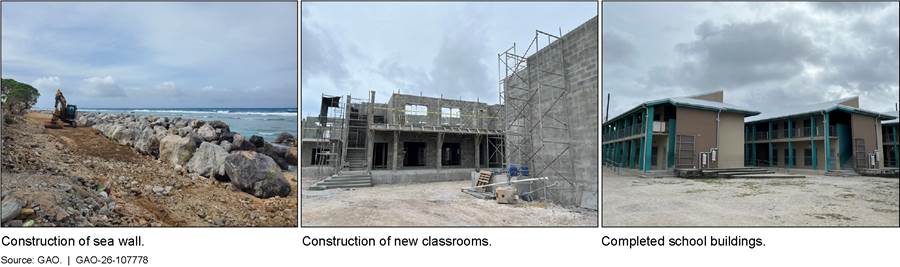
The development projects are wide-ranging and include a newly constructed technical education facility at the College of Micronesia’s campus in Pohnpei in the FSM, construction of a sea wall and school facilities in Ebeye in the RMI and needed repairs for Palau High School and several elementary schools.
But finding enough skilled workers is difficult. The FSM’s population decreased by 26% between the 2010 and 2023 censuses, dropping to 75,817. In the RMI the population is down by 20% between the 2011 and 2021 censuses to total just 42,418.
There are other barriers to development.
“Geographic isolation, economic conditions, and complex local governance, among other factors — have hindered the initial stages of implementation for the renewed compacts,” the report states.
All the while, in 2025 the FSM, RMI and Palau governments did not submit their single audit reports for fiscal year 2024 and were reported overdue by 183 days. The RMI and Palau government also had not submitted their single audit reports for fiscal year 2023, overdue by 548 days.

“Single audits are a critical element in the federal government’s ability to ensure that federal funds are used properly and that oversight entities … have information to fulfill their oversight responsibility for the funds provided to the FAS,” the report says.
Meanwhile, China is showing greater interest in Micronesia. Although it does not provide official development aid to the RMI or Palau, other forms of Chinese investment and influence in the two countries include Chinese nationals running businesses such as restaurants and heavy investment in the Palau tourism sector including hotels.
“The PRC previously used tourism as a political tool against Palau by limiting Chinese tourism in response to Palau’s continued recognition of Taiwan,” the report explains. Organized crime and espionage linked to China are also “security concerns in Palau,” according to U.S. and Palau government officials.
Walsh agrees that problems with COFA could lead other nations to expand their influence in Micronesia.
“China started making inroads in Kiribati and we’re seeing this in some of the FAS,” he said. “It really started to hit the radar of U.S. policymakers that we took our eye off the ball, we deprioritized the region and we let it lapse. And now we have a major power competitor who sees an opportunity and is starting to exercise their own influence in the region, and that represents a threat to our ability to continue to to operate unchallenged in that environment.”

Julie Walsh, an associate specialist at the University of Hawaiʻi Mānoa’s Center for Pacific Islands Studies, echoed the view of Case and Michael Walsh (no relation) that the GAO report generally repeats the findings of earlier audits. But she also agrees with Case that the U.S. has not followed through on its own funding implementation requirements.
“The most striking one for me is the report really doesn’t touch upon the delays in trying to implement the Veterans Affairs services for those who are eligible,” said Julie Walsh, a cultural anthropologist whose work focuses on U.S. relations with Micronesia. “That was negotiated in the Compact Impact Fairness Act of 2023, I believe, and you know there’s no mention of that delay, and that’s on the U.S. side.”
The act, which was championed by the Hawaiʻi delegation in Congress, restores access to a range of federal benefits for COFA citizens who reside in the U.S., including some 20,000 in Hawaiʻi.
Julie Walsh, who has done extensive research in the RMI, said the GAO report also illustrates why it is important for the U.S to follow through on its own commitments including the appointment of staffing. It takes time for small island nations, she said, to work with new agencies and officials and to build relationships.
“Those things require time because you have to understand how island cultures and peoples work,” she said. “New people take a while to understand that island leaders have to retrain outsiders — to sort of say, ‘This is how and who, and this is our process.’ I think the islanders are saying, ‘You’re asking for these things, and we need guidance and support,’ but these support systems are also responsible for oversight.”

