The Elections Commission Is Struggling To Elect A New Leader
Hawaiʻi’s most dysfunctional board is still dogged by “election integrity” conspiracies. Can new leadership find a way forward?
June 14, 2026 · 7 min read

About the Author

If you want a sense of where the work of the Hawaiʻi Elections Commission is at these days, there is no better place to look than the first question on the applicant questionnaire to be the group’s next chair:
“Which candidate do you believe was the rightful winner of the 2020 U.S. presidential election, and how certain are you about your answer?”
Six years after Joe Biden defeated Donald Trump, election denialism continues to drive the work of our state Elections Commission. Despite tremendous efforts, commissioners can’t even reach consensus on whether Hawaiʻi’s 2024 elections were fair and uncorrupted, either.
Now, with the 2026 primary just weeks away, the commission is trying to find a new chair.
But it can’t agree on who that should be because the nine-member panel is balkanized over matters of “election integrity” — the Orwellian rationale that Trump and MAGA Republicans use to cast doubt about the voting process involving mail-in ballots and voter identification as well as unverified rants over voter suppression, election subversion and other perceived threats to just and impartial elections.

The elections commission is responsible for investigating reports of election violations and complaints, and to hire and evaluate the chief election officer. Their work is more important than ever as — “in the face of the Big Lie that Donald Trump actually won” — election officials nationwide are “a prime target in the attempt to interfere with our elections,” the Brennan Center for Justice warns.
That big lie is alive and well in the islands, as illustrated by the answers of three of the eight applicants for the chair position to that first question stated above:
- Wendell Elento: “I believe Donald Trump was the rightful winner of the 2020 U.S. presidential election. I hold this view based on unresolved questions regarding the integrity of the electoral process in several key states — questions that were never fully adjudicated on their merits in a court of law.”
- Michael Jauch: “I believe there is enough creditable information from creditable sources suggesting that it should be investigated. Unless it is investigated there will always be questions.”
- Sherilyn Wells: “The Answer to Question One required extensive research and the research uncovered information of such crucial importance that it merits a ‘file’ of its own. Mahalo for your serious consideration of this research.”
For her part, Wells then submitted 31 pages of “research” that included unsubstantiated reports of flipped votes, ballot manipulation and hackable machines. Along the way she also conspiratorially drops the names of Dominion Voting Systems, Smartmatic, Venezuela cartels, Colombia’s FARC, Serbia, the CIA, Lou Dobbs, Joseph Stalin, Tulsi Gabbard, Brad Raffensperger, Herschel Walker, Newsmax and Tina Peters. the former elections clerk for Mesa, Colorado.
The good news is that Elento, Jauch and Wells will not be Hawaiʻi’s next chief elections commissioner.
Nor will Wally Nishimura, who skipped his Zoom interview Wednesday with commissioners but who also managed to answer that first question accurately and appropriately: “Joe Biden won the 2020 election. Why is this even a question?”
Props For Transparency
I’ll give the commission credit for doing their interview process largely in public. All eight Q&As are posted online and the Zoom interviews were public. That’s in contrast to the process to select the current chair, Mike Curtis (his term expires June 30), which was done in executive session four years ago.
Some of the other questions on the chair questionnaire also tried to address some of the other pesky problems with the board, which has been widely criticized as dysfunctional. It includes question No. 9, which is actually four questions in one:
“What experience do you have leading boards, commissions or advisory bodies? How would you conduct meetings to ensure transparency and civility? Are you well-versed in Robert’s Rules of Order, parliamentary procedure, and the Sunshine Law? Would you rely on alternatives to these for running meetings?”

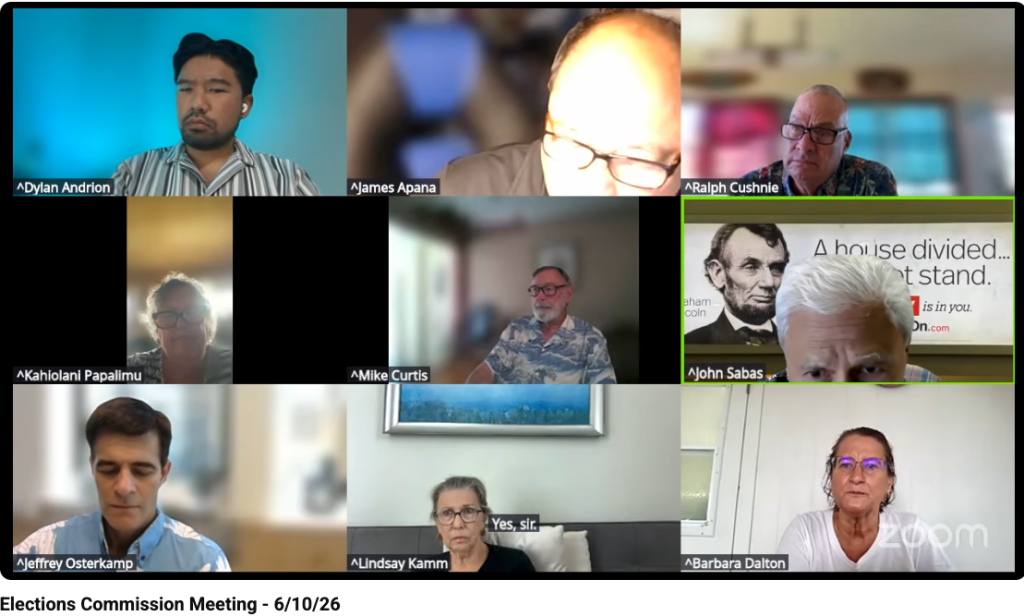
But the hunt for a new leader has still been awkward and bumpy. One of the commissioners, John Sabas, recused himself because he’s upset that one of the commissioners, Ralph Cushnie, applied for the chair job.
(Cushnie, the lead protagonist questioning Hawaiʻi’s 2024 election results, was rejected for chair by a majority of his colleagues.)
Another commissioner, James “Kimo” Apana, unsuccessfully tried to recuse himself because he felt it was a problem for him to vote on a new chair if Apana himself won’t still be on the commission come July 1. The terms for commissioners Cushnie, Barbara Dalton and Lindsay Kamm also expire June 30, so it’s unclear who will be on the board come July.
Several commissioners in the past year have bailed before their terms expired. But then, when meetings run up to seven hours (Wednesday’s lasted six hours) and are filled with members of the public attacking them and commissioners attacking each other (that also happened Wednesday), one can understand why the unpaid work is a real drag.
It takes six commissioners to reach a required two-thirds majority for a new chair, and only one of the applicants came close: Tamara McKay. (It’s pronounced “makai,” by the way. It’s Irish, not Hawaiian.)
But there are concerns about political baggage with this applicant, too, as she is a former chair of the Hawaiʻi Republican Party.
While Cushnie has said the media has wrongly described the Elections Commission as political while he argues strenuously that he is merely asking important questions about the elections process, it remains a fact that four of the commissioners are appointed by Democratic legislative leaders and four by Republican legislative leaders. The eight then elect a chair.
Except when they can’t.
Now the plan is for the commission to meet again June 24 with legal advice from Deputy Attorney General Jordan Ching on whether state law allows for a temporary chair to be elected and whether six votes are required for a board that — based on their voting history — is split along the lines of the four GOP appointees (Cushnie, Lamm, Dylan Andrion and Kahiolani Papalimu), three Dem appointees (Dalton, Apana and Jeffrey Osterkamp), the recused Dem appointee (Sabas, whose votes have varied) and Curtis (formerly a GOP appointee who as chair is not allowed to vote for a new chair but who has generally sided with the Dem commissioners).

By now, tensions between some commissioners are pronounced. Dalton seemed to relish grilling Cushnie for failing to submit on time a resume with his cover letter and for speaking at the Hawaiʻi Republican Convention last month. (Cushnie defended both actions.) Osterkamp wondered whether Cushnie had colluded to submit questionnaire answers that seemed identical to McKay’s. (Cushnie and McKay denied the charge.)
Osterkamp also pointed to reports online that two of the nine commissioners are election deniers. He did not name them, but the Election Deniers website said the two are Cushnie and Papalimu. The website is run by States United Action, a nonpartisan 501(c)(4) nonprofit organization “with a mission to protect elections and the rule of law.”
Ultimately, if a new chair is not chosen by July 15, the chair selection may fall to the chief justice of the Hawaiʻi Supreme Court. The current CJ is Vladimir Devens, who was appointed by a Democratic governor and confirmed by majority Senate Democrats.
July 15 comes six days before primary ballots are supposed to first begin arriving in mail boxes statewide.
In the meantime, two new laws are intended to ensure that Hawaiʻi still has a chief election officer — the person who certifies the primary and general election results — should the commission fire Scott Nago anytime soon: One says the chief must be fired for cause and the other establishes a succession plan should the chief position be vacated.
Written Questions For Elections Commission Chair:
 Sign up for our FREE morning newsletter and face each day more informed.
Read this next:

Local reporting when you need it most
Support timely, accurate, independent journalism.
Honolulu Civil Beat is a nonprofit organization, and your donation helps us produce local reporting that serves all of Hawaii.
ContributeAbout the Author