The Future Of Honolulu Rail: Report Details Pricey Possibilities
The new report envisions innovative rail extensions to reach much more of Oʻahu’s population but the HART board is asking for more study in anticipation of seeking more public funding.
A long-awaited report on possible next steps for the $10 billion Honolulu rail line outlines a bundle of options that are already drawing fire, including subways and streetcars in the urban core as potential extensions of the elevated Skyline system.
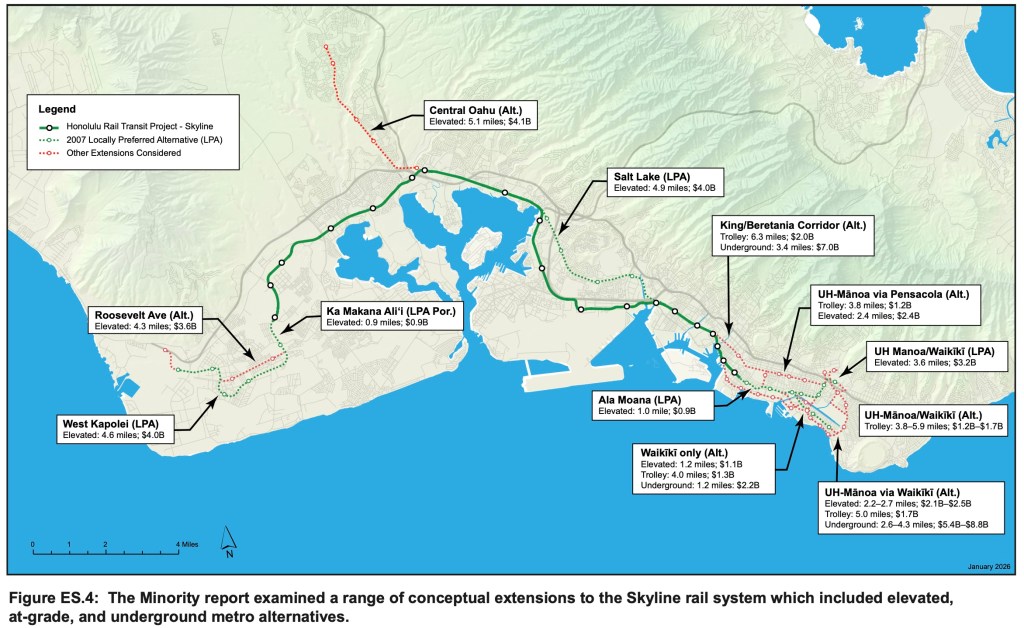
The “Minority Report of the ‘Ala Moana and Beyond’ Interaction Group,” also includes cost estimates totaling billions of dollars for various alternatives for extending the reach of the rail line to destinations including Waikīkī, the University of Hawaiʻi Mānoa, Ko ‘Olina, and even Central Oʻahu.
Rail critics who reviewed the report were quick to dismiss the concepts it raises as wildly cost prohibitive and unnecessary. One called it “a transit planner’s hallucination,” another said it was “a fever dream” that would cost “insane amounts.”
The document is largely the work of Anthony Aalto, a member of the board of directors of the Honolulu Authority for Rapid Transportation and a former chair of the O‘ahu Group of the Sierra Club. The HART board voted unanimously in 2022 and 2023 to appoint Aalto chair of a HART panel to study future options for rail.
But the document he produced is now called the “minority report” because two other members of the panel — HART Board Chair Kika Bukoski and board member Roger Morton — refused to endorse Aalto’s draft. They said it went beyond what the Honolulu City Council approved for the rail project nearly 20 years ago.
Instead, the HART board voted Friday to formulate an entirely new panel to consider future rail extensions.
Bukoski said Friday the new panel needs to finish its work quickly so the board can present “some specific asks and deliverables” to state lawmakers before the next legislative session begins. The new panel will be led by HART board member John Katahira, and is supposed to report back to the board by Oct. 2.
“Given the timing and the time frame, this next session is going to be critical for seeking additional funding options, if any, from the state,” Bukoski said.

That urgency is driven in large part by a looming deadline. The Oʻahu excise tax surcharge, which currently generates about $350 million a year for the rail project, is scheduled to expire at the end of 2030. Extending that tax surcharge to keep the money flowing would be key to any future rail extensions.
The new HART panel, also known as a permitted interaction group, will consider extensions that are part of the “Locally Preferred Alternative” for rail that was adopted by the Honolulu City Council in 2007. The LPA calls for a rail system that reaches Ala Moana Center, Waikīkī, the University of Hawaiʻi Mānoa and West Kapolei.
Laying Out The Options
All of those destinations were also considered in Aalto’s minority report, along with an array of other possibilities. But the options are pricey.
The report’s conceptual cost estimate for extending the Skyline system from Kakaʻako to Ala Moana Center — as the city had planned to do when Skyline first broke ground in 2011 — is nearly $1 billion. The estimated cost of continuing the elevated Skyline system another 1.2 miles to Fort DeRussy in Waikīkī would be $1.06 billion.
The report also floats the idea of an at-grade electric streetcar system linking Skyline to the University of Hawaiʻi Mānoa via Kalākaua and Kapahulu avenues for $1.7 billion, and offers up an even more daring proposal for an underground segment linking Waikīkī and UH Mānoa via Kapahulu for $8.8 billion.
At the western end of the system, the cost to extend rail from East Kapolei to West Kapolei via Kalaeloa would be nearly $4 billion, according to the report, while the option of extending the elevated guideway system from Waiawa to Mililani would be more than $4.1 billion.
Aalto said those estimates were based on the most recent cost of the Honolulu city center portion of Skyline or on comparable mainland transit projects, but said some may be dated because the calculations were done more than a year ago.
Karl Kim, professor of urban and regional planning at UH Mānoa, reviewed the minority report and opined that “given the billions spent already, this sort of analysis, deliberation and discussion is long overdue.” Kim is a transportation expert and a longtime supporter of the Honolulu rail project who worked on rail during former Honolulu Mayor Frank Fasi’s administration.
“The Skyline, with the extensions that we explore in this report, our catchment area would be 700,000 people, half the state’s population,” Aalto said. And he contends rail has already proved successful at steering growth on Oʻahu into areas along the rail line.
“As an environmentalist, that’s my starting point,” Aalto said. “We are saving the environment.”
Some 35,000 housing units including many affordable units are planned for the rail corridor through Kalihi and Iwilei alone, with more planned along other parts of the line, he said. That is development that won’t happen in Oʻahu’s diminishing rural areas.
And without rail extensions, Aalto said, those tens of thousands of new housing units will result in “a massive traffic problem in the future.”
A ‘Transit Planner’s Hallucination?’
Others mocked the minority report. Panos Prevedouros, a longtime critic of the Honolulu project, described it as “a transit planner’s hallucination.”
“It’s the sheer magnitude of the things,” he said. “They’re tossing two and three and four billion dollar options and many extensions like it’s chump change. It’s absolutely incredible, and they’ve got a terrible track record for delivery.”
The Honolulu rail project was budgeted at about $5 billion when construction began in 2011, and the line from East Kapolei to Ala Moana Center was supposed to be completed by 2020. But delays and cost overruns drove the price up to $10 billion, and the rail line was shortened to end it in Kakaʻako instead of at Ala Moana.
Construction is now running more than a decade behind schedule, and HART CEO Lori Kahikina said Tuesday on Hawaii News Now’s “Spotlight Now” that the rail segment from Middle Street to Kakaʻako most likely won’t open until sometime in 2032. That is about a year later than previous public projections.
The minority report acknowledges that history, but contends the per mile cost of Skyline is comparable to other metro system extensions, including projects in New York, Los Angeles, San Francisco and Boston. Aalto argues HART’s performance in recent years under Kahikina’s leadership shows it now has an expert management team in place that has learned from the errors that caused past delays and cost overruns in Honolulu.
Kim, a rail supporter, agrees the rail system should go to the university and Waikīkī because stopping it in Kakaʻako “is kind of falling short.” But given the cost overruns as rail construction advanced through relatively rural areas, he wondered how the city will manage costs “going through the most urbanized, most expensive, most built up areas.”
Prevedouros, a transportation engineer and UH Mānoa professor emeritus in civil and environmental engineering, said the only rail proposals in the report that make sense to him are at-grade extensions of the rail line from East Kapolei to West Kapolei and Ko ‘Olina, and extending rail to Ala Moana and into Waikīkī. He said it makes little sense to stop at Ala Moana because Waikīkī is such a huge generator of traffic.
But proposals such as running a rail line to Mililani, Prevedouros said, is “talking about billions as if there is a money tree.”
Joe Kent, executive vice president of the Grassroot Institute of Hawaiʻi and another rail critic, said the report makes clear that “they’ve got billions and billions of dollars in costs that they are thinking about stacking on residents.”
Kent praised the report for being transparent about the potential costs of continuing on with rail construction “because we finally know the numbers we’re dealing with.”
“We can plainly see this would be totally unaffordable to go beyond where it is,” he said of the report, “and this looks like $10 billion or $20 billion of plans, which is a fever dream and would cost insane amounts.”
Concerns From The Board
The minority report does discuss the difficult issue of how to fund any additional rail construction, including the possibility of extending the Oʻahu excise tax surcharge tax.
The surcharge is often often criticized because it is a regressive tax that weighs more heavily on lower-income taxpayers. Aalto’s minority report floats the idea that in the future 10% of the revenue from the excise surcharge might be refunded to low-income taxpayers in the form of a tax credit.
Another option raised in the report is tax increment financing, or TIF, as a potential source of future rail funding. That arrangement involves government borrowing to finance public improvements such as rail, which then increase property values and property tax revenue. The extra tax collections then repay the debt.
The report also suggests a public-private partnership might be possible if rail were extended along the King and Beretania Street corridor. Under that concept, developers would help pay for the rail line in exchange for allowing increased densities for development.
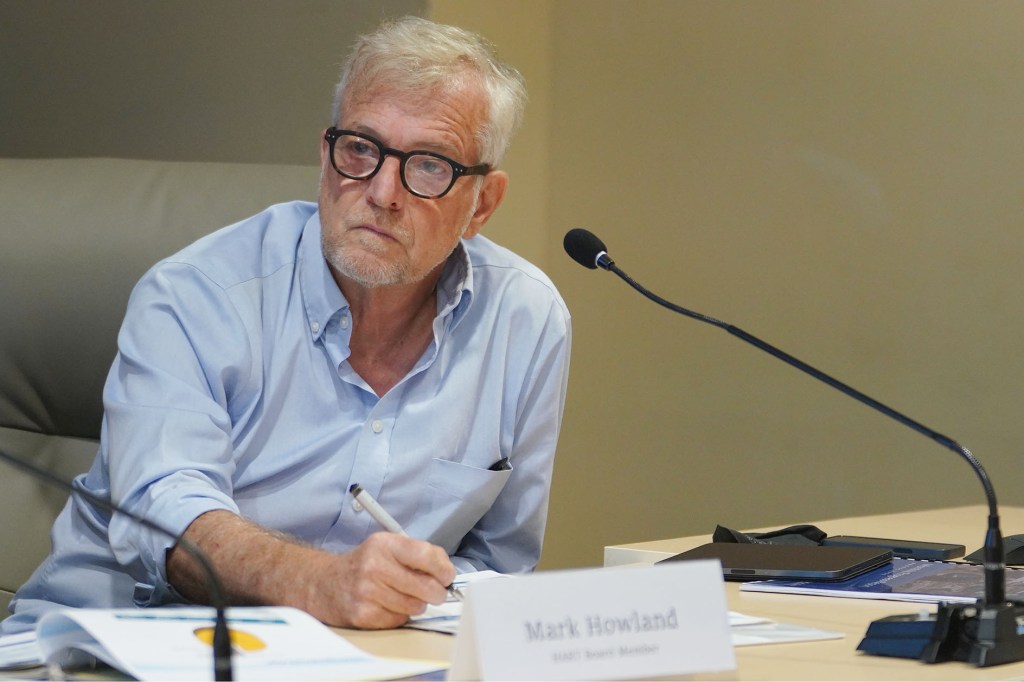
Aalto enlisted the help of engineers and other expert volunteers to support his work in developing the report, and the panel members met privately three times. At the third meeting on Dec. 12 Aalto could not persuade his fellow participants on the panel — Bukoski and Morton — to support the draft report.
Morton said Friday he and Bukoski did not believe it was appropriate for HART to endorse a report that considered options not included in the Locally Preferred Alternative, which was approved by the council in 2007.
“There’s a risk that we have of confusing the public if we have reports that are deviating from the LPA,” Morton said, “and also we’re concerned that our federal partners could be confused” if the HART board backed proposals beyond the limits of what the federal government contemplated for Honolulu.
“Managing expectations, especially public expectations based on the information that we make public, is crucial to our success or failure,” Bukoski said.
The HART board is planning to have a more detailed discussion of the minority report at its July 24 meeting.