

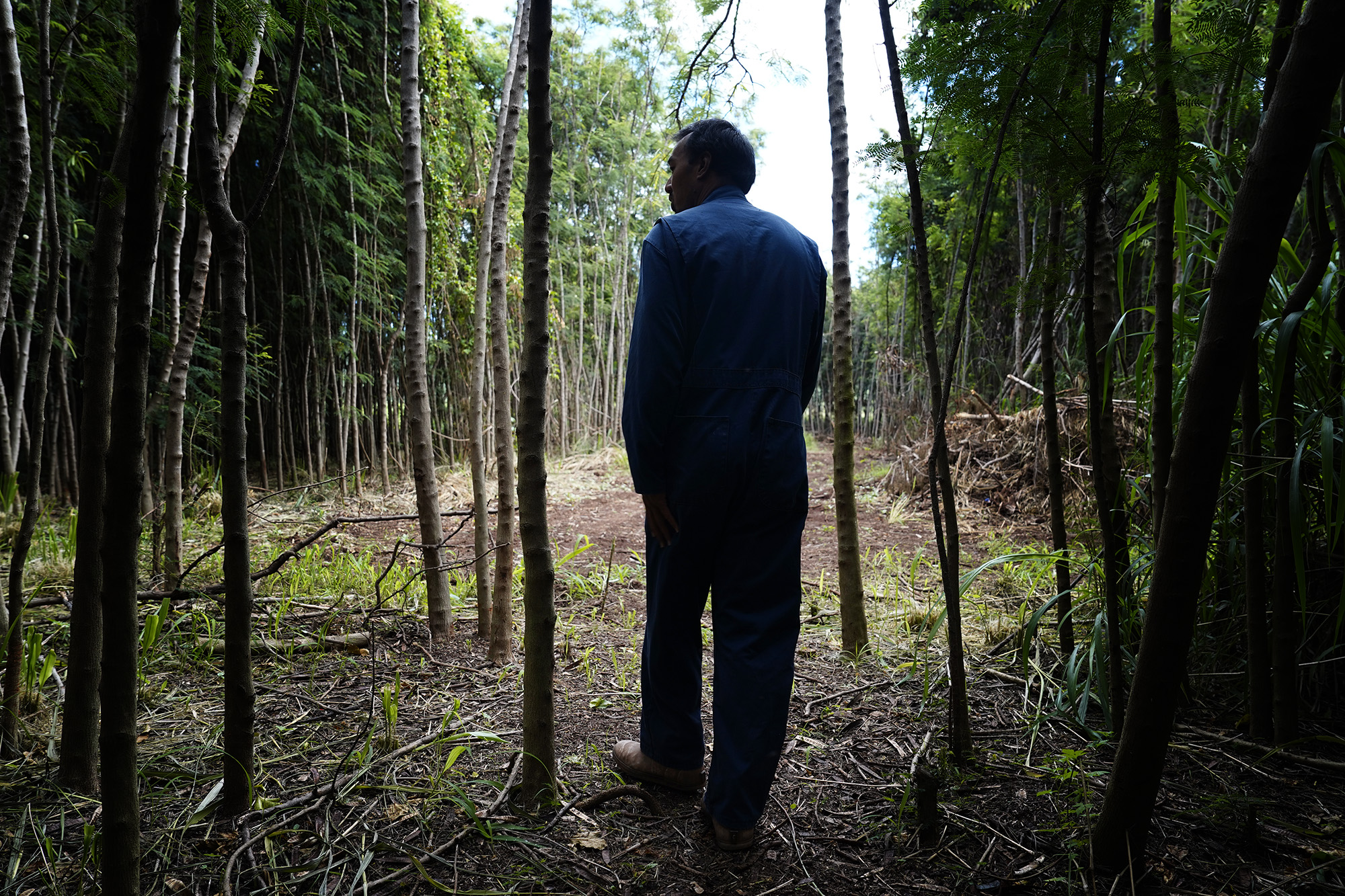
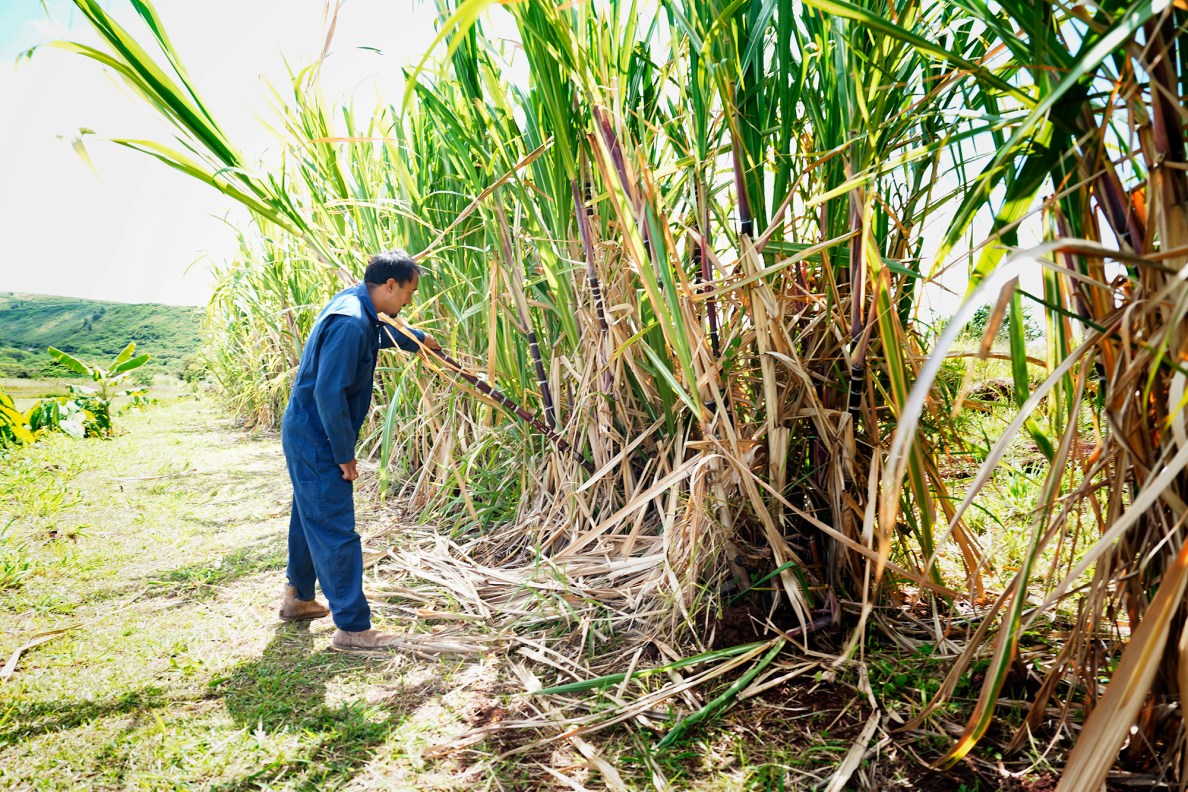
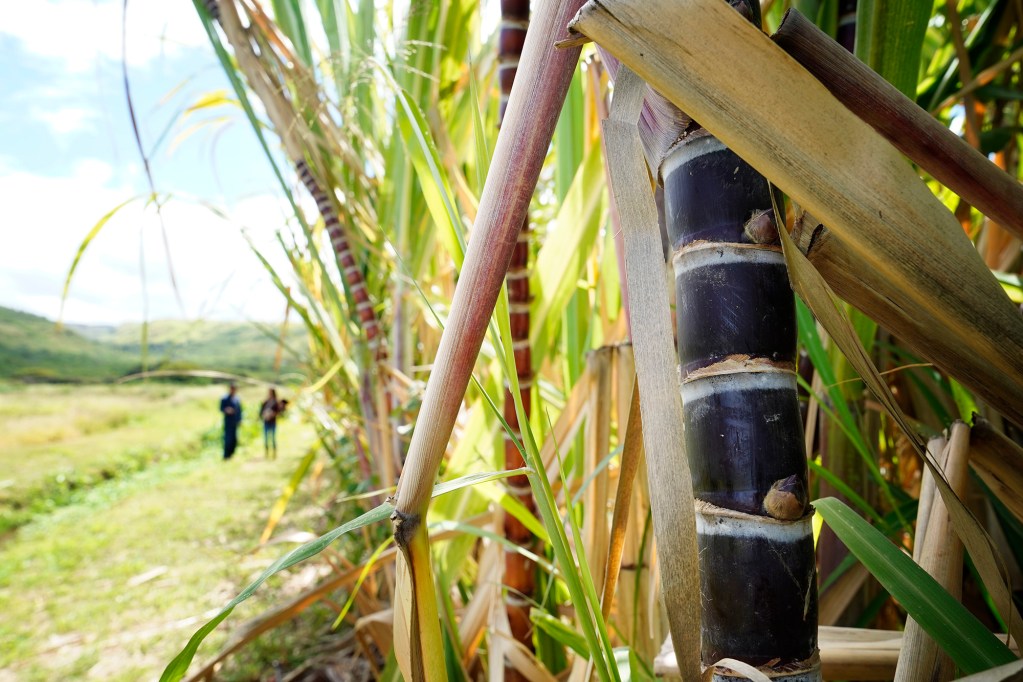
Under the hot morning sun on Kaua‘i’s West Side, farmer Kelsey Hesapene pulls a stalk of kō, or sugar cane, until he hears a sharp crack. He then uses a knife to separate the stalk from the rest of the plant.
He’ll repeat this for each kō in his roughly 500-foot row. Harvested stalks will be processed into cane juice, kombucha, shave ice syrup and molasses.
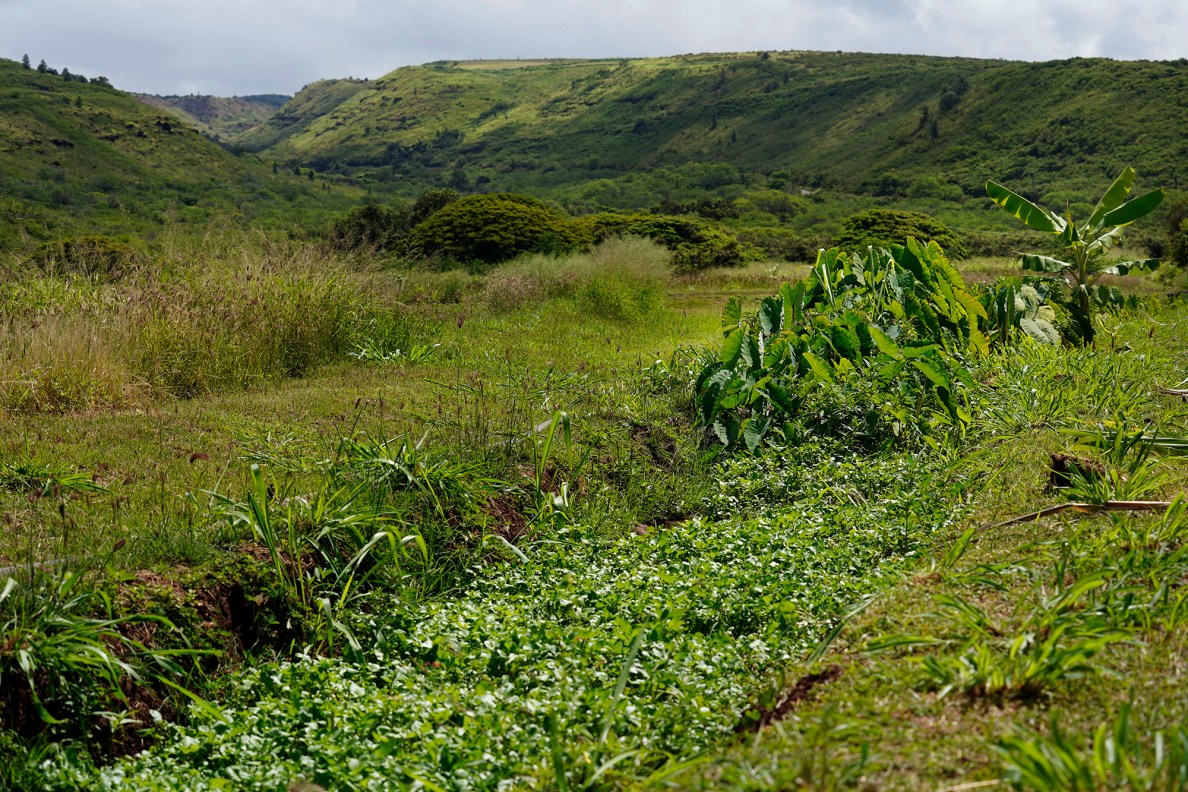
A line of mai‘a, or bananas, and a narrow ditch with kalo, or taro, and watercress grow just feet away. The 37-year-old has been working this sliver of land just outside Kekaha for the last several years.
Having grown up in the town and with family roots tracing back to the western marshlands of the Mānā Plain, where ancient Hawaiians cultivated kalo atop floating rafts, he’s passionate about growing food for his community.
“If we go diverse farming and ranching, including all the animals and everything and people, I think then there’s a big possibility of us not just feeding our own island but expanding from that,” he said.
He’s started clearing the adjacent space to continue his system and add other crops across 7 acres, making him one of several farmers who are expanding or moving onto the state Agribusiness Development Corp.’s Kekaha lands, which includes more than 12,000 acres across the Mānā Plain and mauka of Kekaha. The land has mostly been home to sugar plantations and seed companies growing crops for customers outside Hawai‘i.
Now, as those operations have shuttered or downsized, the area is starting to see another shift — toward growing food for local consumption and getting more than 1,000 unused acres ready for production. The move comes 10 years after Hawai‘i pledged to double its local food production by 2030 — and 32 years after the ADC was created.
“ADC is fundamentally changing and, I think, moving past an era where West Kaua‘i’s infrastructure was primarily served by corporate seed requirements,” said Jayson Watts, who chairs ADC’s board.
Now the agency is focused on supporting established farmers and investing public funds into shared processing facilities, irrigation and other resources that historically prevented local families from surviving in agriculture.
‘You Have To Break That Catch-22’
Footsteps reverberate as Mike Faye and Josh Uyehara, manager and president, respectively, of the Kekaha Agriculture Association, walk through a 13,000-square-foot former seed research facility on the Mānā Plain. KAA is a cooperative made up of ADC’s West Kaua‘i tenants and manages the plantation-era infrastructure in the region.
Parts of the building, which had been used by BASF Seed Research and Beck’s Hybrids in the past, will be retrofitted with a drive-in refrigerator and freezer, stainless steel worktables, wash stations and other equipment.
In 2024, the Legislature appropriated $2 million for the future processing facility. ADC anticipates the facility will be able to process 1,000 pounds of produce per day, based on current production, and it’s meant to encourage more food production, as well as the creation of value-added products.
“It’s a Catch-22,” Uyehara said. “You can’t grow enough food until you have the infrastructure to process it.”
Currently, 33 licensees operate across 3,900 acres of ADC land along the Mānā Plain and above Kekaha town. Another 3,500 acres are tillable but don’t have the infrastructure to support it, said David Hinazumi, Kaua‘i board member with ADC. The rest of the acreage isn’t tillable because it consists of roads, ravines, high flood risks or is otherwise unsuitable for growing food.
“We’re operating at a fraction of what the total production potential could be,” Watts said, noting the lack of reliable irrigation and drainage management on the lower plains.
ADC’s Kekaha lands and water infrastructure were developed for the sugar industry, Faye said. As a result, most of the fields are 50 or 100 acres.
Those amounts are tough for small farmers to manage, but a good fit for genetically modified seed companies that came in as sugar wound down. At one point, Pioneer, Dow Chemical, BASF and Syngenta caused community uproar over pesticide and genetic modification practices.
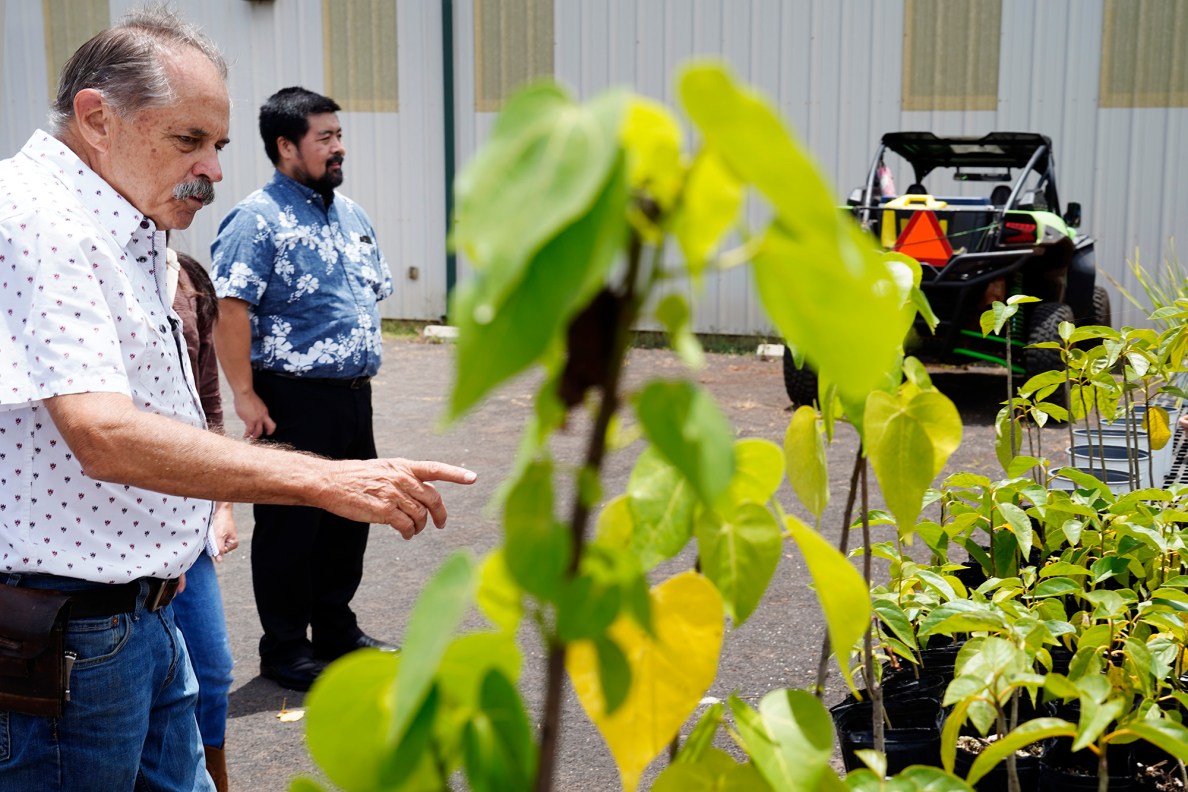

The research companies used only a quarter or less of their total acreage, so they’d have buffers to isolate their crops, Faye said. They also invested millions of dollars into the local economy by providing hundreds of jobs and maintaining the area’s water infrastructure over decades.
“Once you have the baseline capacity to operate it, then it’s feasible, you know, here and there, to add other farmers in,” Uyehara said. “But if you didn’t have those anchor tenants, it would really be a struggle to maintain and operate that system.”
KAA and ADC have spent the last 20 years repairing ditch leaks, replacing pipelines and doing other critical improvements to its irrigation systems, reservoirs and drainage facilities to ensure that farming continues, he said.
That infrastructure also prevents the coastal Kekaha town and Pacific Missile Range Facility from flooding. State funding, as well as infrastructure fees collected from ADC tenants, pay for those efforts, but resources are still limited compared to the amount of work, Uyehara said.
This year, the Legislature appropriated $10.8 million to improve parts of the 21-mile Kōke‘e Ditch system, which will potentially irrigate 1,200 tillable acres not already in use above Kekaha.
Those improvements will also provide irrigation to 2,500 acres owned by the state Department of Hawaiian Home Lands and enable fire mitigation of an additional 5,000 acres of untillable land, ADC’s Watts said.
Opening Land For Smaller Farmers
Umi Martin, a lifelong Kekaha resident who has farmed on ADC land in the area for 10 years, said the seed companies were a necessary step between the sugar plantations and today’s focus on diversified food production.
In some cases, the seed companies put in their own infrastructure, enabling the use of smaller parcels of land.
That’s what Corteva Agriscience, the last seed company in the region, did for a 35-acre field, called Field 107, where Hesapene and two other small farmers grow their crops as part of an incubator program.
Mark Stoutemyer, the company’s Hawai‘i Research Center lead, said the field was historically part of a larger parcel, so Corteva installed perimeter fencing around Field 107 and put in water mains and irrigation risers. Individual farmers then connect those risers based on their specific needs.
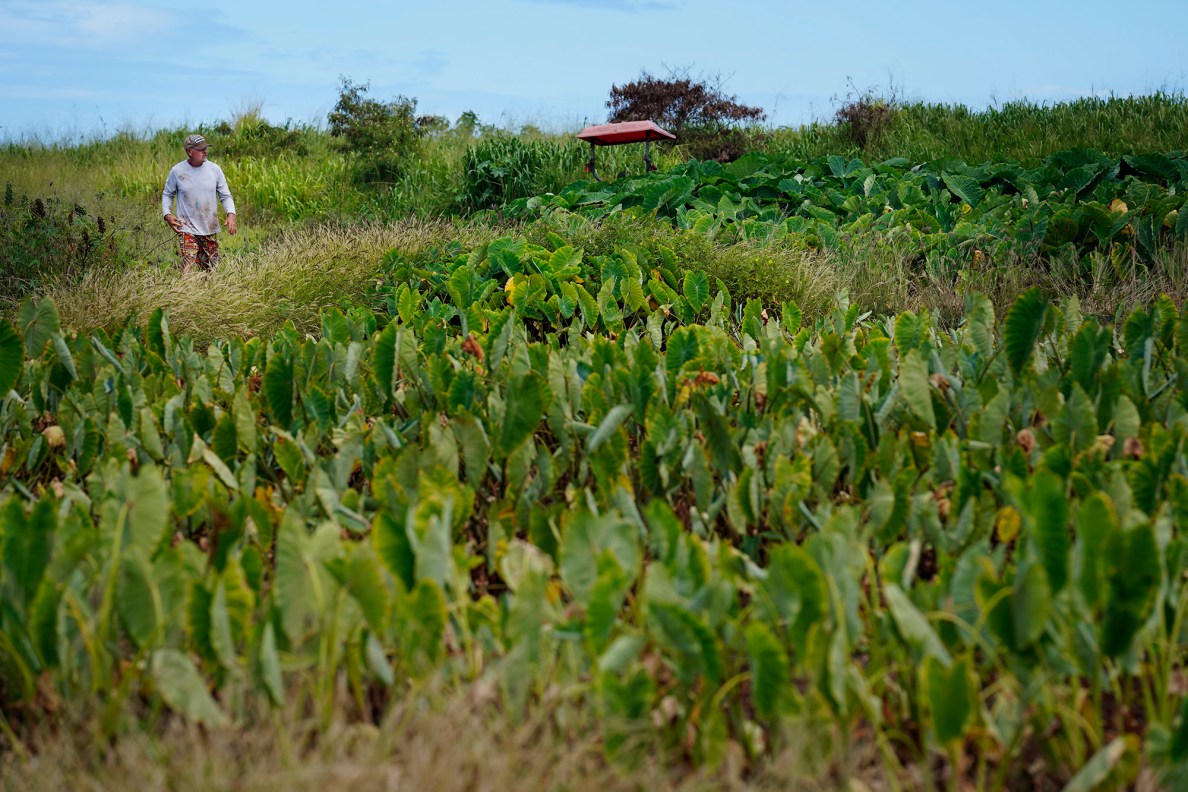
Adam Asquith, who cultivates wetland kalo across seven acres in Field 107, credits Corteva with leading the change to make ADC’s Kekaha lands more accessible to small farmers. Corteva covers the cost of the land, water and fencing so that farmers can focus on growing and establishing stable operations.
He entered the program in 2021 after losing land he had leased in Keālia for 15 years. He finally received his own ADC license last year for a nearly 90-acre neighboring field. He’ll be farming there with Hesapene, plus a couple of others.
While he’s grateful for that license and for the support he’s received from Corteva, he said ADC doesn’t make it easy enough for farmers to get on the land and instead has traditionally favored larger operations because of the plantation-era field sizes. Small farmers are set up for failure if they’re only able to get large fields before they’re ready.
“We haven’t shrugged off this old snakeskin of the plantation system,” he said.
He said ADC needs to offer land at the sizes that farmers are asking for and sees that as a barrier to getting more people interested in farming. In general, he said, very few small parcels of farmland exist on Kaua‘i.
‘A Balanced Ecosystem’
Three years ago, ADC put out a major call for applications to fill its remaining vacant lands and received seven responses for Kekaha.
The responses came from a mix of farmers seeking to grow for Kaua‘i’s market and others working toward shipping off island. Aloun Farms, which began on O‘ahu and has been farming on ADC’s Kekaha lands since 2022, received the highest score from a working group ADC formed to rank the applications. It requested 1,107 acres in Kekaha; ADC has not yet awarded that land.
Watts said that ADC at times breaks down plantation tracts into more digestible sizes to accommodate different types of farmers.
Such arrangements are evaluated on a case-by-case basis based on the characteristics of the field, available infrastructure and proposed agricultural uses, added Mark Takemoto, senior executive assistant at ADC.
Last year, one license was awarded to two farmers who agreed to share a roughly 60-acre field. The two farmers had been leasing Grove Farm land and wanted to lease in a drier climate to grow fruit trees. ADC set a lower rental rate for the first two years to help offset some of the high costs to clear and prepare the land for planting.
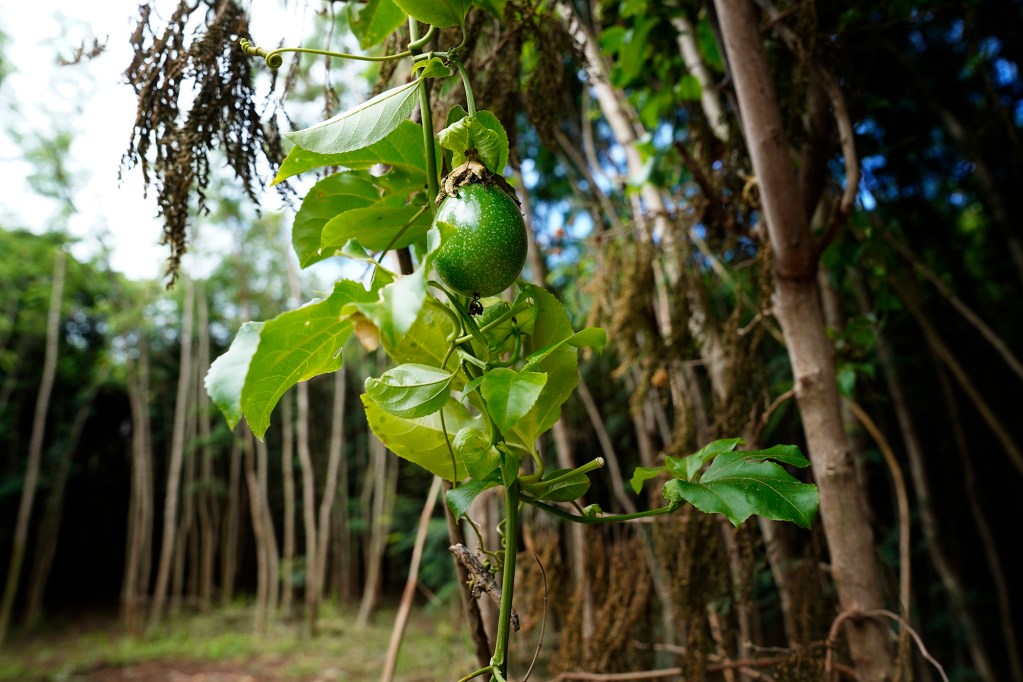
ADC is also looking at how it can help farmers clear land through grants for shared equipment. Asquith’s new 90-acre field largely consists of a winding maze of liliko‘i and haole koa because it had been unused for years. Hesapene plans to use much of the already growing liliko‘i, but Asquith and others will have to clear the land to grow their crops — a massive undertaking.
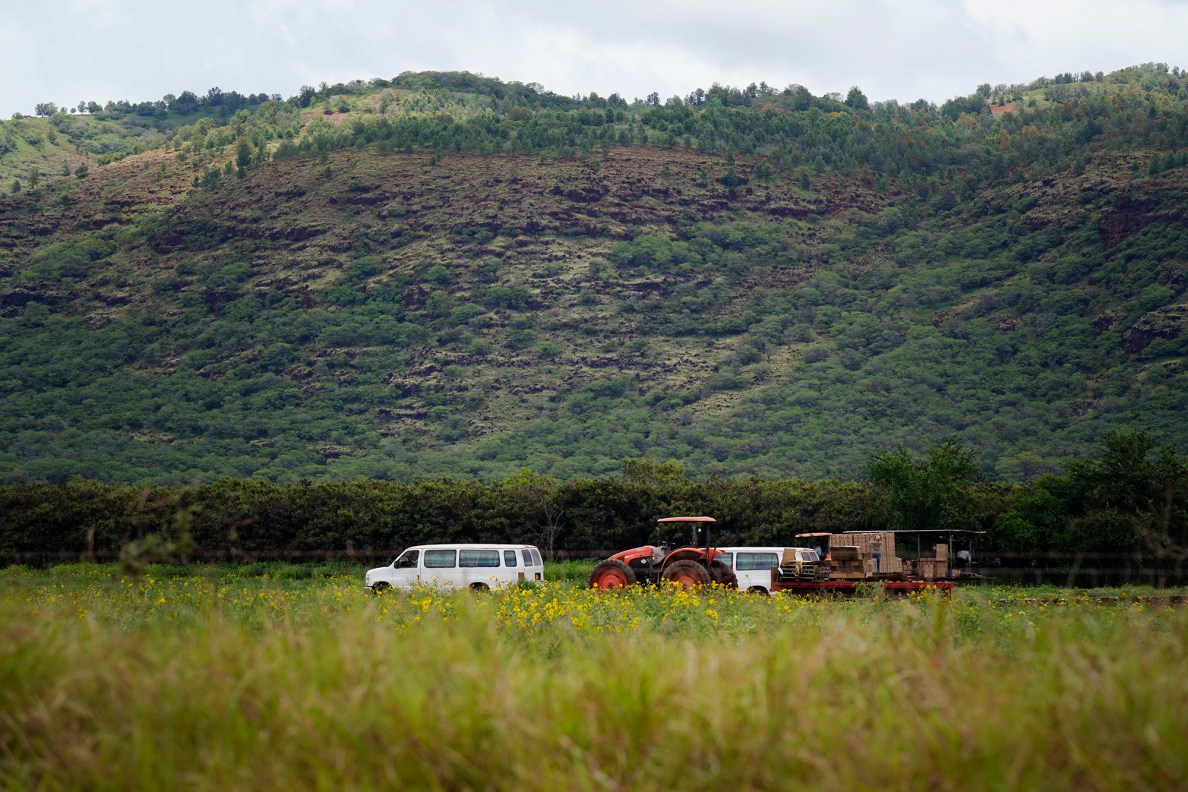
Martin said ADC helped him survive because they let him start with 5 acres before growing to 18. Orchard crops, he said, can take five or so years to start bearing fruit. The agency also reduced his rent for a few years to offset the cost of him putting in a fence to prevent further pig damage.
“They’re doing a lot already to try to get people on,” he said.
ADC is also working with KAA to incrementally pressurize some of the water infrastructure along the Mānā Plain — an effort that will enable irrigation at a smaller scale. That work has started on the western edge by Polihale State Park and will move eastward, Uyehara said.
Watts said that the agency’s main focuses are infrastructure development and supporting established commercial agribusinesses that are structured for high-volume institutional and wholesale markets. It also hopes to see large-scale operations and smaller farmers work together to bolster the region’s food production.
“ADC’s goal is really a balanced ecosystem,” Watts said.
He and others say Aloun has been a catalyst for the region by growing high volumes of local food and being a distributor that smaller operations can potentially one day piggyback off.
Aloun, which did not respond to multiple interview requests, is ADC’s largest tenant with 2,682 acres. In 2024, it bought Kaua‘i Shrimp. Last fall, the farm took over Hartung Brothers’ Hawai‘i operations, which came with roughly 1,700 acres that were not in production but were kept clear of overgrowth. Faye said the farm plans to put most of those fallow acres back into production over the next several years.
Aloun had also been farming on Gay & Robinson’s Kaumakani land up until the beginning of this year when the island’s largest landowner filed suit for more than $687,000 in unpaid rent and sought an eviction order. Gay & Robinson operated Kaua‘i’s last sugar plantation on the west side and harvested its last crop in 2009. Fifteen years ago, Aloun’s owners, brothers Alec and Mike Sou, were accused of conspiracy to commit forced labor, visa fraud and document servitude, but all charges were dismissed midway through the 2011 trial.
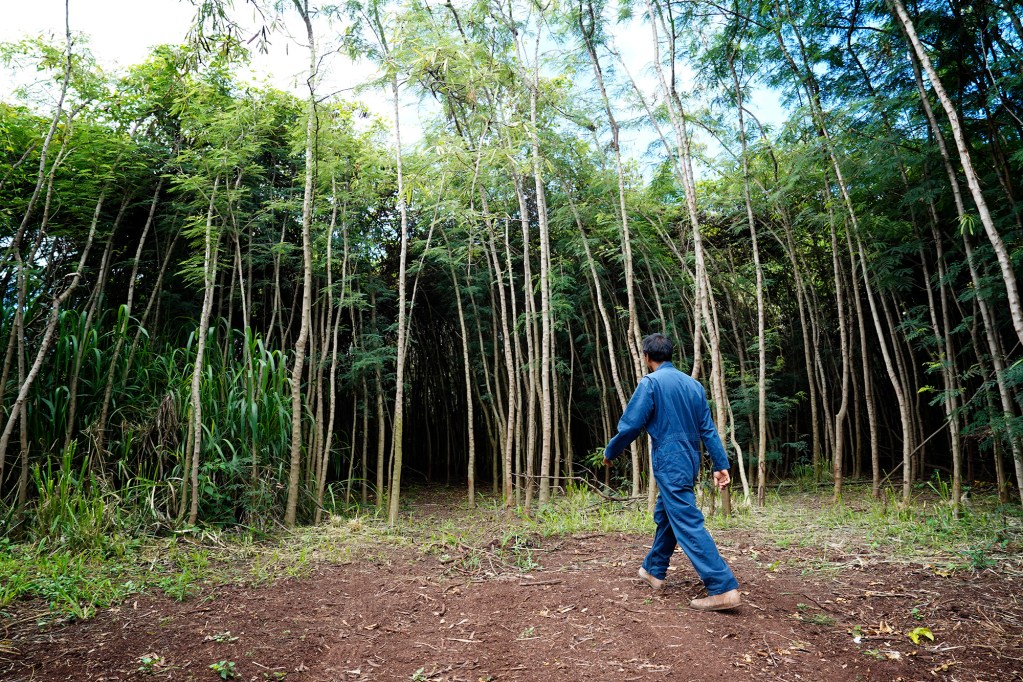
Watts said ADC has also been changing to be more reflective of Kaua‘i. Hinazumi, senior vice president at Grove Farm Co., was appointed as a Kaua‘i board member in 2025, and Uyehara joined the board as an at-large member this month.
Watts said the production potential of ADC’s Kekaha lands is immense. Infrastructure, like the future Kekaha agriculture processing facility, is meant to help level the playing field between large operations like Aloun and smaller farms.
“We’re really trying to give the smaller independent farmer the exact same technological and logistical advantage that a large corporate operation would have, which allows them to compete and scale sustainably,” he said.
Farmers like Hesapene and Martin plan to use it so they can get into or expand their value-added offerings. Martin, who focuses on mangos and citrus, will be able to create juices and pulps, as well as provide cut and frozen fruit to local juice companies.
Asquith said the region’s move toward diversified farming and more food production is the start of a monumental change equivalent to the shuttering of the plantations.
He hopes it’ll be seen through.
“It’s a time for action,” he said.
Civil Beat’s reporting on Kauaʻi is supported in part by a grant from the G. N. Wilcox Trust. “Hawai‘i Grown” is funded in part by grants from the Stupski Foundation, Ulupono Fund at the Hawai‘i Community Foundation and the Frost Family Foundation.
