Court Clears The Way For $81M Affordable Rental Project In Kona
The Honuaʻula project was delayed for years by a Big Island affordable housing scandal and then by a dispute with a neighboring land owner.
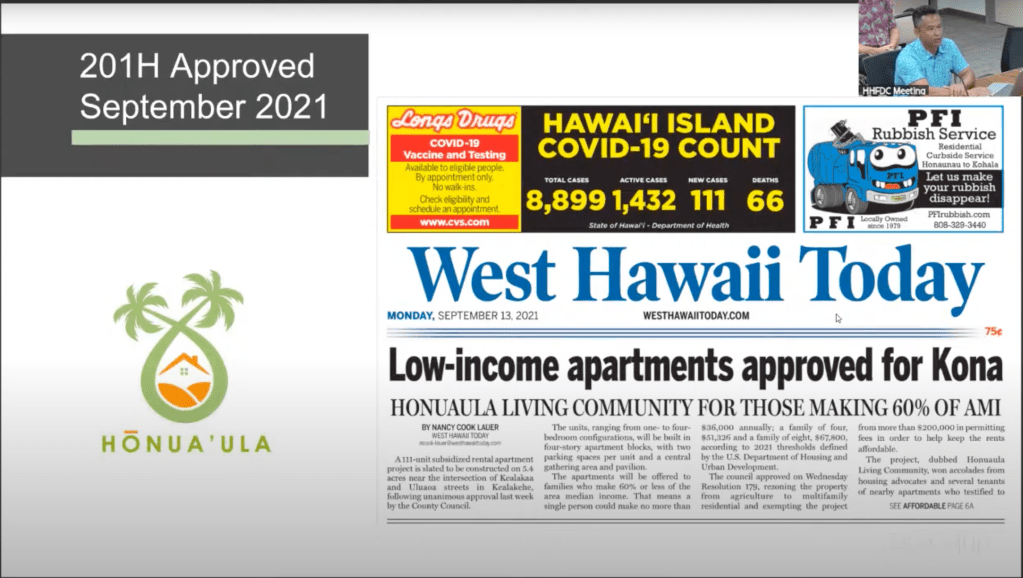
A project to provide more than 100 affordable rentals in Kailua-Kona is back on track after being stalled for four years following a Big Island corruption scandal involving affordable housing credits.
Carlo Mireles, chief operating officer of Honuaʻula, said Tuesday he aims to finally begin construction early next year on the four-story, $81 million apartment complex in Kealakehe after Third Circuit Judge Kauanoe Jackson struck down a land covenant that had been blocking the project.
That court decision on April 10 and an out-of court settlement the following month marked the end of a long ordeal for Honuaʻula. Years of delay boosted the pricetag for the project by more than $30 million. But Mireles said West Hawaiʻi badly needs that housing.
Rents in Kona today “are ridiculous, and a lot of the data that is out there doesn’t show people who are living in their cars, or the school teachers that are living with six or seven people in a house,” Mireles said. “We are in a housing crisis, an emergency crisis.”
According to the Hawaiʻi Housing Handbook 2026 published by the University of Hawaiʻi Economic Research Organization, nearly 52% of tenants on the Big Island are considered “rent burdened,” meaning their monthly rents take up more than 30% of their incomes. More than 27% are considered “severely rent burdened,” meaning rent consumes more than half of their incomes.
The problem is particularly acute in the tourism and job hub in North Kona, where market rents are sky high. The median asking rent in Kailua-Kona is $2,400, according to UHERO. Many working people can’t afford those prices, and instead live in less expensive housing in Puna and commute 90 miles or more to jobs in West Hawaiʻi.
A Fraught History
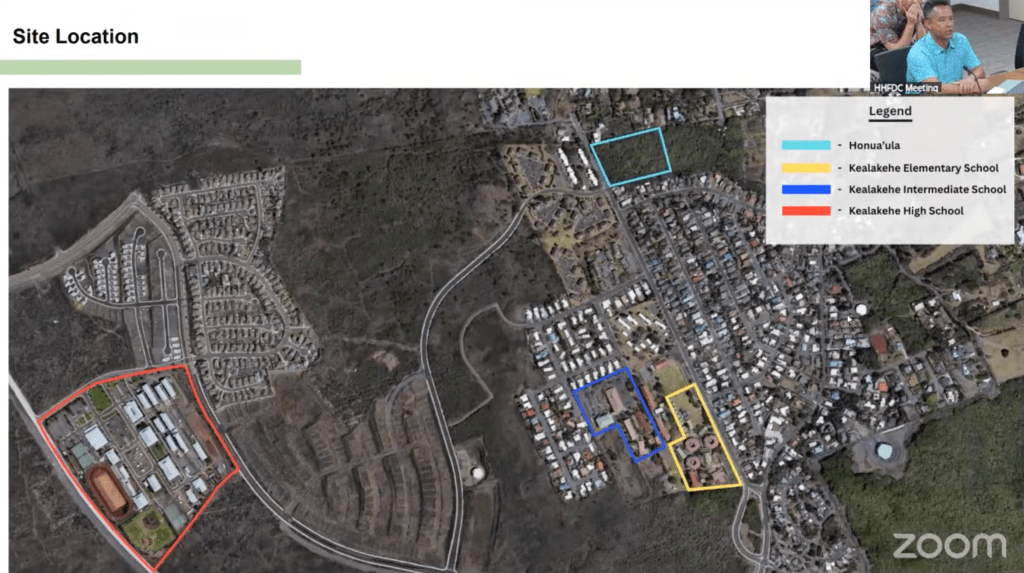
The convoluted history of the Honuaʻula project began in 2020, in the early days of the pandemic. The developer struck a deal with a company called West View Development that year to lease 6 acres near Kealakehe Elementary School for the Honuaʻula project and set about securing financing.
In the summer of 2022 a former Hawaiʻi County housing specialist named Alan Rudo pleaded guilty to conspiracy to commit honest services wire fraud, a felony punishable by up to 20 years in federal prison. He admitted to seeking or accepting $1.8 million in bribes and kickbacks during his time with the county.
His partners — Hilo lawyers Gary Zamber and Paul Sulla Jr. and businessman Rajesh Budhabhatti — were indicted a week later. Rudo testified at their trial last year, and a jury found Sulla, Zamber and Budhabhatti guilty of conspiracy to commit honest services wire fraud and nine counts of honest services wire fraud. Sulla was also convicted of money laundering.
Rudo’s partners were sentenced earlier this year. and Rudo was finally sentenced to four years in prison in May. The Honuaʻula developer was never accused of wrongdoing in that investigation, but the corruption case created major problems for the project.
Rudo turned out to be a secret partner in West View Development, and after the federal indictments, authorities seized money and property involved in several real estate deals engineered by Rudo and his partners. That included the 6 acres Honuaʻula leased from West View for its project.
In the end, federal authorities honored Honuaʻula’s leasehold interest in the property, and in fall 2024, the federal government finally sold the fee interest for the 6 acres to buyers who included Mireles’ company, Mirein Development Holdings. It took two years to untangle that mess.
And there was another major complication that grew out of Honuaʻula’s dealings with West View. West View had sold 7 acres just mauka of the Honuaʻula property to a buyer called PMJ Kona in 2021, and as part of that deal agreed to record a restrictive covenant imposing a height limit on the Honua’ula property.
That was done without Honuaʻula’s knowledge or consent, according to court documents, and was intended to provide unobstructed ocean views from the PMJ property. The height limit would have made it impossible for Honua’ula to build the four-story apartment complex it had planned for its property, and Honuaʻula sued to have the covenant lifted.
Big Island Judge Kauanoe Jackson finally declared in April the covenant is void and cannot be enforced, but Mireles said by then the federal property seizure and the court case over the covenant had delayed the project by a total of four years.
“The community is suffering,” he said, “and at the end of the day if there wasn’t a federal case, and there wasn’t this screwy civil case, we would actually have people living in those apartments right now.”
Picking Up The Pieces
All of those delays have presented new challenges for the project, Mireles said, including higher interest rates and a 30% to 50% escalation in construction costs.
The Honuaʻula project will provide workforce housing for families earning 80% of the area median income or less, which works out to $96,700 or less for a family of four.
According to data provided by Honuaʻula, tenants at in the complex will pay rents ranging from $864 to $2,305 for three-bedroom apartments, depending on their incomes. Four-bedroom units will rent for $964 to $2,572.
Mireles said Honuaʻula has been by far the most difficult project of his career. “At the heart of it and the truth of it,” he said, “the community is really the victim because they could have had those units already.”
Civil Beat’s reporting on economic inequality is supported by the Hawaiʻi Community Foundation as part of its work to build equity for all through the CHANGE Framework; and by the Cooke Foundation.