Grassroot Institute Aims To Keep Growing Its Political Influence
Now in its 25th year, the nonprofit policy research organization wants to play a larger role in influencing state and county governance.
July 5, 2026 · 11 min read

About the Author

What started a quarter century ago as one man’s mission to promote individual liberty and economic freedom in Hawaiʻi has become a substantial force in effecting public policy statewide.
Today the Grassroot Institute of Hawaiʻi takes credit for helping persuade the Legislature to preserve a historic tax cut, to expedite the county process for obtaining building permits and to allow for worker housing on farms. The legislation, all approved this year, aligns with Grassroot Institute policy to ease the tax burden on local residents and to increase the affordable housing supply.
Now the organization is embarking on a course to further expand its work by amending its nonprofit status to allow for more lobbying of state and county governments.
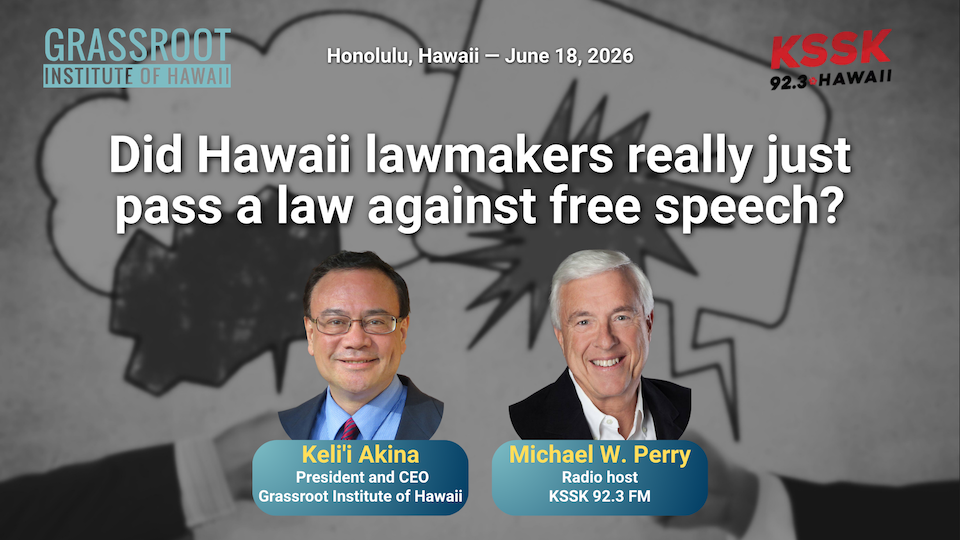
“Grassroot has been growing in its influence,” Keli‘i Akina, the institute’s president and CEO, told a lunchtime audience at the Pacific Club in downtown Honolulu last month. “It’s time now for us to increase our capacity and go from influence to impact.”
The lunch, the institute’s opportunity to share its wrap up on the 2026 legislative session, also allowed Akina to expound on a second major initiative this year: a lawsuit filed by the institute in U.S. District Court June 5 that challenges a new Hawaiʻi law intended to truncate political spending by corporations.
Akina argues Act 11, which goes into effect a year from now and is meant to neuter the Citizens United Supreme Court decision of 2010, will suppress the right to free speech and thus the work of the Grassroot Institute.

He welcomed the timing of the lawsuit and his group’s expansion in a year marking not only the institute’s 25th anniversary (a gala in Waikīkī headlined by radio personality and comedian Adam Carolla is planned for Sept. 4) but also the 250th anniversary of the Declaration of Independence.
“What a fitting way to transition to that with this federal case,” he told the Pacific Club audience. “We want to show the state of Hawaiʻi that those who are principled also have capacity to make an impact.”
Taxes And Nonprofits
The institute, as it states on its homepage, produces policy research to “promote individual liberty, economic freedom and limited, accountable government.”
It does that “by challenging bad ideas with good ones” through detailed published reports, public events, weekly newsletters, social media and regular meetings with lawmakers.
Akina explained at the luncheon and in an interview that Grassroot has been steadily stepping up its efforts, part of what he calls a strategic plan to become the most influential voice in public policy.

“We believe someday that will be achieved, but during the last five years we’ve made remarkable strides in becoming a very influential voice in public policy,” he said.
A major step in that direction came in the 2024 session, when Hawaiʻi passed the biggest tax break in the history of the state. But, because of increasing global economic uncertainty, the governor and legislators considered rolling back the tax cut this year.
“Some people thought that this year when the Legislature opened, our leaders were singing a different song,” he said. “They were saying, ‘Where is the money to handle all of the problems of the state? We’re running out of money, and as a result, we have to take back our promise, and we can’t let the people have the tax break.’”
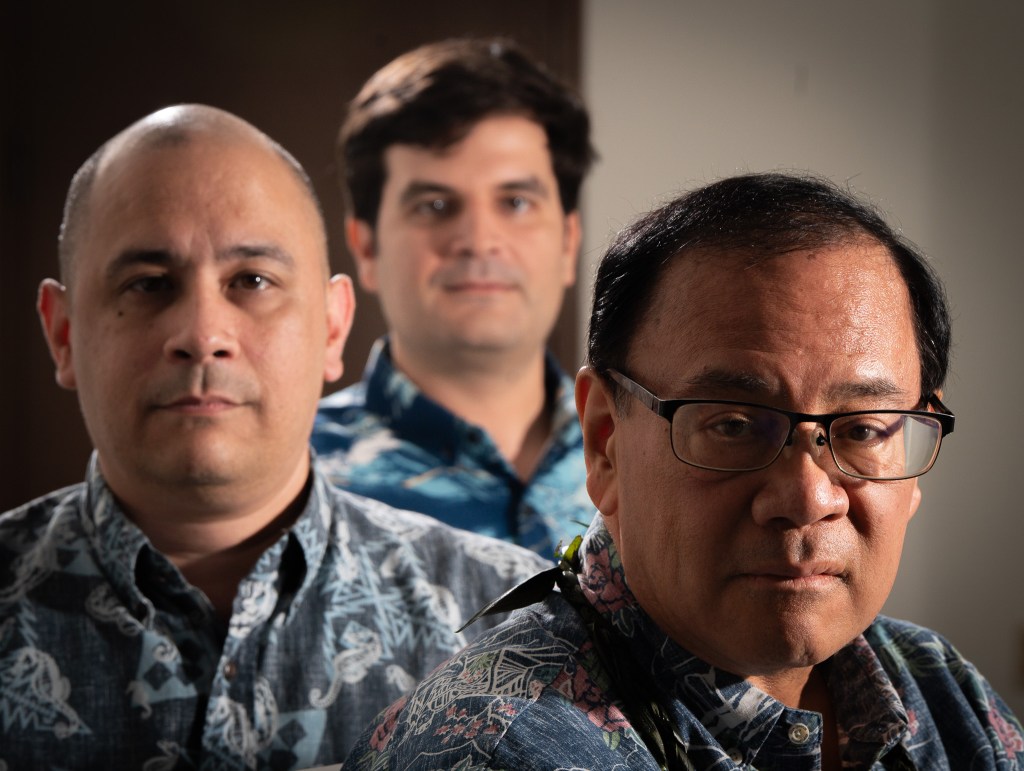
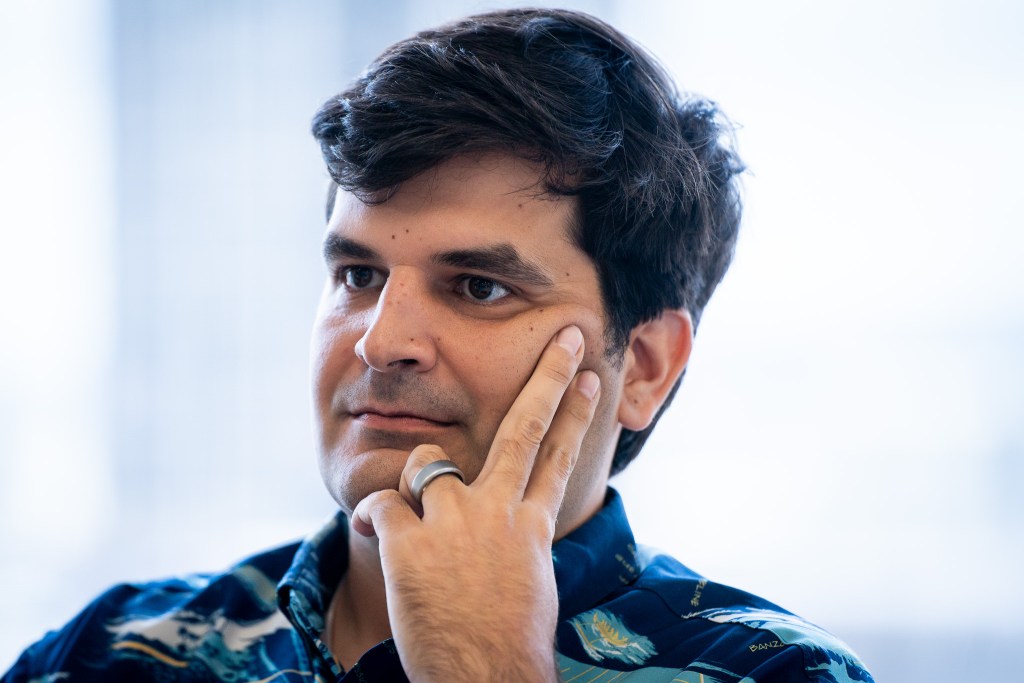
Leading the charge to preserve the cuts, the institute’s two lobbyists — vice president Joe Kent and Ted Kefalas, director of strategic campaigns — spent a lot of time working with legislators, especially staff on the Senate Ways and Means Committee and the House Finance Committee. Having spent more and more time at the Legislature, they had become familiar with the people they most needed to speak with.
Among the institute’s lobbying strategies was to issue a flier identifying 10 ways to “free up resources” to close an estimated $246 million budget gap without raising taxes. It included repurposing $500 million from idle special funds and removing all vacant state positions to save $380 million.
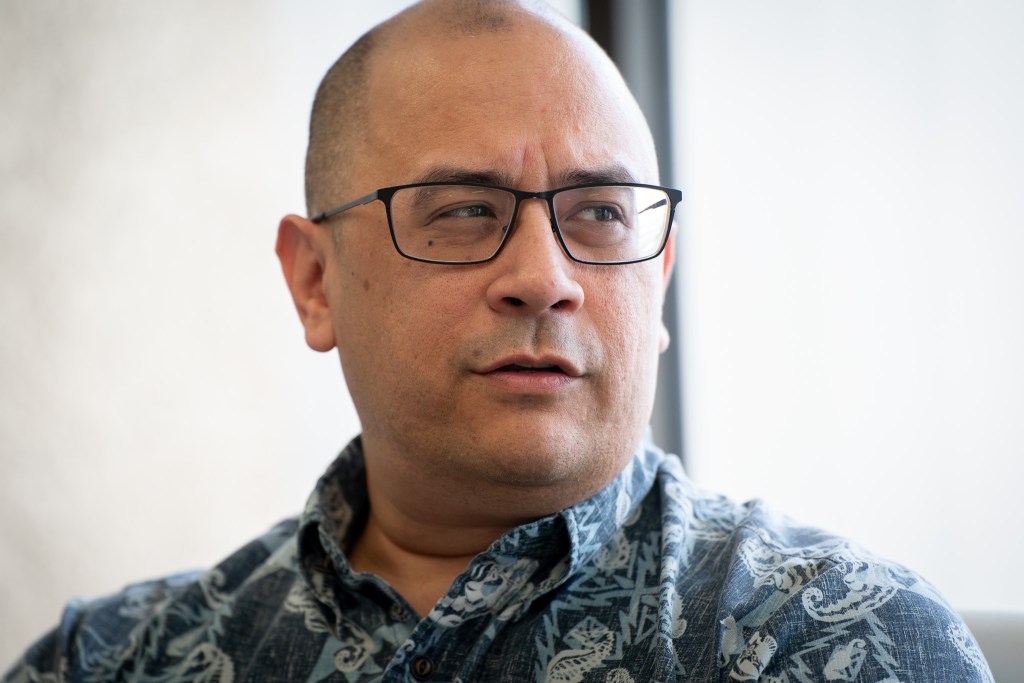
Kent and Kefalas calculated that their suggestions could generate $1.4 billion in revenues savings in fiscal year 2028.
Ultimately, they did not get everything they wanted. In fact, legislators ended up creating a new 13% tax hike on top earners, said Kent, that placed Hawaiʻi among the top states taxing wealthier residents.
The Legislature also took away tax credits for the solar industry. Then last month, Gov. Josh Green intervened on behalf of the industry to extend the credits already granted for 2026.
“Sometimes in a tug of war you can keep things from getting worse, so these ideas I think helped put pressure on the budget to at least go a little bit in our direction,” Kent told me.
Kefalas said the institute was able to present budget-cutting ideas that were an alternative to the default tendency to just raise taxes. It helps that Kent and Kefalas are even-keeled in their presentation of solutions-oriented proposals that rely on solid data rather than political ideology.
“Our argument was that the people depended on this tax cut, and that resonated, especially in the Senate,” Kefalas said.
Because it is a 501(c)(3) nonprofit and has federal tax-exempt status, the institute cannot attempt to influence legislation as a substantial part of its activities. It also can’t participate in any campaign activity for or against political candidates.
But, if the institute can set up a new 501(c)(4) entity called the Grassroot Action Center, it could up its lobbying presence. According to the IRS, a social welfare organization “may engage in some political activities, so long as that is not its primary activity.”
Akina said that currently the institute is limited to using 10% of its revenue for lobbying, or about $200,000 a year. Under a 501(c)(4), that amount is unlimited.
“We’re finding that there’s a greater need to advocate on issues before the Legislature,” said Akina in a recent interview at Grassroot’s Pioneer Plaza office.
“If there was some issue this year that popped up like the tax cut issue, and we wanted to get involved, we may not be able to based on how much previous lobbying activity we’ve done in the year,” said Kefalas, who started at the institute six years ago after working in the Virginia and Washington, D.C., area for the public affairs and government relations firm Capitol Results.
Kefalas added that the institute is not projecting to spend, say, $10 million “in lobbying and whatnot” and would not be making campaign contributions.
“It’s strictly just so that we remove that ceiling from our efforts,” he said.
A 501(c)(4) is also not required to disclose where it’s getting its money. But Akina insisted that the Grassroot Institute is not beholden to outside influence.
“First, we’re independent,” he said in the interview. “We, by design, do not accept funds from the government, nor from any political parties, nor do we take clients. Our organization, through its board and staff, determine what issues are germane and relevant to the people (of Hawaiʻi), and those are the ones that we pursue.”
Libertarian Origins
The Grassroot Institute is a far different operation than when Dick Rowland, a retired Army colonel, founded it in 2001. A graduate of Texas A&M University and Columbia University, he came to the islands in 1971 to serve as an officer on the U.S. Pacific Command staff.
“His wife was Vietnamese, and he got involved with local things,” recalled Ken Schoolland, now a retired economics professor at Hawaiʻi Pacific University. “He was chair of the Libertarian Party of Hawaiʻi for a while, and decided that politics was just not his passion.”
Schoolland explained Rowland’s inspiration for the institute by relaying the story of Sir Antony Fisher, a British World War II pilot, and Austrian economist and professor Friedrich Hayek.
“Hayek had once advised Fisher, ‘Don’t go into politics, instead start a think tank and develop ideas and do research,” said Schoolland, who would join the institute’s board of advisory scholars. “And that story stuck with Dick, and he decided to start his own little institute.”
Because of his political leanings, the label “libertarian” has often been applied to the institute. Rowland, who died in 2020, ran as a Libertarian Party candidate against U.S. Sen. Dan Inouye in 1992 and U.S. Sen. Dan Akaka in 1994.
And Kent — who hails from Hilo and has a background in music education — ran as a Libertarian against U.S. Rep. Tulsi Gabbard, then a Democrat, in 2014.
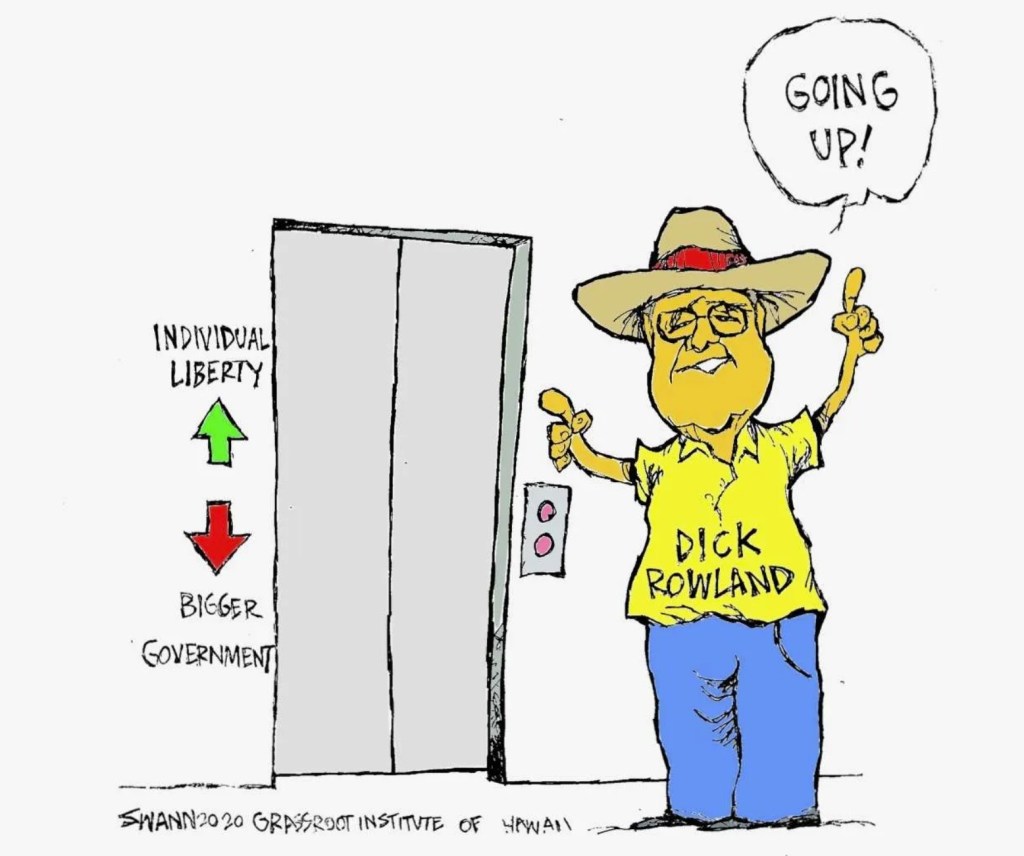
In essence, Libertarians, according to the national party’s website, support a future “in which personal liberty, responsibility, and opportunity are revered and protected.” That certainly fits with the Grassroot Institute’s general philosophy.
“Conservative” is another label that has been applied, due in part to Rowland’s work with the late state Sen. Sam Slom, a Republican who advocated for independent and small businesses. But Schoolland said the institute has always been open to other interests and ideas.
“Yes, there were Libertarian origins, but they wanted to have a broad enough room to allow other people who would be interested in limited government, accountable government. They had a Libertarian streak in them, but it wasn’t exclusive. There were probably more Republicans than Democrats, but there were some Democrats involved with the activities too.”
Schoolland pointed out that Grassroot has from time to time teamed up with Democrats where there has been “an overlap in interest.” A prominent example was opposition to the Honolulu rail project, in which Ben Cayetano, a former Democratic governor, aligned with Slom.
Schoolland was at the lunch last month, where I counted nearly a half-dozen Republican candidates for office this year. Kelafas told me that the institute’s positions were much more a matter of “common sense” than party preference.
Grassroot Institute has also joined with other organizations and elected officials to sponsor public forums. They include one with U.S. Rep. Ed Case, a Democrat, on the Jones Act and maritime shipping, and another with state Rep. Luke Evslin, a Democrat, on housing co-sponsored by the Hawai‘i Appleseed Center for Law and Economic Justice.
The Needs Of The One
At the core of the institute is the individual, which is why it’s named “grassroot” rather than “grassroots.”
“Think of the blade of grass as standing alone — that’s the individual,” Akina told me. “This organization is committed to the rights of the individual. People don’t have to stand alone when we band together as a grass root.”
Akina, who took over the institute in 2013, has a doctorate in philosophy from UH Mānoa. The institute today has 10 full-time staff and 10 working part-time. Akina is part of the institute’s nine-member board (and the only paid member), and all board members are from Hawaiʻi.
In 2024, according to federal tax documents, Grassroot Institute received $1.7 million in grants and contributions. Of that figure, $950,000 went to salaries, other compensation and employee benefits while $667,000 went to expenses.
“I would also share is that we truly believe in e hana kākou — ‘let’s work together’ — because divided, we as Hawaiʻi’s people, there’s nothing we can do, but united, there’s nothing that can stop us,” said Akina, who has also served as a trustee with the Office of Hawaiian Affairs since 2016.
“And that’s not just a slogan for us. It has become the methodology for how we operate internally, it’s become the methodology for how we reach out to the Legislature. We may be involved in some aggressive means of communicating or even advocating by going to the courts from time to time, but our first pass is always to reach out to the people who are making policy to educate, to listen, to convene groups that come up with solutions, and I think that’s been the basis of our growth.”
Before he ran for office, Akina asked for and received an opinion from the Hawaiʻi State Ethics that said there was no conflict in his running for office. If ever an issue came before the OHA board that raised concerns of a conflict of interest involving Grassroot business, Akina told me he would recuse himself.
 Sign up for our FREE morning newsletter and face each day more informed.

Local reporting when you need it most
Support timely, accurate, independent journalism.
Honolulu Civil Beat is a nonprofit organization, and your donation helps us produce local reporting that serves all of Hawaii.
ContributeAbout the Author