

Housing, Affordability Are Center Stage In East Kaua‘i House Race
Rep. Luke Evslin is being challenged by David Hazlebeck, an algae farmer who is new to politics.
East Kaua‘i’s candidates for state House are on opposite sides of the political spectrum, but they both want to see local families stay and thrive on the island.
It’s the pace of progress in passing legislation to further this goal that has spurred Republican political newcomer David Hazlebeck to challenge Democratic Rep. Luke Evslin this election.
Hazlebeck says he wants to push proposals that expand tax relief and help families through hardship. If reelected, Evslin, now in his second two-year term in the Legislature, plans to continue working to reduce the cost of housing.
Both candidates are fathers to young children, are small business owners and live in Līhu‘e — on the same street. They’re each uncontested in the Aug. 8 primary so will automatically advance to compete in the Nov. 3 general election.
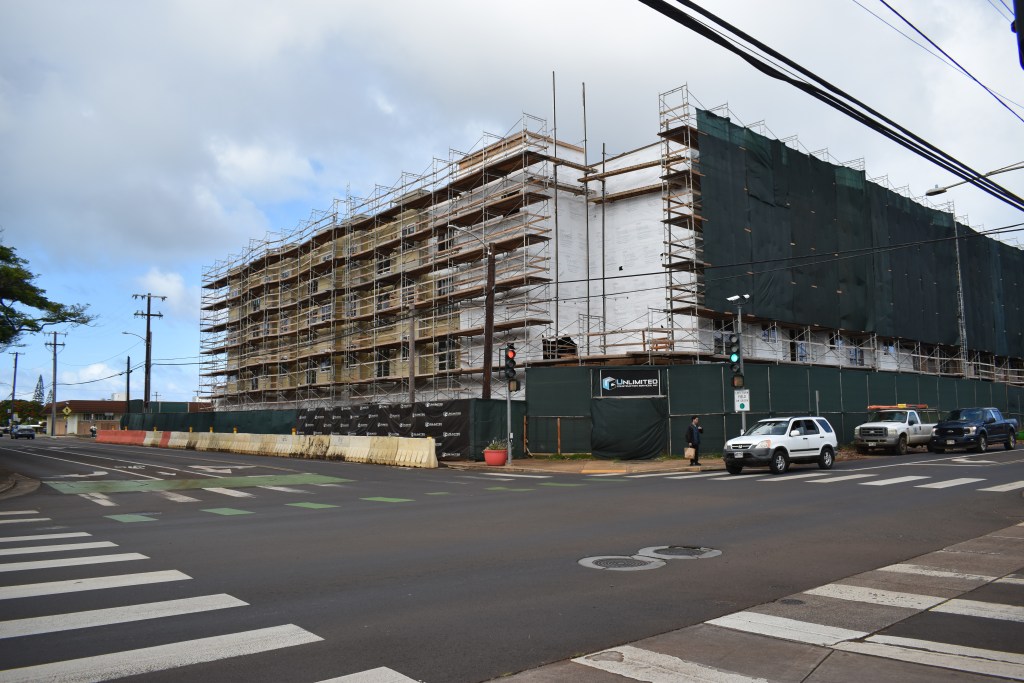
Housing And Infrastructure
Evslin grew up in Wailua Homesteads and returned to the island after he broke his pelvis and injured his back and spine in a 2010 accident. After his recovery, he began coaching canoe paddling and serving on county commissions and nonprofit boards — experiences that he said clarified how rising housing costs were impacting the community.
“It became more and more clear that the cost of housing was destroying community and that if I wanted to dedicate myself to community, probably the most impactful thing I could do would be to try and, like, dedicate my life to bringing down the cost of housing,” he said.
He passed 26 bills and resolutions throughout his time on the Kaua‘i County Council — where he served for five years — and 23 while in the Legislature.
On the council, that included laws to eliminate up to $20,000 in fees for affordable rentals, dedicate an annual percentage of property tax revenue to building affordable housing, and establish a program to help homeowners convert their cesspools to septic systems.

Kaua‘i County’s cesspool conversion grant launched in 2024, receiving 340 applications and ultimately awarding 100 homeowners $20,000. A second funding round is expected to launch later this summer. The Legislature also created a Cesspool Conversion Revolving Loan Fund that will be administered by the Hawai‘i Green Infrastructure Authority; the measure is awaiting the governor’s signature.
Hazlebeck, who has a background in quantitative economics, said Kaua‘i County’s cesspool conversion grant doesn’t fully solve the problem. He received a county grant and said that the price for a septic system increased by over $30,000 because there was so much demand, making it out of reach even with the assistance. Instead, he thinks the state needs to give the county more funding to expand its sewer systems.

“That one thing alone will make it so many more people can build on their land and actually use the land that they want to be able to use and not have to either decide between spending $60,000-plus dollars on a septic or not building,” he said.
He added that he doesn’t think the state’s 2050 conversion deadline is realistic for most families without significant state support.
“I think it’s just going to end up forcing more families away more than anything, which is a shame,” he said. “It’s not what we want to be doing as a state. I know that’s not the intention of the lawmakers, but that’s the result of it.”
Homeowners can’t get a building permit to expand their homes if they’re on a cesspool. Earlier this year, Evslin tried to push a bill that would have allowed existing homes with cesspools to add additional bedrooms if they are not close to the shoreline or water resources — something he’ll try again if reelected.
He added that he would also support putting more state funding toward sewer expansion, but the county needs to be willing to take that on. Two years ago, the Legislature funded the University of Hawai‘i to look at where sewers can be expanded around the state.
Reducing Costs
Hazlebeck grew up in California but spent his high school summers on Kaua‘i after his father founded Global Algae, which he now runs. The business consists of a lab and farm on Kaua‘i and headquarters and manufacturing facility in Southern California, and is a federal government contractor.
His business offers community service leave, is working toward a four-day workweek and holds an annual marriage conference for employees on the island. He decided to run for office because he wanted to help more residents as it gets harder to afford life in Hawai‘i.
“I don’t think it’s right that local people have to leave, like they shouldn’t be forced to leave because of the cost,” he said.

He believes the government needs to take a more active role in helping families stay together. One idea is to require that employers who already offer bereavement leave allow employees to claim it for the loss of an unborn child, whether it’s through miscarriage or abortion. About one in four pregnancies end in miscarriage.
“That’s a very easy way to protect families that are wanting to stay together but maybe have a new factor in life that’s going to drive the wedge between them,” he said.
He also thinks that while some of Evslin’s efforts will be helpful in the long run, residents still need help today, so he advocates for policies that will offer more immediate relief.
One idea is to have the state to give an income tax reimbursement to owner-occupied and long-term affordable rental property owners to essentially eliminate property taxes for the working class.
He also wants to temporarily pause the state’s capital gains tax for home sales to owner-occupied buyers. Many families have two or three homes as retirement investments or to secure their children’s futures, and he thinks the moratorium could be a bipartisan solution to help flood the market with supply and help the next generation get into those homes.
“The combination of those two things, I think, will help bring the pricing down a little bit, not a ton, but enough that it’ll bring it down a few percent, probably, and really help make sure that you get things a little bit closer to just being realistic and affordable,” he said.
He prefers that approach over Evslin’s proposals to revise the state conveyance tax. One of Evslin’s bills would have raised conveyance tax rates on sales of luxury homes over $4.3 million. Hazlebeck said increased taxes on high-end homes leads to stagnation for that portion of the market.
Evslin said that stagnation is worth it because conveyance tax rates on homes that locals can afford would decrease, and Hawai‘i doesn’t need more luxury housing.
Līhu‘e also would have benefitted from the bill’s funding allocations: up to $60 million in revenues a year for the state Department of Hawaiian Home Lands — which plans to develop roughly 1,100 homes and subsistence agricultural lots close to Wilcox Medical Center — and another $40 million a year for infrastructure that supports development in transit-oriented areas.
Read More: Higher Luxury Home Taxes? State Eyes New Ways To House Hawaiians and Luxury Home Tax Pitch To Fund Hawaiian Homes Flopped. Now What?
Evslin’s other conveyance tax bill would have closed a loophole that business entities and the ultra-wealthy use to avoid paying the tax. Larry Ellison used this loophole when he purchased 98% of Lāna‘i in 2012. Evslin plans to pursue the conveyance tax reforms again next session.
In the meantime, other enacted legislation will help increase affordability, Evslin said. Those include expanding a state program that essentially provides downpayment assistance to help critical workers buy homes and creating a fund to subsidize housing projects for households who make too much to qualify for low-income housing.
Supporting The Garden Isle
Housing is where Evslin feels he can be the most effective given his work on the council and his role as housing chair. His philosophy is that making it easier to provide housing around job centers while preserving agricultural land can help improve Kaua‘i’s towns and residents’ quality of life.
He led the passage of legislative measures to allow two accessory dwelling units per residential lot, streamline historic preservation reviews for certain housing projects, and reduce fees and requirements for housing that permanently deed-restricts 80% of the units to owner-occupant Hawai‘i residents.
“I really strongly believe that the housing crisis is a crisis of our own making in that we’ve made it so hard to build housing, and so it’s an area that I have, like, a lot of hope that we can solve this,” he said. “I wouldn’t be doing it if I didn’t think we can solve the housing crisis.”
With his chairmanship, he joins his three other Kaua‘i counterparts in having a powerful leadership role. Rep. Nadine Nakamura, who represents East and North Kaua‘i, serves as House speaker, Rep. Dee Morikawa, who represents South and West Kaua‘i, is the majority floor leader, and Sen. Ron Kouchi is the Senate president.
Nakamura and Kouchi are running unopposed this election, while Morikawa is being challenged by two opponents.
Read More: Political Newcomers Are Trying To Unseat West Kauaʻi House Rep
Despite Kaua‘i legislators having those roles, Hazlebeck said he feels like that power isn’t always used to primarily benefit Kaua‘i. He also worries that the Garden Isle misses out on opportunities for its voice to be heard when Evslin focuses so much on housing.

Evslin said the Kaua‘i delegation secured roughly $47 million in Capital Improvement Project and grant-in-aid funding for District 16 for fiscal year 2027. The prior fiscal year, the district received roughly $115 million.
Outside of housing, Evslin helped ensure that residents have exclusive access to Wailua River State Park on the weekends, appropriate funding and positions so the state Agribusiness Development Corp. can acquire and manage the East Kaua‘i Irrigation System, and allocate $39 million for ADC to acquire 1,000 acres of farmland that will benefit from the irrigation system.
Evslin said that he’s spent most of his life in District 16 and his love for it replenishes him, even as he shares in the struggle to keep a small business afloat. He co-owns an O‘ahu-based canoe manufacturing company called Kamanu Composites.
“At the end of the day, I am in this to support my community and do everything I can for my community,” Evslin said.
That’s a sentiment that Hazlebeck shares. He’s a Christian and highly values working across party lines and learning from different perspectives. He said he aligns with the Republican Party’s values of faith, family and freedom, but he’ll be voting based on what constituents tell him is good for them, not based on whether the bill is Republican.
“I’m going to look at bills and say, is this good for my community or not,” he said. “And if it is, then I’ll vote for it, and if it’s not, I’m not voting for it.”
Campaign Fundraising
Evslin has nearly $22,000 in his campaign chest, while Hazlebeck has less than $600, according to their latest campaign spending reports. Evslin’s reports cover up until the end of 2025, Hazlebeck’s include through April 30 after filing later. The next reports, which will cover up until the end of June, are due July 9.
Evslin’s largest donors include the political action committees of ILWU Local 142, the longshoremen union, and United Public Workers, Grove Farm CEO Don Horner and Honolulu-based MK Advocacy Group.
Hazlebeck’s largest donor is Charles Seymour, a retiree from Spring Valley, California. He also received a little under $185 from Steve Yoder, who ran against Evslin in 2024, and $104 from a Kaua‘i doctor.
Civil Beat’s reporting on Kauaʻi is supported in part by a grant from the G. N. Wilcox Trust.

