It’s Your Money: $125,000 On A Model Airplane Field In Kailua
In a time of budget trimming, the city found $125,000 to pave a runway for toy planes.
Tom Bellit, a long-time Kailua resident, was driving to the waste dropoff site down Kapa‘a Quarry Road recently when he noticed heavy equipment excavating the grass area alongside the marsh across the street.
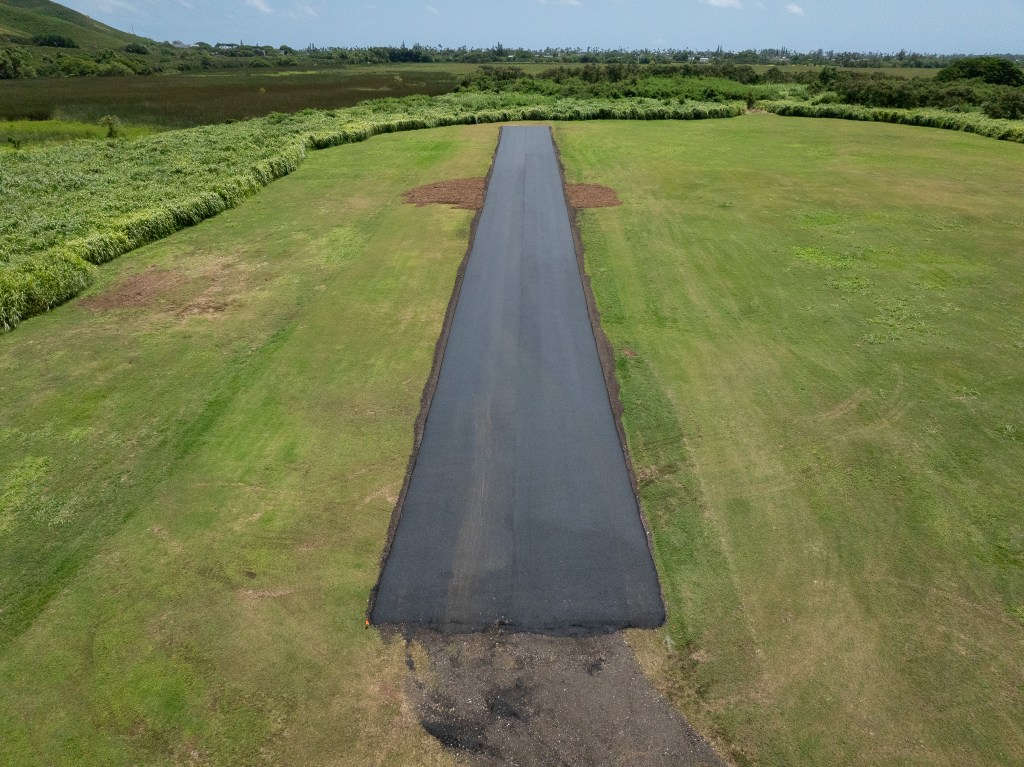
He went home and did some research, and found that the 10.6-acre Kawai Nui Model Airplane Field was getting a new asphalt runway for $125,000.
It’s a fraction of the city’s $5 billion budget. But on the heels of Honolulu leaders cutting costs, citing stagnant revenue and rising expenses, Bellit was surprised the city would spend that much to “indulge hobbies.”
“I don’t have an ax to grind with people who play with model airplanes,” Bellit said. “But I will admit, $125,000 seemed like a hell of a lot of money.”

The model airplane field sits on the western edge of Kawai Nui Marsh in Kailua, and was built over a former county landfill. It is the only site on Oʻahu formally designated for enthusiasts to fly radio-controlled model aircraft, including fixed-wing planes, helicopters and gliders.
The city first designated the site for model aircraft use in 1972. For most of its history, the model airplane field has been a large patch of grass. The recent construction project, which began on June 15 and was scheduled to go on for two weeks, replaced part of the grass area with a new asphalt runway.
When Civil Beat visited the field on the morning of June 19, the construction of the runway appeared finished, but a sign outside still displayed that the runway could not be used.
Eddie Sterling, born in Guam, flew his first model aircraft at this field in 1988. An avid flyer, after retiring, he hasn’t missed a single Saturday.
“I think any improvement to the field is a good thing,” he said, adding that this new runway has attracted “people that haven’t flown for many years.”
The Department of Parks and Recreation said in a statement that the funds for the project came from the discretionary fund of the area’s City Council member, Esther Kia‘āina.

Community members expressed a desire for the runway last year after Hawaiian Electric moved power lines in a way that obstructed the planes’ flying routes.
The new lines “present a serious hazard,” wrote Matthew DeRego, a model airplane enthusiast, in a letter to the city government at the time.
“I was very concerned because they said that basically what they normally are able to do was being impeded,” Esther Kia‘āina, a district council member for Kailua, said. “I thought to myself, ‘This is not right.’”
At a June 2025 Kailua Neighborhood Board meeting, Kiaʻāina said that the power lines were “ruining a lot of planes” and that, “a lot of people who have expensive planes don’t even go there” as a result.
The $125,000 paving contract went to Alakona Corp., selected based on the lowest bid from a list of pre-approved contractors, according to Nathan Serota, a Department of Parks and Recreation spokesperson.
Bill Hicks, president of the Kailua Neighborhood Board said he doesn’t see a problem with the expenditure.
“A $125,000 paving project is not unusual,” he said. “It doesn’t seem outrageous. It just seems to me like the city took on a responsibility,”
Other US cities with populations around a million, like O’ahu’s, such as Jacksonville, Fort Worth, and Austin, all have two to three model airplane fields.
The 2006 environmental assessment estimated the field drew 25 to 40 users on an average weekday and 60 to 80 on weekends. The department in charge of maintaining the runway does not track the number of users on a regular basis.
In addition to funding the project in her district, Kiaʻāina said she has secured funding increases for the county parks department that will benefit the whole island. And members of the public from across Oʻahu are welcome to enjoy the plane runway.
“It’s not just enthusiasm from Kailua or the rest of the Windward side,” Kia‘āina said. “It’s from all of O’ahu.”