Less than 3 days left in our summer campaign to raise $125,000 by September 4. Support Civil Beat today!
Neal Milner: Moderates Make Little Difference In Solid-Blue Hawaiʻi
Even moderate Republicans tend to vote Democrat because GOP candidates are too extreme or non-existent.
July 5, 2026 · 7 min read

About the Author

With all this political polarization, what’s a moderate to do?
Possibly nothing she can do. Though, oddly, a moderate may have more options when the candidates are extreme — in places where elections are actually competitive.
If you just consider the degree of polarization in this country, a moderate voter can’t do much but hold her nose, choose a candidate who’s least offensive, or not vote at all.
A Pew Research Center survey recently asked thousands of people questions focusing on their cultural and political values, and not simply on what political party they supported.
Looking at politics this way, there is lots of diversity and moderation. Pew finds nine distinct groups. A few are very politically oriented and very ideological.
But the others are somewhere in between, even if they tend to identify with one party or the other.

Here are two of Pew’s moderate categories: “Order and Opportunity Left” and “Pragmatic and Polite Right.”
People in the latter tend to vote Republican, are conservative on economic issues and moderate on immigration, a lot like what used to be called, boldly and proudly, a “moderate Republican.” They favor civility, but as most Republicans did, voted for Trump in 2024. But they now disapprove of Trump’s job performance. They pay attention to politics but aren’t passionate about it.
“Order and Opportunity Left” people consider themselves Democrats and usually vote that way. They are economically liberal, but more concerned about crime and more supportive of immigration control than other Democrats. They voted for Harris, disapprove of Trump’s performance and pay attention to politics, but they think politics has gotten out of hand.
So on the surface, what a moderate can do rather than holding her nose, is become part of a coalition that shares their values. Instead of just two political parties, there would be a variety, each reflecting more accurately this diversity — a real choice.
It’s not possible in the U.S. because our elections are winner take all. So, a minor party vote is not very attractive because it’s a wasted vote.
In theory, that’s a good thing, and at various times in America’s history, political parties took care of the “moderate” issue by having a “big tent.”
That is, in order to win an election, parties and candidates had to gear their policies to as broad a base as possible, which meant moving to the center to bring the moderates.
Instead of outcasts and irrelevancies, moderates became the key voting bloc, the pivot point of a coalition of sensible people who know when to hold ‘em and when to fold ‘em.
That doesn’t work well anymore because now extremism — advocating policies away from the center — works better.
There are within both political parties real pressures for being immoderate.
Candidates can win elections by being extreme because so many races are non-competitive.
About 90% of both U.S. Senate and House seats are safely in the hands of one party or the other. Only about a dozen states have competitive races for governor.
In such situations candidates can and do take “pure” liberal and conservative (which now means Trumpian) stances without worrying about those middle voters because they don’t need those votes.
You want to see how this pressure for extremism works, consider what Seth Masket discovered when he talked to Republican county chairs about the 2024 presidential race.
During the 2024 presidential primaries, many of these chairs had doubts about Trump and worried that he could not win again. They believed that the party had a number of other good candidates, Nikki Haley particularly.
It hardly made any difference what the chairs thought or wanted. The strong Trump support in the 2024 primaries took their influence right out of their hands.
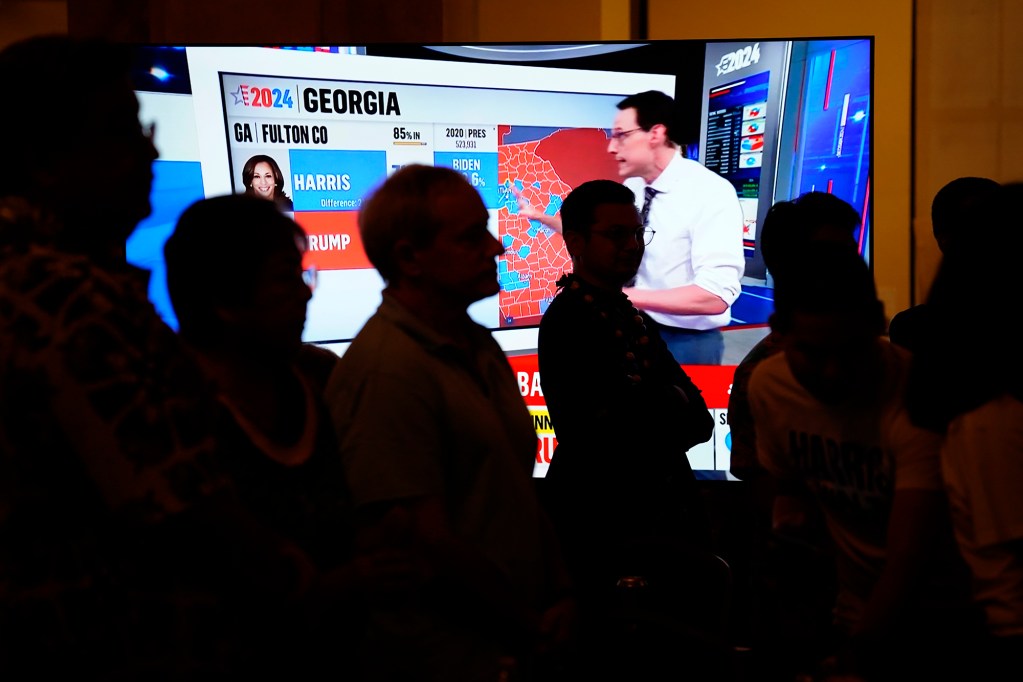
But there’s a twist to this moderation influence if the politics are polarized but the state is highly competitive. Consider two states with very different politics, Hawaiʻi and Wisconsin.
In terms of political ferment and political choice, Hawaiʻi is ho hum.
Hawaiʻi is one of the four bluest states in the country. Hawaiʻi voters mostly vote Democratic if they vote at all.
Hawaiʻi’s congressional races are non-competitive, as is the election for governor. That goes for the upcoming elections, too. Can you even name this year’s Republican candidates for Congress or governor?
Ed Case, the state’s 1st Congressional District representative, presents himself as a centrist, so in that sense maybe moderates have found a place.
As in the past, Case has faced primary challenges from the left wing of the party. The leading challenger this time, Jarrett Keohokalole, is maybe a little more formidable than usual.
Case’s recent haughty, in your face response to an invitation to debate Keohokalole shows how sure of winning Case feels. A moderate voter has some choice here — maybe — but there is also a good chance, as Case believes, that the primary is a slam dunk and the general election will be too. A moderate simply is one of the many. Big deal.
Go back to those two categories of moderates in that survey and apply them here to Hawaiʻi elections overall.
The centrist Democrat votes Democratic pretty much regardless of the candidate because the GOP candidate barely exists. Maybe not holding her nose, maybe a little better than OK, but often with a sense of apathy.
Her moderate Republican cohort has no real choice at all — the Democratic way or, if not the highway, a bumpy road leading nowhere.
When it comes to political activity, Wisconsin is about as different from Hawaiʻi as it gets. It is one of the most competitive states in the country and has a very high voter turnout.
Because it’s so different from Hawaiʻi the role of moderates is also very different.
As the Milwaukee Journal Sentinel’s political analyst Craig Gilbert put it, “In swing-state Wisconsin, moderates are vastly outnumbered within the Republican Party by voters to their right and vastly outnumbered within the Democratic Party by voters to their left.”
But because the outcomes of elections are so razor thin, the moderates’ votes are important because they can’t be ignored.
This year both the Republican and Democratic primaries are highly contested. In the governor’s race, the primary-winning candidates from both parties will make it quite likely the most polarized choice in the state’s history.
But here’s the thing: For sure, the election will be very close.
It’s a very interesting situation of a kind that never arises in Hawaiʻi — two strong opposing candidates at the extreme needing to find a way to get the votes of a very small number of moderates who really dislike many of the things that the respective parties now stand for.
For the Wisconsin moderates, a move from “I’m so sad and lonely” to “Ma, he’s making eyes at me” is no guarantee. But at least there’s a chance that their voices will be heard and their votes will be important.
You will be courted, possibly by two extreme candidates who have to do their own nose-holding when they appeal to you middle of the roaders.
In that situation, the best case for moderates is that they will actually make the key difference. The worst case is that they will find the candidates so offensive that they will not even bother to vote.
The middle case: watching candidates wiggle and squirm trying to convince moderate voters that they are not so immoderate after all.
Sometimes revenge is the only reward. In life and in politics.
 Sign up for our FREE morning newsletter and face each day more informed.

Local reporting when you need it most
Support timely, accurate, independent journalism.
Honolulu Civil Beat is a nonprofit organization, and your donation helps us produce local reporting that serves all of Hawaii.
ContributeAbout the Author