Unopposed For Reelection, Honolulu Budget Chair Isn’t Afraid To Fight Admin
Council member Val Okimoto has charged into public disputes against powerful members of the city administration.
Honolulu council member Val Okimoto’s first annual cycle as city budget chair has been a tumultuous one.
When the mayor proposed a $5 billion budget in March, he said he kept it relatively lean to brace against flat revenue projections. Okimoto, who has long been a fiscal conservative, then shaved it down more, targeting an economic recovery office she felt has lost its focus. When the mayor’s team characterized her efforts as obstructionist, she wasn’t afraid to rebut.
“Council oversight is not an obstruction,” Okimoto said in a floor speech minutes before passing the budget. “It is oversight, and the role Oʻahu residents expect this council to perform.”
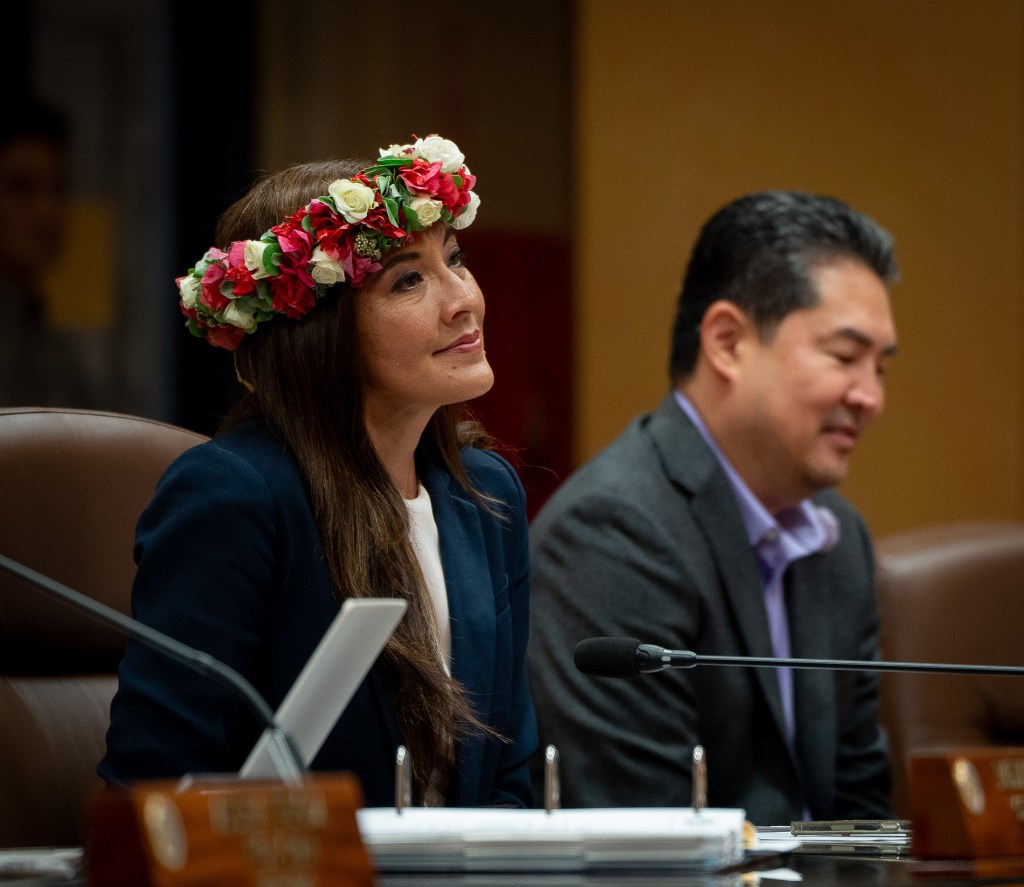
Under Okimoto’s leadership, council members slashed two-thirds of the positions from the Office of Economic Revitalization, set up during the pandemic to support island businesses. Blangiardi called the slashes “illogical” during the council’s final budget vote, asking them to reverse the cuts. His plea was unsuccessful.
“The people you were elected to represent have never demonstrated their support for your decision to cripple an agency that provides critical services to their friends and neighbors,” he later said in a letter to the council as he vetoed the cuts. The council, which passed the budget with a veto-proof majority, plans to vote July 8 on whether to override it.
It’s through these kinds of conflicts that Okimoto is framing herself as a champion of independent and responsible governance as she runs reelection this year, vying for a second term representing the area between ʻAiea and Mililani. With no one stepping up to challenge her, Okimoto is running unopposed and will appear on the August primary election ballot.
‘Not Afraid To Push Back’
Okimoto grew up on Kauaʻi and was a special education teacher before running for state House in 2018.
She was elected as a Republican to represent Mililani, and like many Republicans in the heavily Democratic Legislature, she lacked the power to actually create laws.
As a state and city lawmaker, Okimoto has gotten more traction in the realm of advocacy than legislation.
Out of 78 measures she introduced during her four years in the House, only two passed, both of which were resolutions: one that commended Kalihi Pālama Culture and Arts Society and another that reorganized House Republican leadership.
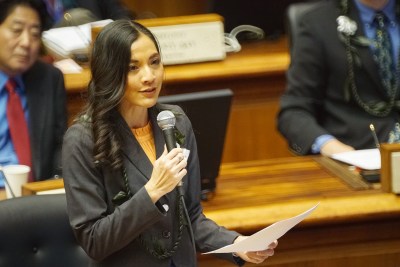
She has passed marginally more bills and resolutions on the nonpartisan City Council, but she’s still among the least legislatively productive members. Since taking office in late 2022, only five out of 18 bills she’s introduced, and 14 out of 20 resolutions, have passed.
These include designating May as Honor Our Kūpuna Month and chipping away at how much homeowners pay in property taxes, as well as renaming the Pearl City District Park Pool and initiating city audits, including a review of an obscure fund of the Honolulu Fire Department to the city’s CORE program, which responds to unsheltered homeless people in crisis.
“I’ve never gauged my success since being in office as a legislator as how many bills I’ve championed or passed,” she told Civil Beat. “That’s never been my mantra.”
Okimoto instead focuses on other pursuits. Council members wear lots of hats, and her top priority will always be delivering for her constituents, she said, including through community projects such as lights for a skate rink in Mililani and a new roof for a gymnasium in Pearl City.
“We’ve had a long laundry list of items that we’ve given her,” Pearl City Neighborhood Board chair Larry Veray said, referencing the new roof, “but she has always been there for us.”
Meanwhile, she also has a growing reputation as acting as a check on the mayor’s power, even if she sometimes acquiesces to his wishes.
We’ve had a long laundry list of items that we’ve given her, but she has always been there for us.”
Pearl City Neighborhood Board chair Larry Veray
Since Okimoto joined the Honolulu City Council, University of Hawaiʻi Mānoa political scientist Colin Moore said, “she’s been more outspoken and more aggressive in her opposition to aspects of the administration than I anticipated.”
Okimoto’s party affiliation and lack of seniority made her a relatively small player in the Legislature, Moore said.
“But now having this power on the council, she’s not afraid to use it,” he said. “She’s not afraid to push back pretty aggressively … that takes a certain amount of courage.”
During a council hearing at the end of 2025, she publicly called out – but refused to name – a senior administration official who had threatened to withhold funding to her district if she didn’t vote to confirm the mayor’s choice for city housing director. (The official turned out to be then-Managing Director Mike Formby.)
“If the executive branch can threaten to withhold funds to secure a confirmation,” she said at the hearing, “the independence of this body is diminished. If we confirm a nominee under these conditions, we establish a dangerous precedent that public resources are bargaining chips.”

Okimoto voted with reservations to confirm the housing director nominee anyway. Moore, the political scientist, said at the time that the episode served as a “warning shot” towards the administration.
Earlier that year, Okimoto postponed reconfirming Department of Emergency Services Director Jim Ireland after some of the department’s past and present employees alleged he fostered a toxic work environment.
Two months later, the rescheduled hearing prompted a rare personal appearance from Gov. Josh Green. A fellow medical professional, Green testified in favor of Ireland at Okimoto’s Public Safety and Customer Services Committee, calling him “a bulldog to positive ends for our people.”
Still, Okimoto maintained that she had concerns.
“It has become increasingly evident that longstanding issues within our emergency medical services division persist,” she said near the end of the rescheduled hearing. “Issues that are not new but which remain unsolved – unresolved – and under current leadership.” She said these include staff shortages, ambulance closures, billing issues and low staff morale.
Okimoto failed to persuade her fellow council members to vote against Ireland. Everyone – including her – voted to let him keep his position, and her vote was the only one that registered reservations.
Asked how she feels looking back on the result, Okimoto said she did her job as committee chair of ensuring people’s voices were heard.
“If anything,” she said, “I helped bring to light some things that either weren’t known or weren’t addressed.”
Gutting Economic Revitilization Office
Council Chair Tommy Waters made Okimoto budget chair a year ago when he reorganized his leadership team. It’s an intense and sought-after role, and it helped keep Okimoto happy enough to support Waters’ continued chairmanship.
She frames her approach to the role as ensuring sure taxpayer dollars are spent as efficiently and transparently as possible, though not everyone agrees with that framing.
In early May, Okimoto and Waters pushed to funnel $41 million into a provisional account controlled by the council.
Too often, they said, the administration transfers money between accounts throughout the year after the budget has been finalized, bypassing crucial council oversight. Administration officials — and even some council members —opposed the move, saying it would make city finances less efficient and less transparent.
Okimoto and Waters eventually relented and reduced the account’s size, restoring much of the funding to where they had pulled from. Blangiardi targeted the remaining $1 million account in his list of line item vetoes.
Blangiardi’s bigger frustration with Okimoto’s handling of the budget remains her decision to slash positions from the Office of Economic Revitalization, which came despite oppositional testimony from Sherry Menor, president and CEO of the Hawaiʻi Chamber of Commerce, and Kiran Polk, executive and CEO of the Kapolei Chamber of Commerce.
“Reducing OER to a minimal staffing level would significantly diminish the City’s ability to administer recovery programs, support entrepreneurs, coordinate economic initiatives and pursue opportunities that strengthen Oʻahu’s economy,” Polk said in written testimony.
The pushback from Chamber of Commerce leadership was particularly striking since Okimoto pitched herself four years ago as a business-minded candidate.
Asked how she feels she’s done so far in that realm, Okimoto pivoted and emphasized her message of responsible spending.
“Economic development is one aspect,” she said. “I’ve always been a proponent of fiscal responsibility and government transparency and accountability.”
In Okimoto’s view, the Office Economic Revitalization had strayed from its initial mission and needed to be culled. A city audit published in January said the office had accomplished only three of its eight responsibilities. Okimoto kept some parts of the office, including its film industry position, and said she envisions a reworked agency whose job is in part to guide city legislation.
“I’ve always been a proponent of fiscal responsibility and government transparency and accountability.”
Council member Val Okimoto
Dan Smith, a member of the Pearl City Neighborhood Board, said he appreciated the Office of Economic Revitalization’s efforts to expand broadband access and that he recently stopped by a job fair they held in Kalihi, which he said is an important function. There might be ways the office could be more accountable to hitting its goals, he said, but he was surprised to see Okimoto cut so many positions.
“I disagree with that,” he said about the cuts.
Smith said he has his own list of items he wants Okimoto to help with, including restoring bus access to Pearl City High School, which no longer has a stop directly next to it after route changes in 2023.
He thinks Okimoto could be better about fulfilling constituents’ asks, though other constituents – including Marilyn Lee, who ran against her for the state House in 2018 – say she has generally been responsive.
Asked what her proudest accomplishments have been from her first term, Okimoto spoke vaguely. She said she tries to represent her district honestly and that she’s proud of her team.
“You’re not going to really ever hear me say, like, ‘Oh, I’m proud of this bill or this measure,’ because to me, that’s part of what I do,” she said. “But I’m most proud of the person I am and the roles that I’ve been carrying while being in this position.”
And her plans for next term?
“I’m just going to be consistent with who I’ve been and who I am now,” she said. “Nothing groundbreaking.”