

‘We Can’t Screw It Up’: Infighting Rankles OHA
A legal battle among the Office of Hawaiian Affairs Board of Trustees has spilled out of court and into the public eye.
Bitter divisions at the Office of Hawaiian Affairs over how to handle a lawsuit from the office’s ousted CEO are weakening OHA’s ability to defend itself, destabilizing the office’s Board of Trustees and threatening to imperil projects years in the making, trustees and a lawyer for the organization said Monday.
In a series of court filings and a rare public legal discussion, trustees have accused each other of retaliation, violating the public meetings laws, stifling dissent and making unauthorized legal filings, one of which became the focus of a contentious meeting Monday morning.
On one side of the divide is OHA Chair Kai Kahele and four fellow trustees who hold board leadership positions and have thus far steered the office’s legal strategy. On the other are four trustees who took the unusual step of filing legal documents that supported Stacy Ferreira, the deposed CEO, in her claims that Kahele overstepped his authority last year to take control of the office’s budget process and then retaliated against her for reporting him to state authorities alleging violations of the state ethics code and breaches of his duty as a trustee.
The trustees sparring with Kahele have said they are being silenced and that the court filing was their way of speaking out, but one of OHA’s lawyers said Monday that their legal move has kneecapped the agency’s defense.
“It has impaired my ability to defend OHA in this case,” attorney Joe Adams said.
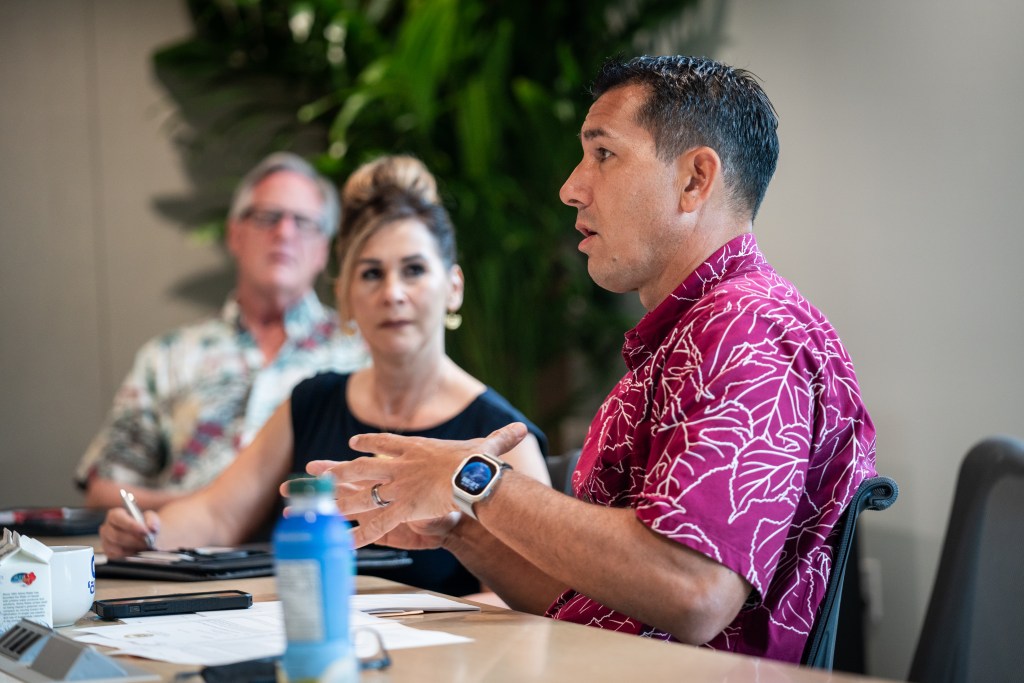
The fight between Kahele and Ferreira is a rare stumbling block for a board that has virtually moved in lock-step for the last two years, often voting in near-unison to launch programs for first-time homebuyers, revamp educational programs for high schoolers and lay down new policies to raise revenues for beneficiaries. The board is also on the verge of finally pushing forward with development in Kaka‘ako Makai, where plans have stalled for the last decade.
Some of the trustees siding with Kahele are worried that division over the lawsuit could undermine that work.
“The Legislature is watching us, we can’t screw it up guys,” Trustee Brickwood Galuteria, a former state senator, said before excoriating the four dissenting trustees. “There’s a longer game here … for your short game, we’re going to blow the long game? What the heck is that? What kind of politicians are you?”
OHA is a fourth branch of state government created to uplift Native Hawaiians, and its trustees control more than $600 million in assets, including a trust fund and real estate across the islands.

It’s not uncommon for there to be 5-4 splits among OHA trustees, according to former Trustee Peter Apo. It mirrors other board disagreements in the past over budget decisions and who gets money. Apo also said there has been tension in the past between trustees and OHA administrators about who holds ultimate authority.
“I’m surprised there haven’t been more lawsuits,” Apo said.
Ferreira was appointed CEO in November 2023. Kahele took office a year later. The lawsuit and the various issues it has dredged up stem from a dispute between Kahele and Ferreira over how OHA’s budget was handled last year. Last June, Kahele introduced a budget that caught staff off guard. The budget was eventually settled, but only after a series of marathon meetings that brought tearful testimony from staffers in the office.
At Monday’s meeting, Kahele said that trustees can always propose alternatives and advocate for opposing viewpoints. But he said they must ultimately speak with a single voice once a decision is made.
“That is the foundation of fiduciary governance,” he said at the close of the meeting. “It’s not about silencing dissent, it’s about protecting the integrity of the board’s authority and the beneficiaries we serve.”
Dissenters Want To Call Out Wrongdoing
The OHA Board of Trustees placed Ferreira on leave in September amid an internal investigation. While the specific allegations remain unclear, they were unrelated to the complaint she made against Kahele, according to a letter from OHAs’ lawyers to Ferreira in October
Ferreira later sued the organization, alleging that the trustees — and Kahele in particular — created a hostile work environment and were retaliating against her for raising issues with major changes Kahele made to the budget that appeared to benefit certain organizations over others.
In April, the board approved the office’s legal response which involved asking that claims against the trustees be dismissed and that the case be sent to an arbitration process outside of the court system as required by Ferreira’s contract.
By that time, four trustees — Keli‘i Akina, Luana Alapa, Kalei Akaka and Carmen Hulu Lindsey – disagreed with that direction and had already sought their own attorneys because they felt that their views were not being represented, the trustees told the court in April.

Three of the four trustees had previously held leadership posts on the board but lost their positions over the last two years. Lindsey and Akaka were part of the ruling faction until Kahele, a former congressman, took over as chairman in 2024, replacing Lindsey. Alapa was also part of leadership and ran the board’s budget committee but she resigned that position in October after a contentious series of meetings over a proposal from Alapa to raise Ferreira’s pay that was voted down by all of the trustees. At that time Ferreira had been on paid leave for more than a month.
OHA’s executive policy manual requires trustees to support the decisions of the board and to “act with loyalty to the institution.”
However, the dissenting trustees pointed out that the following sentences in the manual also allow for trustees to express differing opinions without fear of being silenced.
The following month, the board voted unanimously to dismiss the case and sent it to mediation. But that strategy was upended when the dissenting trustees filed an answer to the lawsuit that largely sided with Ferreira in late June.
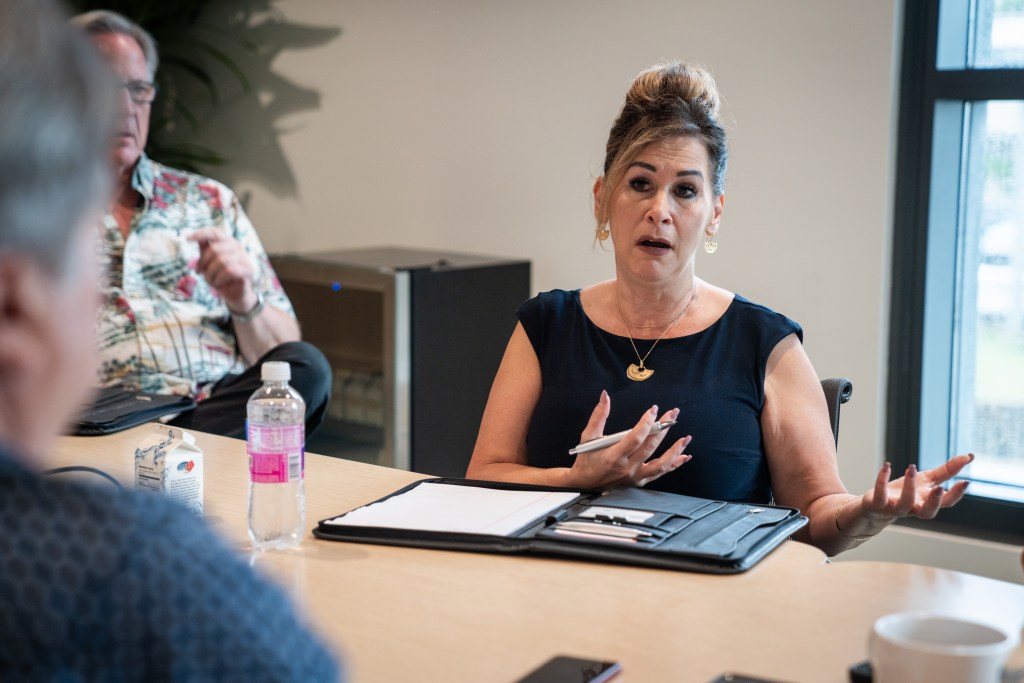
In it, they state that Ferreira’s claim that she was the target of a conspiracy is correct, and that the vote to put her on leave was not done in accordance with Hawai‘i’s open meetings law. They paint a subsequent investigation into Ferreira as retaliatory. They also accused Kahele of usurping Ferreira’s authority and creating a toxic work environment.
Margery Bronster, one of Ferreira’s lawyers, called the investigation that put her client on leave shibai – a hoax. She said that neither Ferreira nor her lawyers have been allowed to see the investigation, its charges, or its findings.
Bronster said that kicking the case to mediation and out of court is another attempt to silence her. The case is still proceeding in court and after a flurry of legal filings in the last week, a state judge pushed the next court date to Aug. 6 to sort through the various disputes.
She likened the minority trustees to Oz Stender, a former Bishop Estate trustee who raised issues with the conduct of his fellow trustees enriching themselves with trust funds meant to benefit Native Hawaiian children. As state attorney general, Bronster led a yearslong investigation into the estate and asked the courts to remove the trustees.
“They can’t speak on behalf of OHA. They can’t say, ‘I’m the one who makes decisions for everybody,’” Bronster said. “But they have a right to point out wrongdoing.”
‘Speak Up’
But at the board’s meeting on Monday, the trustees siding with Kahele pointed out inconsistencies in the dissenters’ approach.
Vice Chair Keoni Souza said that the vote to put Ferreira on leave in September amid an internal investigation passed 6-3, with Akaka voting in favor.
One trustee directly challenged the allegations in Ferreira’s lawsuit.
Trustee John Waihe’e IV, whom the lawsuit names as one of the members who conspired against Ferreira, said he was not part of any conspiracy. He said he walked into the September meeting that ended with Ferreira being placed on leave with no knowledge of what would be discussed and only voted based on the recommendation of OHA’s lawyers.
“It’s a lie,” he said Monday of the conspiracy allegations.
He later asked the board’s attorney if other “untruths” would be revealed.
Adams, a lawyer for OHA, said he would not disclose the meeting minutes of the September executive session that Ferreira and the minority trustees say violated state law because the board lacked a legal basis to meet in private. But, in an interview with Civil Beat, he said that the court statements made by the minority trustees are “factually incorrect.”

Throughout the two-hour meeting on Monday, Kahele said that court filings by the four trustees admitting wrongdoing by OHA raised serious questions of violating OHA’s internal policies and the state open meetings law.
Kahele asked the four trustees several times who authorized their filing, which did not go before the full board. Akina and Lindsey said they individually authorized their attorney to file their response in court.
Akina said that he was not intending to speak for the board and believed he was only answering the allegations in the lawsuit truthfully, at least as he saw it.
Souza filed a complaint against the four trustees for breaches of the office’s code of conduct related to that filing. Akina said that the complaint from Souza “shows a well-established pattern of retaliation.”
Later in the meeting, Akina said he was not defending Ferreira per se, but was trying to lay out a path to finding the truth of what happened between her and the board. He tried to strike a conciliatory tone and said that board members might disagree over how to proceed but that they have a common goal of serving beneficiaries.
“That might work at a public policy think tank,” Kahele said, referring to Akina’s outside employment as president of the Grassroot Institute of Hawaii. “But not here.”
Kahele said that Akina and the other trustees have received misguided legal advice.
Normally such contentious discussions, especially those dealing with lawsuits, would take place in executive session closed to the public. The minority trustees blocked the board from closing its doors on Monday for at least the third time this year.

Despite forcing a public discussion on the lawsuit, three of the four trustees siding with the CEO sat mostly silent during Monday’s meeting under a barrage of questions from the majority trustees.
That silence prompted a Shakespearean monologue from Trustee Dan Ahuna, who sides with the board’s majority.
“Speak up for your side … stand up, I’m begging you,” he said. “To come out and say absolutely nothing, your beneficiaries are getting nothing from you. Guess what you get from nothing? Nothing!”
In the end, the board voted 5-1 to order the minority trustees to withdraw their court document that states that the board violated Ferreira’s rights as a government whistleblower.
Akaka was the lone “no” vote, Akina abstained and Alapa and Lindsey had already left the room.
John Mackey, the dissenting trustees’ attorney, declined to say if his clients would actually withdraw the filing. The trustees have previously declined to recant.
Akina also wouldn’t say directly whether he would agree to withdraw the document, but said that “it’s important for individual trustees to stand up on behalf of beneficiaries regardless of what the majority chooses to do.”
CORRECTION: A previous version of this story included incorrect information about a court hearing on legal representation for the four dissenting trustees. The story has also been updated to clarify the office’s April legal response.
Claire Black, one of the attorneys defending OHA against Ferreira’s lawsuit, is a private attorney occasionally employed by Civil Beat for legal review and contractual matters.

