

OHA Trustees Punt On Confirming New CEO
The Office of Hawaiian Affairs had voted 5-to-4 on Wednesday to select Todd Apo but by Thursday they were not so sure.
Trustees of the Office of Hawaiian Affairs declined to move forward on Todd Apo’s nomination as the agency’s next CEO after hearing more than two hours of testimony from the public on Thursday, most of it in opposition to Apo.
Many of those who have testified during the selection process supported interim CEO Summer Sylva, but a majority of the trustees on Wednesday had voted in favor of Apo as the top pick to lead the office. Then, a day later, the board faced new questions about why it was advancing the CEO selection just weeks before the General Election, which could usher in a new group of trustees.
In the end, board Chair Kai Kahele deferred a final vote until Nov. 2, a day before the next election on a 5-to-4 vote.
“Taking additional time is not a sign of indecision, it’s a demonstration of responsible governance,” he said, while cautioning that pushing a vote on the next CEO further, until after the election, could mean having to restart the process if even one new trustee is elected.

That the initial appointment of Apo advanced on a narrow 5-to-4 vote along factional lines gave many of the testifiers pause.
“If only you fought for us as much as you fight with each other,” said Maui council member Keani Rawlins-Fernandez, who flew from Molokaʻi to testify in person in Honolulu.
She was among many who also questioned Apo’s ties to developers, which in fact appeared to be one of the driving factors behind the trustees’ choice of Apo as OHA attempts to build in Kakaʻako Makai.
Rawlins-Fernandez said the trustees have become too hyperfocused on Kakaʻako.
“If you’re so consumed with this Kakaʻako fiasco, you’ve lost the plot,” she said, adding that OHA must advance other areas such as protecting water resources and cultural rights.
Apo worked for Ward Village as it developed luxury condos but said during the CEO selection process that OHA should stay within current zoning rules rather than building residential towers there.
Apo and his wife sat in the audience during the contentious board meeting. Later, as Kahele thanked him for being willing to face the public, he got a round of applause from the crowd that packed the OHA boardroom.
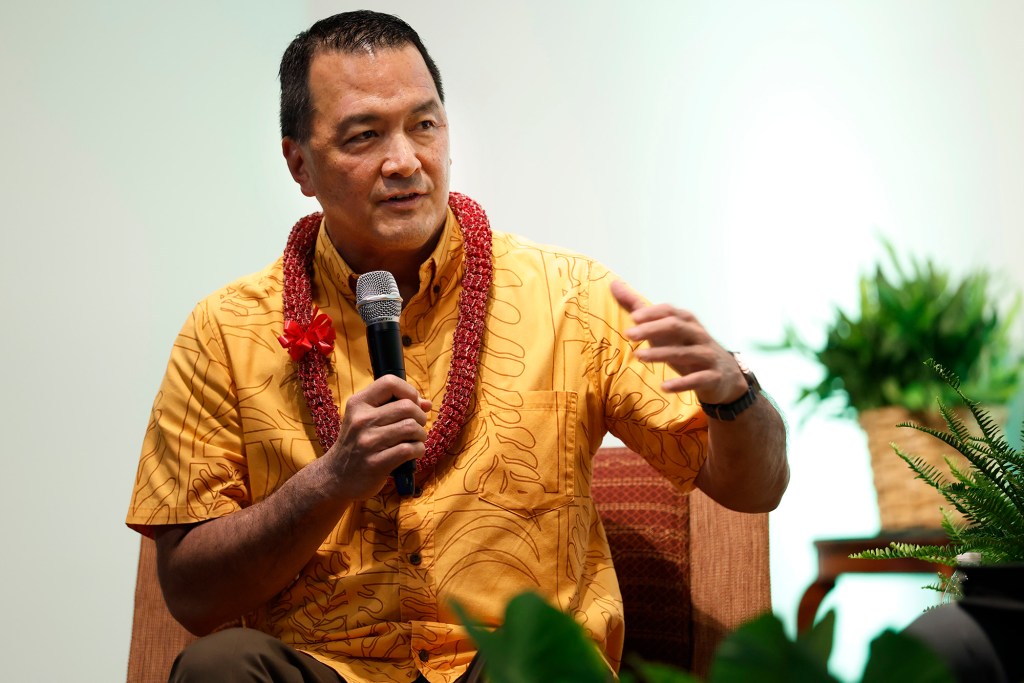
“I think he’s seen the gravity of what is before him,” Kahele said. “We are a divided board. We are a community that can often be divided around important issues that can face this state.”
“If you do become the next CEO,” Kahele said, addressing Apo, “That’s what is waiting for you.”
Earlier in the hearing, Kahele called on each of the trustees to explain why they voted in favor of Apo over Sylva. That decision had come with no deliberation among the board on Wednesday.
Trustee Luana Alapa said Apo’s ability to articulate issues struck her. Trustee John Waiheʻe IV said he liked Apo’s approach to addressing issues. Trustee Carmen Hulu Lindsey, who nominated Apo, similarly pointed to his performance in job interviews with the board.
He was “very to the point … a no-nonsense administrator,” she said. Lindsey also said she had negative comments about Sylva but would not air those publicly other than to say OHA has internal politics.
Trustee Keliʻi Akina said that all three candidates were qualified, but that his vote came down to who could get things done for the board.
“We have to be certain he will do what the board wants,” Akina said.

