Ranked Choice Voting Could Shake Up Honolulu Elections
But there’s a catch. The Nov. 3 ballot measure includes a requirement that the Legislature approve this departure from traditional voting.
Honolulu voters are being asked to fundamentally change the way top city officials are elected in a major overhaul of the election system envisioned to give more candidates a better chance at public office and more voters the opportunity to decide who’s running the city.
Question No. 5 on Oʻahu ballots in the Nov. 3 election asks if the city should switch to a ranked choice voting system for mayor, City Council and prosecuting attorney. It would allow voters to consider as many as five candidates for each office in a single November election, when voter turnout is often double the number of people who vote in the August primary.
Ranked choice voting has been controversial in many states, partly because of the uncertainty it poses for incumbents. Even so, it was one of the fastest growing election reforms in the country and, as of March, is used in 49 U.S. jurisdictions. Two states, Maine and Alaska, use RCV statewide, according to the national voting reform group FairVote.
But even if local residents vote to change Honolulu’s election system, it still won’t happen unless the Legislature says it’s OK. That’s because the proposal includes a provision that allows the new system only if the Legislature explicitly authorizes it. Supporters of ranked choice voting and even a key lawmaker say the requirement is unwarranted because state law already gives counties the authority to establish their own election systems.

Hawaiʻi’s 2026 elections are right around the corner and Civil Beat’s elections guide is here to help with essential information, candidate positions, news stories and more.
The proposal is one of 20 placed on the ballot by the Honolulu Charter Commission. The proposal also delays any switch to ranked choice voting until 2032 even though a new mayor, a new prosecutor and roughly half the City Council will be up for election in 2028. Holding off for six more years would give the Legislature time to change the law and give the city time to put in place a voter education program, commissioners reasoned.
Commissioners were told by the city’s Corporation Counsel that a switch to ranked choice voting conflicts with state law and the Legislature would have to change the law to allow it. Some commissioners wanted to shelve the idea altogether but most of the 13-member panel decided it would be better to take it to voters.
“Someone has to move first,” Commissioner Trey Gordner told fellow commissioners in July when they voted 10-3 to move forward with the proposal. “I think it falls on the city to move first. It falls on voters to be clear that this is what they want, and for the state to react to that.”
Deb Otis of FairVote told commissioners in July that the reform measure has been popular at the ballot, noting that ranked choice voting measures have been approved in 33 out of the last 34 ballot measures that have gone before city voters around the country. Some other areas have passed the reform while waiting for necessary state sign-off, she said.
“It ensures more candidates get to face voters in November when turnout is twice as high and the electorate is often most diverse,” Otis said. “So you’re shifting that decisive election from low turnout to more choice, more voice and more voters in November.”
Still, ranked choice voting is facing stiff opposition in some areas. The conservative American Legislative Exchange Council introduced model legislation a few years ago to eliminate it and since than some places have rolled it back. Nineteen states now prohibit ranked choice voting. Opponents argue that it forces voters to choose candidates they don’t really like and skews the vote.
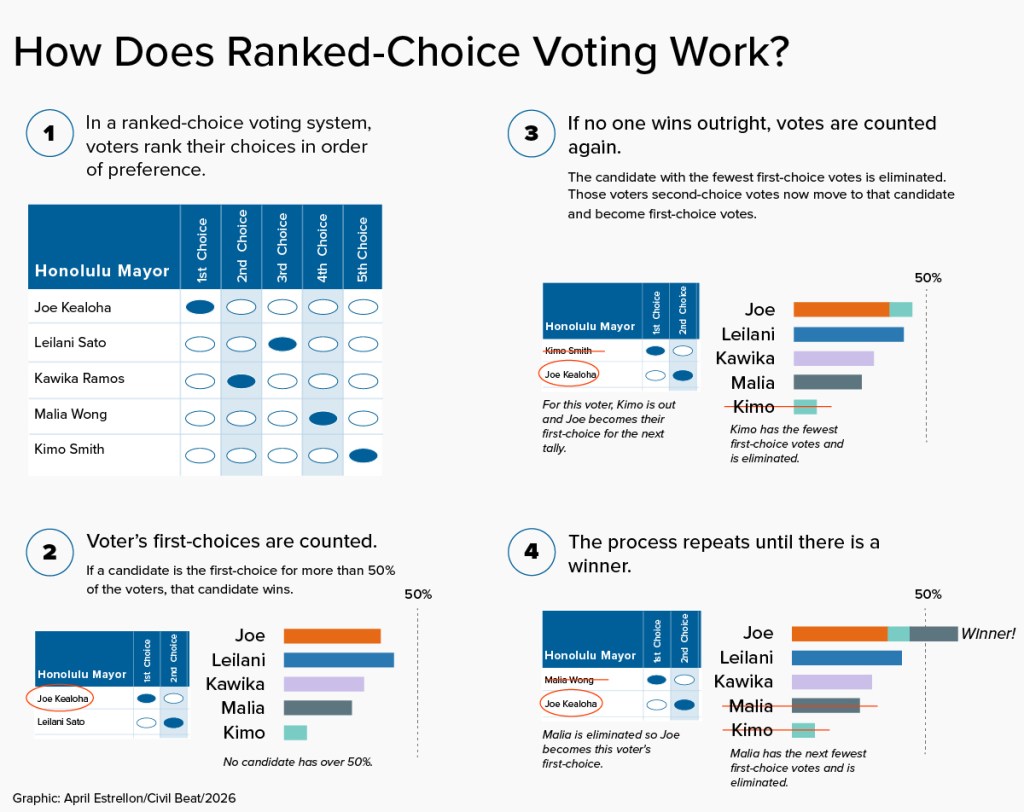
The Honolulu proposal, where elections are already nonpartisan, is similar to others around the country. As many as five candidates would be on the ballot in November, rather than just two as happens now.
Voters would rank their choices from one through five. If no one got more than 50% of the vote, the candidate with the fewest first place votes would be eliminated. Those voters’ ballots would transfer to their next choice (so their second choice would now become their first choice), the ballots would be tallied again and the candidate with the fewest first-place votes would be out. The ballot redistribution then would repeat in rounds until one candidate received more than 50% of the vote.
Now, voting in Hawaiʻi is fairly simple: most candidates compete in the August primary and, if no one gets more than 50%, the top two go on to a run-off election in November.
With ranked choice voting there would be no August primary unless there were more than five candidates in the race. In that case, the August election would be held to narrow the candidates down to the top five who would then go on to compete in November.
“Turnout in August is typically much lower than in November. This means a relatively small group of voters who may not represent the views of the City as a whole decides the options (or the winners) for everyone else,” the Charter Commission wrote in a ballot explainer.
It also notes that in 2024, all city officials were elected in the August primary. They either had no opponent or won outright.
Years Of Discussion
The Charter Commission meets every 10 years and considers proposals from residents that seek to update or change the City Charter, which is the city’s foundational governing document. Ranked choice voting was a major topic for the 2015-16 commission, which was unable to come up with a ballot measure but recommended that this year’s Charter Commission tackle it again.
Gordner said at the July meeting that this commission took its predecessor’s request to heart and researched the topic.
“We found that ranked choice voting means more opportunity for a more diverse set of candidates,” he said. “We found that it means more choices for voters, and we heard from testifiers that it leads to a more collegial sort of democracy in which people are competing for second choices, and so you don’t have these sorts of nasty campaigns.”
The proposal was heartily supported by people who testified repeatedly before the commission and in written testimony. The commission received 38 written testimonies, all in support, including several from other jurisdictions where ranked choice voting has been in use for years.
“I love the effect RCV has on how the candidates campaign,” one San Francisco resident wrote. “In our city RCV elections, candidates go out of their way to find common ground with other candidates, in a way that feels very rare in other elections. In their ads and public appearances, they say, ‘If you like this other candidate’s position on issue X, you’ll like mine too! Rank me after them.'”
The only red flag was raised by the city attorney who advised that the proposal was unconstitutional and not allowed under state law. That led supporters to raise the argument that state law specifically allows counties to set up their own election systems.
In 2022, the Legislature passed a law requiring ranked choice voting in certain federal elections and special elections involving vacant county seats. But there haven’t been any elections using ranked choice voting since that law was passed.
“Both state constitutional law and state statutory law provide Honolulu ample authority to prescribe its own method of election in local elections, including the authority to conduct elections by RCV,” FairVote staff attorney Delaney Barker wrote in testimony to the commission.
Barker acknowledged that the Legislature didn’t address ranked choice voting in all circumstances but that it also doesn’t preclude it.
“To start, it is difficult to see how the state legislature’s explicit embrace of RCV for special elections could be contorted into an implied preemption of counties’ prerogative to embrace the legislature’s own stated goals by adopting RCV (if they so choose) for their own primary and/or general election,” Barker said in an eight-page analysis of the Corporation Counsel’s memo to the commission.
Senate Judiciary Committee Chair Karl Rhoads says he agrees that the city doesn’t need permission from the Legislature to conduct ranked choice voting.
“There’s nothing in the (statute) that says counties can’t elect someone with RCV,” he told Civil Beat.
Rhoads said he had his chief legal analyst review the law after someone from the Charter Commission asked him what he thought. He said he told the commission that his office’s analysis concluded the proposal did not need to hinge on state permission.
“Our read is I don’t see anything that prohibits it,” he said.
Rhoads pointed out that politicians are resistant to changing the way the system works now because they are familiar with it and it gets them elected. Changing it would be hard for them because they run the risk of losing, he said.
Rhoads is retiring at the end of this year and won’t be around next session to oversee any ranked choice voting bill, which would run through the Judiciary Committee.
He says key will be whether Honolulu voters embrace the change. If they do, he said it’s likely some lawmakers who support ranked choice voting will introduce legislation as the ballot measure now requires.
Supporters are hoping for a strong showing by voters. FairVote has created a ballot issue committee that allows it to support the measure with advertising and other campaign efforts. Recent reports filed with the state Campaign Spending Commission showed the committee had raised and spent about $35,000 on the issue.
“All that we’re asking is for permission for the county to make its own choice about how it elects its own officials,” Gordner said at the July commission meeting. “And I think that state legislators, if they hear from the voters of the City and County of Honolulu that that’s what they want for county elections, that they’ll be willing to entertain that.”